
Question answered
Can you reduce the height of a chimney?
The short answer
Often yes, but not always without checks. If the flue is still used for a fire or stove, the outlet has to stay high enough to work safely under Approved Document J. Planning may come into it for a listed house or a conservation area with an Article 4 direction, and a party wall notice may apply. A roofer then rebuilds the top, re-leads the junctions and fits a pot or cap.
Lowering a stack is possible, and sometimes sensible for a leaning or worn chimney. A working flue, a shared wall or a conservation area can change the answer.
Why people lower a stack
The usual reasons are practical. A tall stack that leans, has lost its upper courses to frost or has become dangerous in wind is costly to prop and repair. A shorter stack carries less weight above the roof and needs less scaffold next time. Others want to cut the chimney down to improve a view, to clear a new roof window or because the top has simply deteriorated.
Cutting height does not change the fact that the stack sits on the same house and still carries its flues. The brickwork below stays in place, and everything above the new top has to be made weatherproof again: fresh top courses, flaunching, a pot or cap, and the lead round the base of the stack.
If the stack is leaning, read DIY chimney repointing before reaching for a trowel. A lean usually needs a professional look, and repointing alone will not cure it. Our chimney repairs page lists the other options.
A working flue has height rules
A flue serving a fire or stove has to carry smoke clear of the roof so that it can disperse, and Approved Document J (updated 30 September 2022) sets out clearances for solid fuel. One example: where the flue emerges within 600 mm of the ridge, the outlet should stand at least 600 mm higher than the ridge. Elsewhere on a roof, the outlet has to keep a set distance from the weather surface and clear of openable rooflights, and the document adds that heights may need to go up where wind exposure, tall trees or nearby buildings upset the draught.
Cutting a live flue down without checking can leave it too short to draw properly, and a stove installer or building control can tell you what it must be. The rule of thumb called 3-2-10, which you may read online, comes from America and is not an English requirement.
A disused flue that is capped has no such need, which makes it the easier case for lowering.
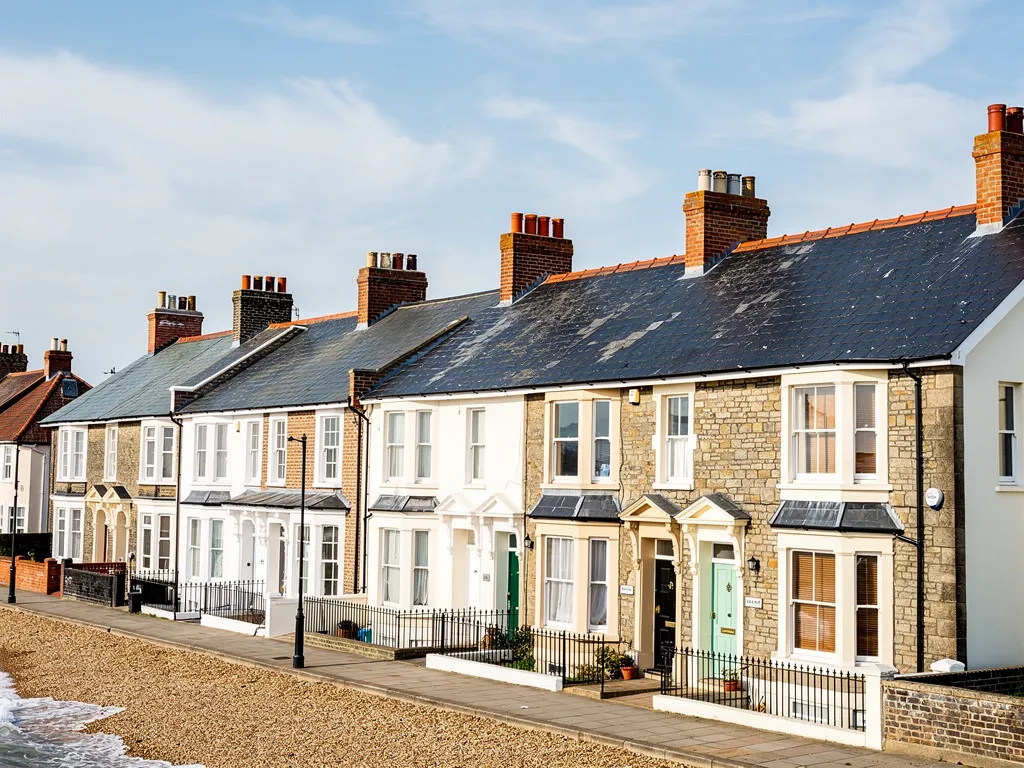
Planning, listed buildings and Article 4
Lowering a chimney alters how the building looks, so it is not just a roofing matter. A listed house needs consent where works would harm its special character, and a chimney is part of that. In a conservation area the council may take an interest in the skyline, even where no direction applies.
Some Adur and Worthing directions withdraw the usual permitted right to alter a chimney. In Old Shoreham and Kingston Buci that right is Class G, which deals with putting in, changing or swapping a chimney, flue or soil pipe, and a planning application is needed instead. In Worthing's Warwick Gardens area, taking a chimney down or changing it is among the matters listed.
Elsewhere, ask the Adur & Worthing planning team whether the change needs anything. Do this before the scaffold goes up, as an unauthorised alteration can be costly to put right.
Party walls and shared stacks
If the stack stands on a party wall, there is a neighbour's flue in it too. The official party wall guide treats taking chimneys out of a party wall as work that needs a notice, served two months to a year ahead, and a neighbour's silence is not a yes. Whether lowering a shared stack counts depends on how much is taken away, so read the guide and speak to your neighbour early.
Both flues must still work afterwards, and the shared brickwork must remain sound. You will also need the neighbour's agreement over scaffold access. Cost and consent for a stack that belongs to two houses are worked through on our page about who pays for a shared chimney stack.
If an aerial or dish is fixed to the stack, it will have to be moved or refixed, and an aerial on a chimney explains the risks of leaving it.
How the roof end is finished
Once the stack has been taken down to the new height, the top is rebuilt in matching brick, with a sloping mortar bed, a pot or a ventilated cap, and sound flaunching. The old chimney flashing, the lead that seals the stack to the roof, will often need renewing as well, because the work disturbs the joints it sits in, and a wide stack may need its back gutter rebuilt.
This is where a lowered chimney most often goes wrong. A neat top with a tired flashing below it still leaks. The stack, the lead and the joints are photographed from the roof at the survey, and the single written total comes after that.
What moves the price: scaffold, the number of flues, how much is removed, and the condition of what is left. The finished chimney should look as though it was always that height.
Lowering a stack: two more questions
Does lowering a stack need Building Regulations approval?
Taking out a chimney breast always does. For lowering the stack above the roof, the position depends on the work and on whether the flue is live. Ask building control at Adur & Worthing before starting, and note that a live flue must still meet Approved Document J.
Can I just have the damaged top taken off?
Sometimes. If the top courses are broken and the rest is sound, removing and rebuilding them is a repair rather than a change of height, and is simpler. If the stack really is coming lower, the planning, flue and party wall points above still apply.
Tell us about your roof
Describe what is happening and we will call you back to arrange a visit.
- Photographs of what we find
- A written quote with one total price
- Or call 01903 299063
10-year workmanship guarantee, in writing.