
Question answered
Should stone slate joints be mortared?
The short answer
Generally no: the joints between stone slates should not be filled with mortar. The Steyning conservation area appraisal lists mortared joints on a relaid Horsham slab roof as an inappropriate repair. A single lap roof is the exception, because its design relies on sparing mortar bedding under the stones, kept back from the edges so water can drain.
Mortar on a stone roof is not a yes or no question. Where it sits, how much there is and which system the roof was built to decide whether it protects the stone or harms it.
What the Steyning appraisal says
Horsham District Council's appraisal for the Steyning conservation area is plain about repairs. Among the inappropriate things done to old roofs, it names relaying the slabs with mortared joints. It also notes that Horsham slab roofs survive in large numbers in the town, so the advice has practical weight there, and a roofer working in the area needs to know it.
The reasoning is simple once you picture the stones. Stone slates are not flat factory products. They are uneven slabs that sit with small gaps between them, and those gaps are part of how the roof drains and breathes. Fill them with a hard bead of mortar and you change both the look and the way water moves.
If your house stands in Steyning, or in any other conservation area, a roofer who proposes pointing up the joints should be asked why, and the answer should refer to the type of roof you actually have.
The single lap exception
Horsham stone has two laying systems. In the usual double lap, each course covers the one two below, and the overlap does the waterproofing. In single lapping, which the Stone Roofing Association (SRA) describes as unique to Horsham roofs, each stone only overlaps the course immediately below. That leaves a gap along the vertical joints, and it is weathered with pieces of Welsh slate called shadows. They do the sealing that the overlap of stone alone does not.
In that system the stones and shadows are bedded in mortar, so resistance to water relies on adequately sized shadows and mortar of the right strength and flexibility. The SRA also says mortar is used to level up uneven slabs. Single lap roofs built that way should usually be conserved as found, and our page on shadow slates shows the detail.
So the question is not whether mortar exists on the roof. It is whether it is bedding or filling.
How the bedding should look
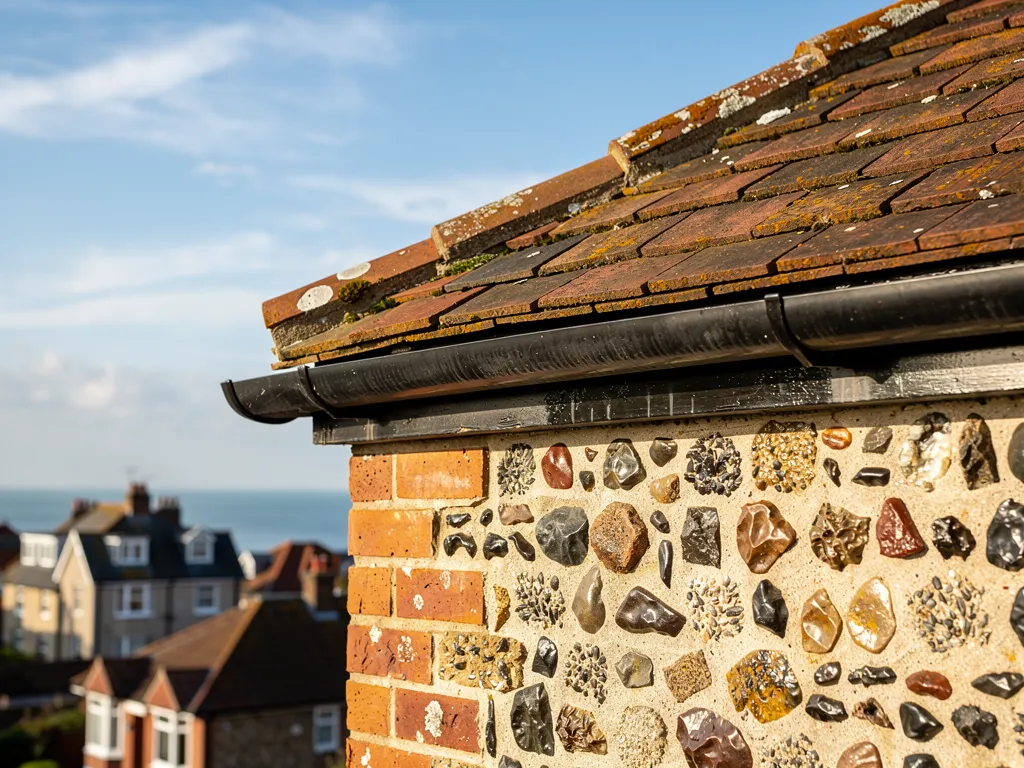
The SRA guide is specific about the craft of bedding. Bedding should be applied sparingly, with the aim of seating the slates and forming a seal without mortar squeezing out onto the surface. A bead width of about 25 mm is suitable.
It should be held back or raked out around 25 mm in the vertical joints to promote free drainage, and held back from the bottom edges of the slates so rain can drip off. It must not reach the battens, because moisture drawn into the wood causes it to rot.
The same guide says loosely adhering mortar that drops into the gutters does not necessarily mean the mortar is failing. That is worth knowing if you find crumbs on the ground after a windy week; it is a prompt for a closer look, not proof of a problem.
Where the original work pointed everything up flush, the visible mortar is a sign the detail was not followed, and we note it early in the survey.
Where mortar causes trouble
Mortar that traps water is a frequent problem. A full pointed joint draws moisture into the structure and stops the roof from breathing. The SRA points out that a roof sealed with mortar needs thought about condensation, and that insulation added to the roof makes ventilation more important still.
Hard cement mixes crack and part from the stone as the roof moves. Lime mortars are more forgiving, but the guide stresses that mixes differ in strength and that torching, the lime and hair mortar applied under slates, must not be used with single lapping because it could be forced against the slates.
Valleys are another place to avoid it. The SRA says mortar should not be used to bed slates onto lead in a valley, although in single lap work the overlying slates are bedded onto each other and raked back as elsewhere. Water behind a slab runs along the timbers before it drips, so the ceiling stain is rarely under the cracked joint. For what actually holds each slab in place, see how stone slates are fixed.
What we do when a roof arrives with mortar on it
We start by identifying the system, because the answer differs. A double lap roof with filled joints can often have the mortar taken out, which restores the gaps the stones were meant to have, so water drains between them again. A single lap roof needs its shadows and bedding checked, repaired and re-seated, not stripped.
Swapping one laying system for the other is a much bigger decision. The SRA says the load on the roof and its structural stability have to be reviewed first, that building control approval or a church faculty is required, and that a listed building needs listed building consent from the local authority. Ask the Adur & Worthing planning team, or Horsham District Council, before any such change.
Expect photographs of the joints on your own slopes from the survey, then a written quote giving the price as one total. Cost depends on how much mortar there is and how well it was done, and the starting point for any stone roof is our Horsham stone roofing service. For the stone itself, see the geology of Horsham stone.
Mortar on stone: two follow-up questions
Is crumbling mortar under my stone slates a sign the roof has failed?
Not necessarily. The Stone Roofing Association notes that mortar flaking into the gutter does not by itself show the bedding is failing. What matters is whether the stones still sit firmly and the shadows beneath them are sound, which a survey from the loft and the roof can tell.
Can I repoint my stone slate roof to stop draughts?
Pointing the joints is the wrong way to stop draughts, because it can trap moisture and spoil the drainage the roof depends on, and a stone roof is naturally gappy. Ask for the cause to be traced first, then for the smallest repair that fits the roof's own system.
Tell us about your roof
Describe what is happening and we will call you back to arrange a visit.
- Photographs of what we find
- A written quote with one total price
- Or call 01903 299063
10-year workmanship guarantee, in writing.