
Question answered
Is a metal roof a good idea for a UK house?
The short answer
A metal roof can be a good idea for a UK house, particularly zinc or coated steel on a modern extension, a low pitch or a design-led home. Zinc has a published life of a century or more and copes with sea air, though salt deposits need washing off. In a conservation area or on a listed building, swapping tile for metal usually needs the planners' view first.
Metal roofs suit some houses very well and others not at all. The covering, the distance from the sea and the planning position of your street decide which group yours falls into.
Where metal roofs suit a house
Standing seam zinc and coated steel sheet are at home on contemporary houses, on extensions with shallow pitches and on roofs with awkward shapes that tile cannot follow. Metal comes in long sheets or panels with folded joints, so it can run across curves and low slopes with few joins. It is also lighter than most tile, which can matter on a structure that was never built for heavy loads.
Metal is a less natural fit on a Victorian terrace or a flint cottage, where the street is read through clay and slate. There, metal tends to look like a different house on the same row. Think about how the roof will appear from the road and from the neighbours' windows before you decide, and ask to see photographs of similar roofs in your area. A sample panel held against the brickwork is worth more than a brochure picture.
Zinc: lifespan and the maker's word on salt
One zinc manufacturer, VM Zinc, claims a life beyond a century for the metal, and quotes 100 years from a product declaration by the Building Research Establishment. A contractor quoted by HomeBuilding suggests 60 to 100, so treat the span as typical, not guaranteed. Zinc is light, is shaped on site and builds a protective surface as it weathers, which is part of why architects like it for crisp, simple forms.
On the Sussex coast the question that matters is salt. The maker describes zinc as performing very well in coastal settings, with warranties still valid there, while noting that salty air can act on it. It grades sites by distance from the shoreline: within 1 km is the harshest, 1 to 3 km the sea area, and 3 to 20 km a low maritime influence. A house on the seafront falls in the first group. Pale deposits build up on parts the rain never washes, soffits among them, and the maker advises a twice-yearly rinse with clean water to limit them.
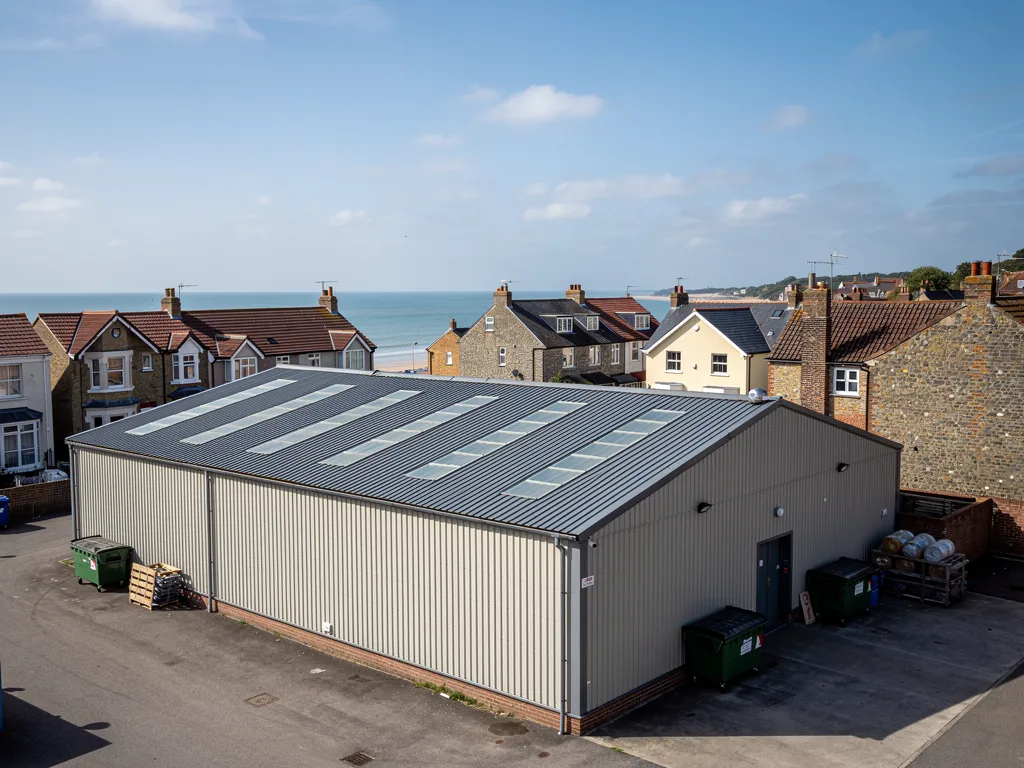
Coated steel and the details around the sheets
Coated steel sheet is the other metal people ask about, usually as long profiled or standing seam panels, and it tends to appear on outbuildings and extensions more than on whole main roofs. How long it lasts depends on the coating and on how well cut edges and fixings are protected, so ask the manufacturer for the specification and for any conditions that apply near the sea. We do not quote a life for it.
Whichever metal you pick, the details around the sheets matter as much as the sheets themselves. Ridges, verges, rooflights and the junction with a brick wall each need a flashing made for that system and fixed to suit the exposure. Mixing metals is a point to raise with the installer, because some pairings react where they touch. A written specification from the supplier, and photographs during installation, are sensible things to ask for before you accept any metal roof as finished.
Planning and consent for a change of covering
Replacing a tile with the same tile seldom raises a planning point, since the house looks as it did. Changing clay or slate to metal alters the look. Ask the planners at Adur and Worthing, or at the South Downs National Park Authority if your house lies in the Park, before you order anything.
Conservation areas add a layer. Two Adur conservation areas, Old Shoreham and Kingston Buci, have Article 4 directions removing Class C rights, roof coverings included, on frontages to a road or right of way. Worthing's Warwick Gardens has its own direction, which catches a changed look to the slope itself, in shape or material, where that slope looks out over a highway or open space. Listed buildings need listed building consent for work affecting their character. The Planning Portal also points out that a covering much lighter or heavier than the old one brings weight checks, which re-roofing and the Building Regulations explains.
Living with a metal roof
Ask about rain noise, because bare metal over a loft room can sound louder than tile unless it is built up with insulation and a suitable deck. Ask who will look after the roof, and how often: zinc near the sea benefits from regular rinsing, and gutters should be kept clear so water does not stand in them. Allow for the time the job takes, too; our page on rain during a replacement explains how a stripped roof is kept covered.
For the question of stripping versus covering, see putting a new roof over an old one, and for the whole service, roof replacement. A metal roof is the right choice when the house, the planning position and the budget all point the same way. Otherwise tile or slate is the safer decision, and we will tell you so when we visit, backed by pictures of what the roof needs.
Metal roofing queries
Does zinc stain or corrode near the sea?
The maker says pre-weathered products within 1 km of the sea are still likely to show lasting staining from salt. Its advice is a clean-water rinse two times a year. Sheltered areas such as soffits collect the most deposit.
Can I fit a metal roof in a conservation area?
Possibly, but check first. The answer turns on the area, any Article 4 direction and whether the house is listed. Put a sample and a photograph to the planning team before ordering, not after the first delivery arrives.
Tell us about your roof
Describe what is happening and we will call you back to arrange a visit.
- Photographs of what we find
- A written quote with one total price
- Or call 01903 299063
10-year workmanship guarantee, in writing.