
Question answered
Lead flashing blown off in the wind
The short answer
If lead flashing has blown off, the roof edge beside the wall or chimney is open to rain and needs covering quickly. A temporary fix holds for a limited period. The permanent repair is to renew or redress the lead and secure it properly into the wall, which also shows why it came loose in the first place.
Flashing is lead that keeps rain out where a slope butts up to brickwork. When a gale peels it back, the joint opens and water gets behind it.
Why flashing lifts in a gale
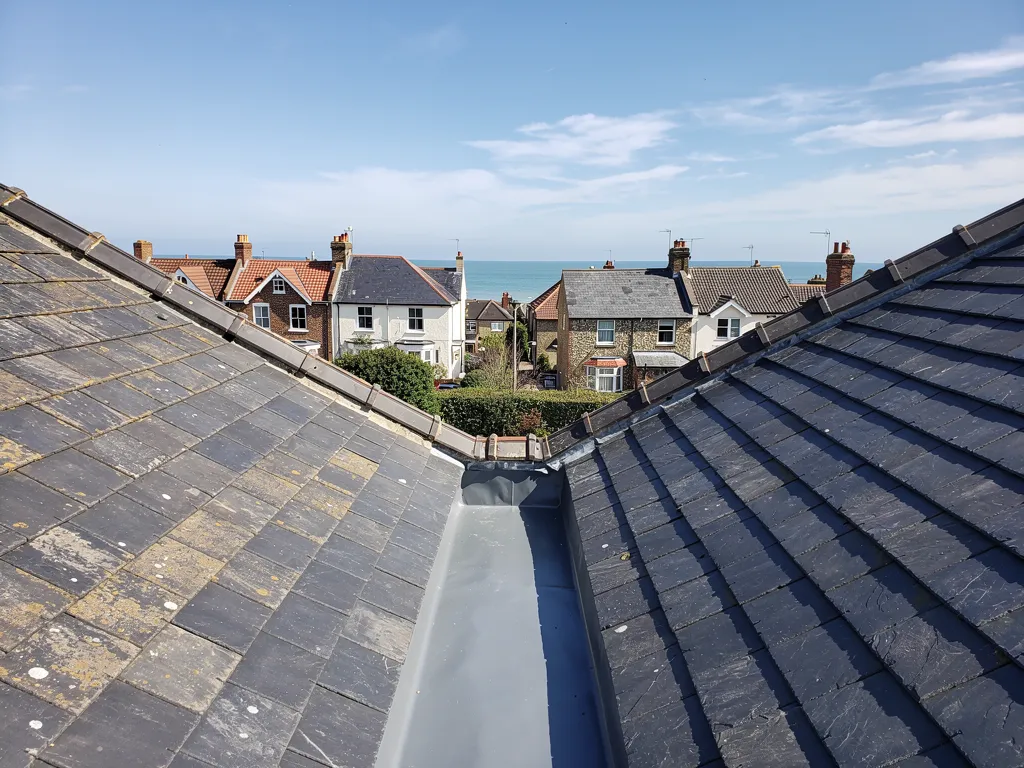
Wherever a roof meets something that rises out of it, such as a chimney, a side wall, a dormer cheek or a parapet, lead is dressed across the junction to shed water over the joint. The top edge sits in a groove raked into the brickwork, called a chase, where wedges and pointing hold it. Water that gets behind a lifted edge runs down inside the wall or onto the roof timbers.
Wind gets under any edge that has loosened. Old pointing crumbles, the wedges work free and a lifted corner catches the gust. Once it flaps, the lead hardens, cracks and tears. Lead lasts a very long time in good order, and MyJobQuote quotes over 80 years for flashing, which is why a blown strip often points to a weak fixing and not an exhausted sheet.
On a coastal roof, gusts funnel up the street and over the eaves with little warning, so a joint that held for years can give way in one bad night.
Making it safe while you wait
The priority is keeping rain out of the gap. A temporary cover over the lifted lead and the tiles beside it is the usual answer, but it has to be secured so that it will not tear in the next gust. Our guide to temporary roof repairs sets out the options, and anything that stays on beyond a few weeks has stopped being a temporary measure.
Sealant and mastic are tempting but poor. They bridge a loose strip for a short while, trap water behind the bead and hide the joint from whoever looks next. Do not climb up to try this.
Photograph the lifted lead from the ground, and look inside for stains on the ceiling beneath. If the damage came with a storm, tell your insurer and keep the dated pictures. See whether a roof leak is worth claiming for the excess question. The main emergency roof repairs page shows the wider options.
The permanent repair: lead codes and fixing
Each sheet of lead carries a code that sets its thickness. Leadworx calls Code 4 (1.80 mm) the standard for ordinary flashing, lists Code 5 (2.24 mm) for general, vertical and pitched uses, and limits Code 3 (1.32 mm) to soakers, the small pieces that slide beneath the tile courses next to a wall. The codes follow BS EN 12588.
Repair means deciding how much to renew. A single short lift may be dressed back, with the chase cleaned, new wedges and fresh pointing. Where the lead has torn, stretched or cracked, that run is renewed. A stepped flashing, where the lead follows the slope up a wall, is laid as separate pieces so that it can move, instead of one long strip.
The holding power is in the fixing more than the thickness. A properly wedged and pointed chase, with well-lapped joints, resists the gale that stripped the first one. That is why we trace the cause before quoting, and why we show you the photographs of what was found at the wall.
What it typically costs
Cost depends on length, access and whether scaffolding is needed. Checkatrade's repair guide lists Code 5 lead flashing at £50 to £70 per metre and stepped flashing at £80 to £120 per metre, excluding VAT. MyJobQuote (22 September 2026) gives £150 to £250 for a patch of chimney leadwork, and £350 to £460 for full replacement without scaffolding, or £700 to £920 with it.
Those are published national figures, not ours. After a survey we put the price to you in writing, with photographs of what we found beside it. Whichever firm quotes, check what the price covers where VAT and scaffolding are concerned, because both can add a good deal.
If the flashing failed because the stack itself is moving, the job changes, and the notes in out-of-hours roofer costs show how timing can affect a bill. A lift caused by someone else's work is covered in accidental roof damage cover.
A repair that goes in when the lead is first loose is generally smaller than one made after a winter of water running behind it. Damp that reaches the brickwork, the timbers at the wall plate and the plaster inside is slower and dearer to put right than the lead itself.
It is worth looking at the wall after the repair too. Lead that is fixed into crumbling mortar will not hold, so loose or eroded joints around the chase are repointed as part of the job, not left for next time. Any loose tiles beside the lead are refixed at the same visit, so the edge is sound along its whole length.
Blown flashing: two more questions
Can lead flashing simply be hammered back into place?
Sometimes, if the lead is undamaged and the chase is sound. It is cleaned, re-wedged and pointed. If the sheet is cracked, stretched or hardened, or the mortar around it has failed, it should be renewed, because a bent-back strip will fail again at the same bend.
Will my insurer treat blown flashing as storm damage?
It can, if there was a storm on the day and the damage fits it. Insurers often look hard at whether the joint was already loose, since wear and slow deterioration are commonly excluded. Dated photographs and a roofer's written account of the lead's condition help your case.
Tell us about your roof
Describe what is happening and we will call you back to arrange a visit.
- Photographs of what we find
- A written quote with one total price
- Or call 01903 299063
10-year workmanship guarantee, in writing.