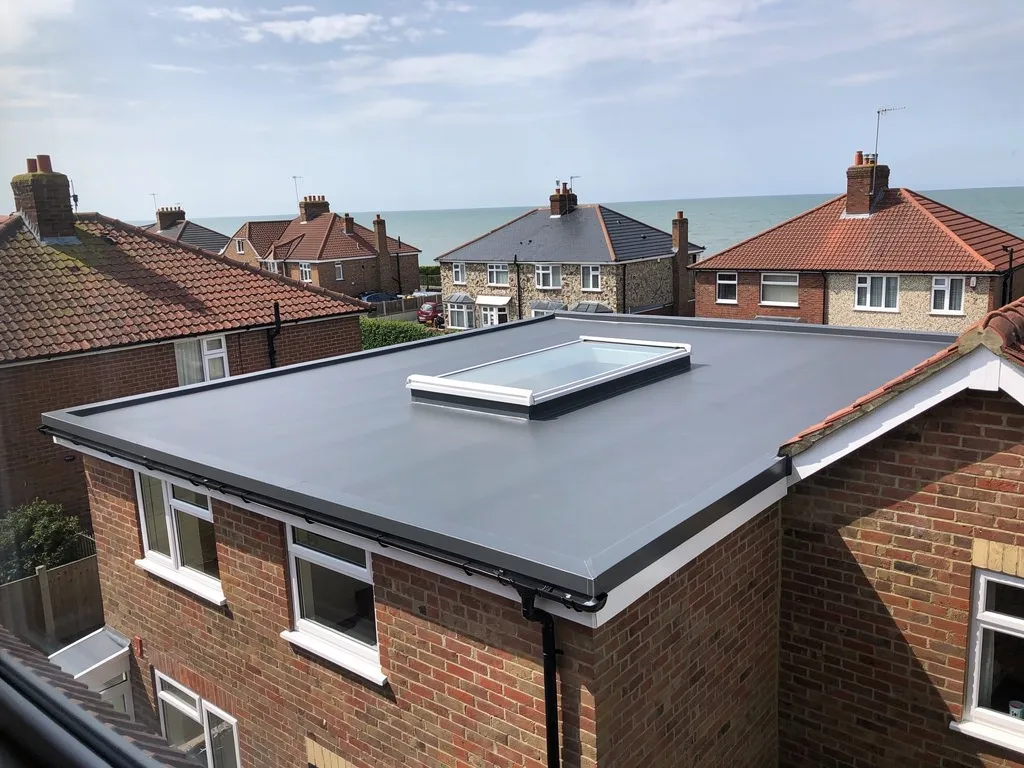
A pitched roof sheds water by gravity. A flat roof relies on a fall so slight that the eye cannot pick it out, and that leaves little margin for error. A blocked outlet, a lifted edge or a small split in the surface can hold water against a weak point for days, and what would be a nuisance on a pitched slope becomes a leak on a flat one.
The routine that keeps a flat roof sound is mostly simple, low-cost work. It means keeping the water moving, keeping the edges and joints tight, and looking at the surface often enough to see change. What it does not need is a bucket of sealant applied to every dark patch, which tends to hide the cause of a problem rather than solve it.
This page belongs to our wider flat roofing advice. It covers drainage, ponding, the trims and upstands at the edges, a sensible inspection routine and the small repairs that suit each type of covering, along with the signs that a repair is no longer enough.
Outlets, gutters and keeping water moving
Drainage is the first thing to check, because every other fault on a flat roof is made worse by standing water. The roof surface runs to an outlet, which may be a gutter along one edge, a hopper and downpipe, or a spigot through a parapet wall. If that outlet is partly blocked, the water backs up across the surface and finds the weakest joint.
Leaves, moss, silt and the grit that washes off mineral-finished felt are the usual culprits. They gather in the corners and around the mouth of the outlet. Clearing them by hand, with a soft brush and a scoop, takes minutes. A metal tool risks scratching or cutting the surface, so we avoid anything sharp on a membrane.
Gutters on a flat roof
Gutters need their own check. Gutter makers give their own guidance on slope toward the outlet, in the region of 1:600 to 1:350 depending on the system. A gutter that has dropped between brackets keeps its water, then spills out at the back and runs down the masonry. Brett Martin gives a spacing of no more than 900 mm between gutter supports, so a gutter that dips in the middle of a long run may need an extra bracket.
Look at the downpipe too. If water is overflowing at the top of a clear gutter, the downpipe or the drain at its foot is blocked. After autumn leaf fall, after a gale and after any building work nearby, these are the first places to check.
A short look from a ladder at the eaves, or from an upstairs window, is often enough. Do not climb onto the roof itself unless it has been built to be walked on and you are confident of the edge protection.
Ponding: when a puddle matters
Water that lies on a flat roof for long periods after rain is called ponding. A thin film that dries within a day is not unusual. A puddle that is still deep two days later is a sign that the fall is wrong, that the deck has dipped, or that the roof was never laid with enough slope.
Those numbers show how little slope a flat roof has to spare. IKO, citing the 2018 edition of BS 6229 (since revised), treats 1:80 as the finished minimum for a flat roof and a 1:40 design as the way to reach it. Slopes that shallow vanish easily when a joist sags or a board warps.
What ponding does
Standing water speeds up the ageing of most coverings. It holds dirt and algae against the surface, carries any chemical wash from above onto the membrane, and in winter it freezes and expands in small cracks. Over years, it also adds weight to a deck that may already be soft.
What can be done
Sometimes the answer is as small as clearing a blocked outlet or fixing a loose one that has risen above the roof surface. Where the deck has moved, a repair is rarely a lasting fix, because the water returns to the same low spot. In that case the honest answer may be to re-lay the roof with tapered insulation or a corrected deck, and the photographs of the pond on your own roof show why, instead of a patch hiding it.
Our guide to the signs of a flat roof leak helps when a pond has already gone further and water is showing indoors.
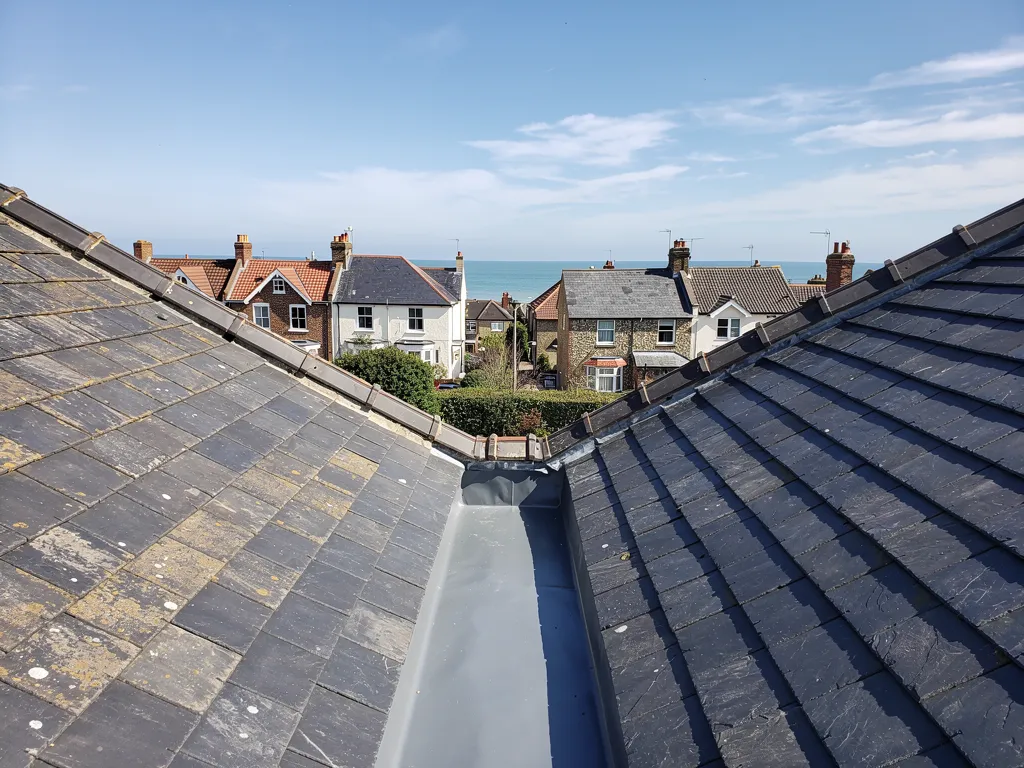
Edges, trims, upstands and flashings
Most flat roof leaks begin where the covering meets something else, not in the middle of a sound sheet. The details around the edge deserve a closer look than the open area.
At the perimeter, a drip trim or edge trim guides water into the gutter and holds the covering down. If the trim has lifted, or its fixings have worked loose, the covering behind it can peel back in the next gale. Wind pulls on a flat roof from the edges first, so loose perimeter details are among the quickest ways to turn a small gap into a large one.
Upstands and wall junctions
Where the roof abuts a wall, the covering rises up the face as an upstand, with a flashing closing its top edge. On houses that flashing is frequently lead, wedged into a raked-out mortar course. Signs of trouble are lead that has curled, cracked or slid out of its slot, mortar that has crumbled around it, and covering that has slumped down the wall. Cracks in the brickwork itself can also let driven rain behind a flashing.
Around pipes, vents and rooflights, the same rule applies: the seal needs to be continuous. A collar that has split with age, or a rooflight kerb whose covering has shrunk away, is a small repair when found early and an expensive one when water has soaked the insulation below.
What to look for
Check each of these in turn, from the ground or a ladder, and only as far as you can do so safely:
- gaps or lifted sections along the edge trim;
- lead that has curled away from a wall;
- cracks in the covering where it turns up at an upstand;
- splits in the collar around a pipe;
- mortar that has crumbled above a flashing.
An inspection routine that suits a flat roof
A set routine makes the job manageable. Twice a year is a good rhythm for most domestic flat roofs, with extra checks after a gale. Autumn, once the leaves have come down, is the time to clear outlets and gutters. Spring is the time to look for damage that frost and winter rain have done.
On each visit, look at the whole roof surface for changes, not just the areas you know are weak. The signs to watch for include:
- splits or cracks in the covering;
- blisters, which are raised bubbles of trapped air or moisture;
- loose or open seams between sheets;
- worn patches where mineral chips or surface finish have gone;
- moss, algae or plant growth;
- water that is still standing days after rain.
Inside the building
The ceiling below tells its own story. A new stain, a patch of flaking paint, a musty smell or a damp corner in a room under the roof is worth noting with the date. Our flat roof leak signs page explains what different marks suggest.
Professional inspections
An inspection by a roofer adds a trained eye and access that you may not have. MyBuilder (updated 21/08/2026) gives a typical UK range of £150 to £250 for a standard roof inspection, with a drone survey at £200 to £400. For roof cleaning, the same guide shows a flat roof at £300 to £600. If work turns out to be needed, the survey pictures and a written quote come to you together.
If you rent your home, report a leaking roof to your landlord in writing, since repair of the structure and exterior is usually their job.

Small repairs by covering
Which repair suits depends on the covering, because a method that works on one material can ruin another. Before anything is applied, the area must be clean, dry and free of loose material, and the cause of the damage must be understood. Painting a sealant over a split without finding why it split is how a repair fails twice.
Felt
On a felt roof, a small split or lifted lap can be cut out and patched with a new piece of felt, heated into the surrounding sheet. Blisters that have not split can often be left alone and watched. A cold-applied bitumen coating or a repair tape can seal a small defect for now, but it is a stopgap, not a cure. Knowing how the layers of a felt roof are built helps you judge what a patch can and cannot do.
EPDM
EPDM is a synthetic rubber sheet, and small tears are usually mended with a compatible patch and primer, pressed on firmly. Seams that have opened can be re-taped. The repair works only if the surface is thoroughly clean first.
GRP
GRP, short for glass-reinforced plastic, is a fibreglass matting set in resin. Hairline cracks in the gel coat are normally cut out and filled, and larger cracks are repaired with new matting and resin. Cracks that return along the same line usually mean the deck beneath is moving.
Costs
Checkatrade (table last updated June 2026) gives typical UK repair costs per m², exclusive of VAT, of £100 to £140 for bitumen flat roofing, £120 to £170 for EPDM and £130 to £180 for GRP. Access, the number of details and the size of the area change the final figure.
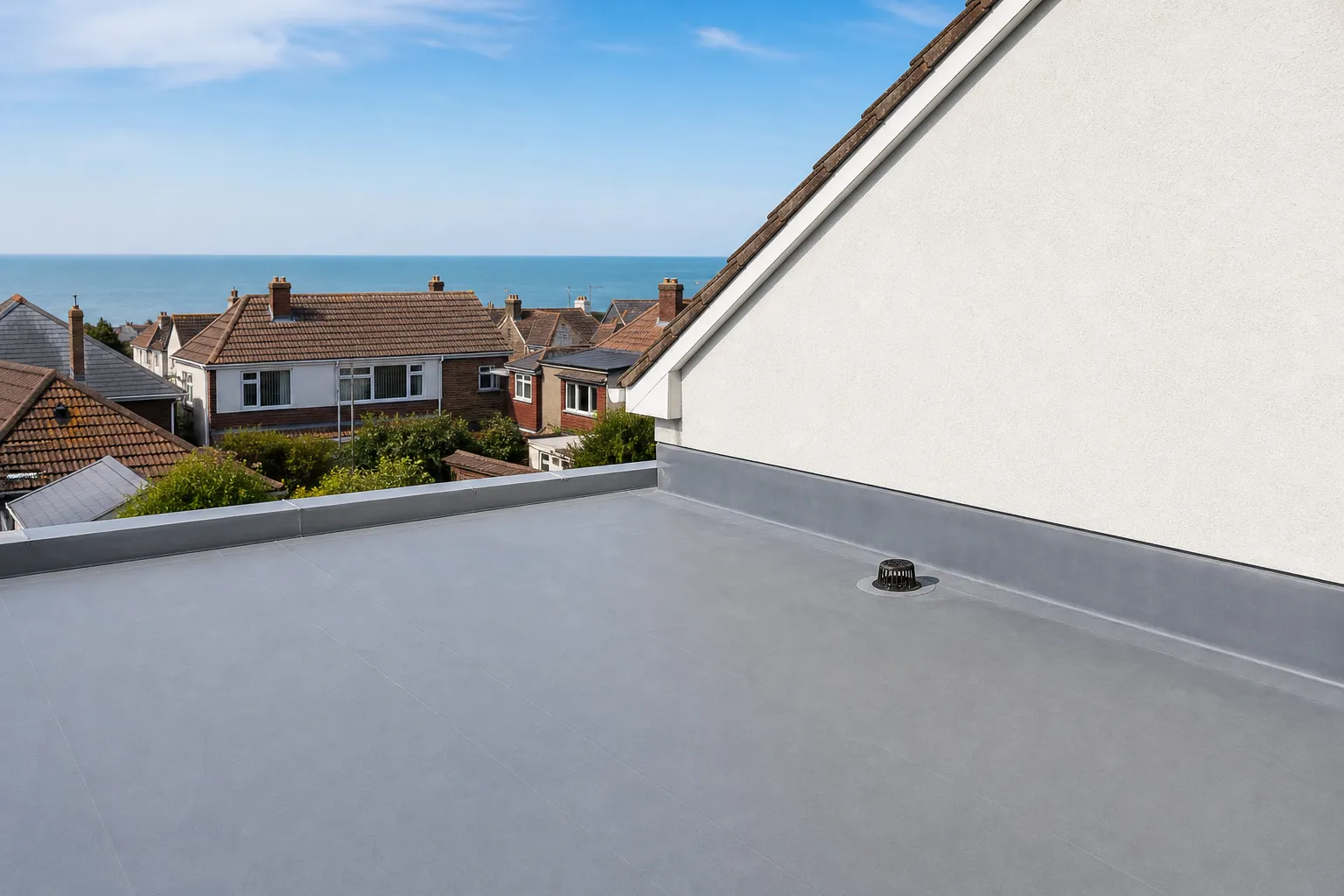
When maintenance stops being enough
Each covering eventually reaches the stage where mending it costs more than it returns. Typical lifespans give a rough guide. MyBuilder (updated 21/08/2026) puts flat roofs in general at 15 to 30 years. Less (last updated March 2026) gives torch-on felt as 10 to 20 years, GRP as 25 to 40 years, and EPDM as 30 to 50 years, while GreenSpec gives 20 to 30 years for EPDM. These are published ranges, not promises, and the care a roof receives moves it within them.
The signs that a repair no longer makes sense are fairly consistent. Splits and blisters appear across the whole surface rather than in one place. The same area leaks again after being mended. The deck feels soft underfoot, or the ceiling below has been stained more than once. The insulation beneath is wet. At that stage, patching is buying time at a rising cost.
Choosing between repair and replacement
Our approach is to propose the smallest job that fixes the cause. Where a local repair will hold, that is the advice. If the covering has run its course, we tell you that and explain the reasoning. Pictures of your own roof back up the reasoning, and you receive the price in writing as one total.
Replacing the covering brings Building Regulations questions with it, because Approved Document L lists a new flat roof membrane as renovation of a thermal element, which can bring insulation requirements. Our guide to Building Regulations for a flat roof replacement sets out the tests. If the roof is also used as a space to sit out, our flat roof terrace guide covers the extra loading and edge protection.