
Question answered
Shared gutter with a neighbour: who pays?
The short answer
Who pays for a shared gutter depends on your title deeds and on who owns the section that is failing. There is no automatic 50:50 split. Start by checking the deeds for repair obligations, speak to your neighbour with photographs of the fault, and agree the work in writing. GOV.UK lists chimney removal on a party wall as notifiable building work, so party wall notice rules can matter if a job grows.
On semis and terraces the gutter often runs straight across the party wall, so one leaking joint can affect two houses. Who pays depends on your deeds and on how the work is done, not on a single rule.
What a shared gutter really is
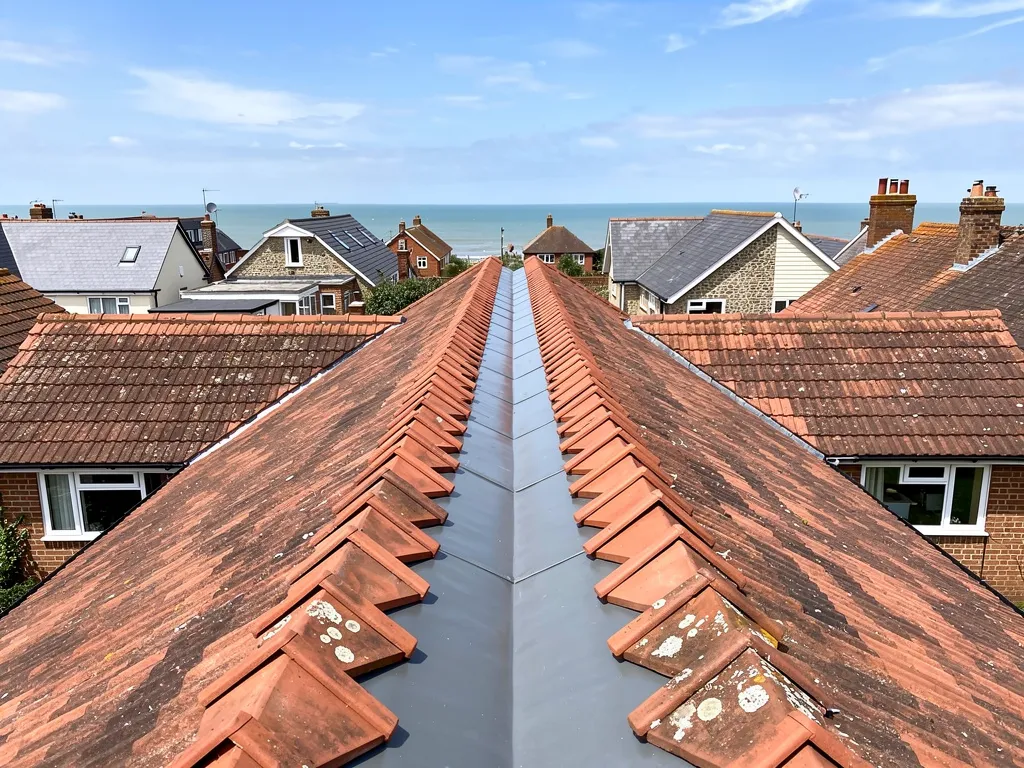
Terraced and semi-detached houses are often built with a continuous eaves line. The gutter may run unbroken over the party wall, with a single bracket or a joint close to the line between the two houses. Sometimes the two roofs meet in a shared valley, and the gutter beneath them takes water from both slopes.
That makes the line of ownership hard to see from the ground. The gutter looks like one object, but the deeds and the plan for each house usually mark where one property ends and the next begins. A leak at the joint can therefore feel like nobody's problem, and neighbours often wait for the other to act while the fascia behind gets wet.
The first step is to work out where the fault actually is. A drip from the middle of a run belongs to one house; a failed union exactly on the boundary belongs to the arrangement between the two.
Where the answer on cost normally sits
Legal advice is outside what we can offer, and the answer varies from house to house. The place to look is the title deeds or the transfer when each house was sold. Some deeds include a covenant to share the cost of anything used in common, such as drains, a boundary wall or a shared roof element. Others say nothing, and in that case each owner is generally responsible for the part on their own house.
If your deeds are silent, a practical approach is usually the most sensible. Agree who benefits from the repair, share the cost of any work that serves both houses, and keep a note of what was agreed. For a formal view, a solicitor with property experience can read the documents.
The reason to settle it early is that gutters get worse as they are left. A joint that drips onto a neighbour's wall in October will be a rotten fascia by spring, and the larger bill is then harder to divide.
How a joint run is repaired in practice
Whichever way the bill is split, the repair is best done in a single visit by one contractor. If two firms each fit their own section, there is a risk of mismatched profiles, a poor union at the boundary and a disagreement about who is at fault if it leaks again.
A full survey of the run shows whether a union needs resealing, a length needs replacing or the whole elevation has outlived its brackets. We photograph the fault on both sides of the line, so each owner can see what was found. Once the survey is done, the written quote gives a single total that you and your neighbour can look at together.
If the gutter has to match a neighbour's existing profile, our note on gutter profiles helps you identify it before you order materials.
When the Party Wall etc. Act may apply
GOV.UK lists chimney removal on a party wall as notifiable work and says you must give your neighbour notice between 2 months and a year before you plan to start. You cannot assume that no response means they agree. If your project grows beyond a routine gutter repair and begins to touch the party wall itself, read the GOV.UK guide to party walls for the full list of notifiable work, and take advice.
Access is another practical point. A tower or scaffold may need to stand on a neighbour's land, and the gutter on their side may be reachable only from their garden. Ask politely and early, and give them a date. A neighbour with a damp wall is usually glad to see a leak stopped, and a clear date for access makes the conversation easier for both of you.
Where a damp wall on either house is involved, our page on the gap between the roof and the gutter, which is a common route for water behind the board.
A sensible order of action
Photograph the fault when it is raining, with a date. Look at the deeds. Talk to your neighbour before sending anything formal, and offer to share the survey findings. If the problem is rotten timber under the gutter, share the information about fascia capping and hidden rot, because fresh boards are often the real job. And if the fascia is plastic on one side and timber on the other, uPVC against timber fascias explains the mismatch.
Agree the scope and the split in a short email, and ask the contractor to confirm it covers both sides of the boundary. The rest of what we do on the roofline is on our gutters, soffits and fascias page.
Shared gutter: two awkward situations
My neighbour will not pay. Can I fix only my side?
You can repair the part you own, and we will tell you where the dividing line falls on the survey. A repair that stops at the boundary may leave a union that still leaks, so we explain what the neighbour's section is doing before you decide. Keep photographs and notes in case it is raised later.
Can my neighbour's overflowing gutter damage my wall?
Yes, a gutter that overflows onto a shared wall can leave damp marks and rot a board. Take dated photographs, speak to them first, and offer to share what a survey shows. If the problem continues, your deeds or a solicitor can tell you what you are entitled to ask for.
Tell us about your roof
Describe what is happening and we will call you back to arrange a visit.
- Photographs of what we find
- A written quote with one total price
- Or call 01903 299063
10-year workmanship guarantee, in writing.