Roofs seldom fail in a single afternoon. The covering tires over many winters, and the evidence turns up in the loft, on the path and along the ridge line well before water reaches a ceiling. Knowing what to look for lets you act on your own timetable instead of a storm's.
No single sign condemns a roof. One slipped tile is a repair, and a patch of moss is a nuisance. What matters is how many of the signs below appear together, and whether the same fault keeps coming back after it has been mended. Many of them can be spotted from the pavement, from a bedroom window, or with a torch from the loft hatch, without anyone stepping onto the slopes, which is the safest way to look.
This guide sticks to the materials found on British houses: clay and concrete tiles, natural slate, lead, felt and the underlay beneath the covering. It explains what each sign means, how to tell it from a fault that a repair can cure, and what to do when the evidence adds up. If it leans the other way, our guide to repairing or replacing shows how to weigh the choice.
Nail sickness and tiles that keep slipping
Tiles and slates hang on small fixings, and fixings do not last for ever. When the nails holding a covering corrode, snap or work loose, the tiles above them start to slide. Roofers call this nail sickness. It rarely announces itself with one dramatic failure. Instead you find a tile or two on the lawn after a blow, then a different pair a month later, then a gap you can see from across the road.
The pattern tells you more than any single tile. Slipped tiles clustered at one corner point to a local problem, such as wind catching an exposed verge or ridge. Slipped tiles scattered over a whole slope say the fixings across the entire slope are tired, and a fresh tile pushed into each gap only borrows time, because its neighbours share the same weakness.
What to look for from the loft
With a torch, look at the nail points showing through the underside of the roof. Rust staining on nail shanks, nails that have eased partway out of the batten, and tiles that lift when you press up from below all point the same way. Battens crumbling or splitting at the nail holes make matters worse. These are the narrow laths running across the rafters that each course of tiles is hooked over, and without sound ones there is nothing firm to fix to.
It also helps to keep a tally of slipped tiles across several seasons. Two incidents in different places over five years is ordinary wear. A fresh gap after every strong gale is a roof telling you its fixings have gone, and on this coast the sea weather gives it plenty of chances to say so. We note which slope the slipping runs along before suggesting anything, since that shows where the fixing has failed.
Spalling, flaking and crumbling coverings
The surface of a tile or slate wears in ways you can read once you know them. Spalling is the word for the face of a clay or concrete tile flaking or peeling away in thin layers, leaving a rough, pitted surface. Water that soaks into a tile and then freezes can cause it, and so can simple age. Tiles that crumble at the edges when handled, or have gone soft and powdery, belong in the same group.
Slates fail differently. A slate that is delaminating splits into thin sheets along its natural layers, with the lower edge lifting and fraying. A slate with a hairline crack across it can pass water long before it drops. Slates are often reused, so a roof may carry old and newer stock side by side, and the older ones fail first.
Moss and lichen get blamed for all of this, but they are mostly a sign of damp, shaded slopes, not of failure in themselves. Heavy growth can hold moisture against the surface and block the gaps between tiles, so it is worth treating, and our guide to roof cleaning and moss removal covers that. The test is what lies underneath. If the tile surface under the moss is sound when it is cleared, you have a dirty roof. If it crumbles, you have a failing one.
One bad area or the whole slope?
Look for spalled tiles on every slope. A few damaged tiles near a chimney or gutter edge, where water runs and sits, can be replaced individually with matching ones. Widespread surface loss means the covering as a whole is giving up, and the sums change, because replacing tiles one by one disturbs good neighbours and may not match.
Sagging, dips and a roof that has changed shape
A roof should show straight lines. The ridge, the long line along the top, should run level, and each slope should look flat from the road. A dip along the ridge, a belly in the middle of a slope, or a slope that bows outward is a signal that something in the structure beneath has moved.
The causes vary. Rafters, the sloping timbers running from ridge to eaves, can soften with long-term damp and rot. Purlins, the heavy horizontal beams that prop the rafters partway down, can deflect under load. A covering heavier than the original, put on by a previous owner, can overload the frame. Sometimes the movement is old settlement that stopped decades ago and does no harm, and that is why photographs from years back, or a neighbour's matching roof, make a useful comparison.
Treat sagging as a reason to get the roof looked at soon, not a reason to climb up. A bowed slope may be carrying weight on weakened timbers, and nobody should walk on it. Binoculars from the ground and a torch in the loft will show most of what matters. In the loft, look for timbers with dark staining, soft patches that give under a screwdriver, and joints that have opened.
Why sagging changes the decision
Fixing a covering on a distorted frame never gives a lasting result, because the new tiles will sit unevenly and let water past. If the timbers need strengthening or replacing, the covering has to come off to reach them, which makes it the sensible moment to renew it. Structural work can also bring Building Regulations into play, as the Planning Portal lists structural alterations among the triggers for approval. We explain what applies once the survey shows how much is involved.
Perished underlay and a damp, musty loft
Under the tiles or slates sits the underlay, a membrane that catches whatever wind-blown rain gets past the covering and carries it down to the gutter. On many older houses it was bitumen felt, and felt does not last as long as the tiles on top of it. It dries, cracks and tears, and sections can hang loose from the rafters. Some older roofs were built with no underlay at all, which makes a covering in perfect shape no guarantee that the roof as a whole is sound.
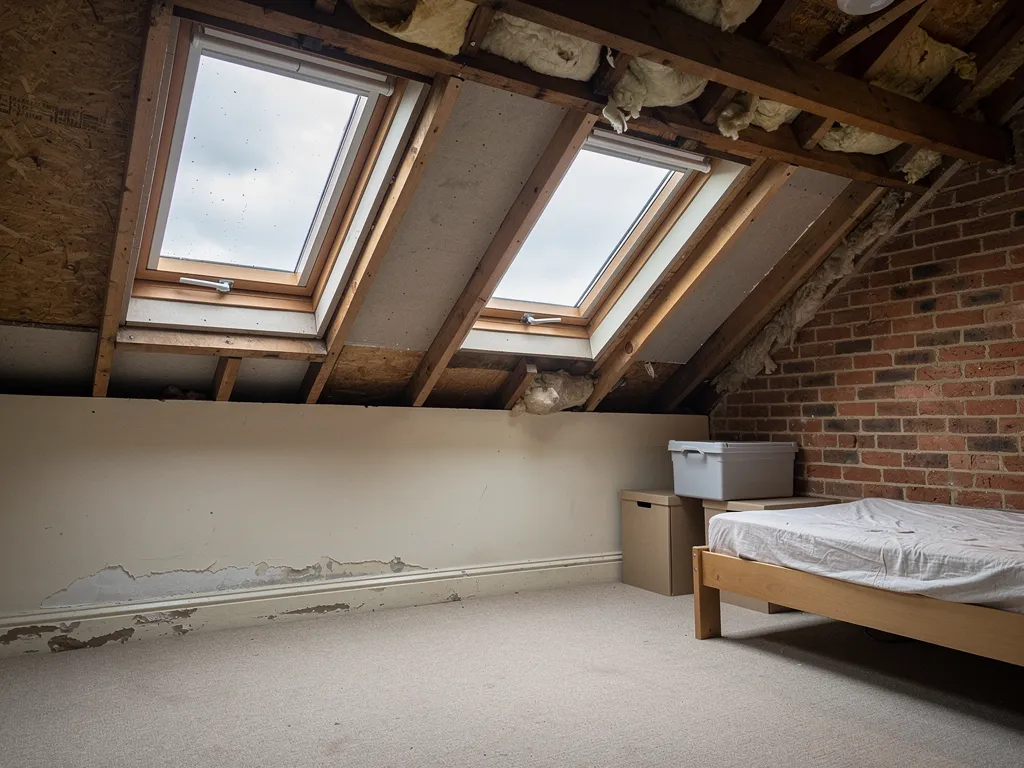
The loft is where this shows. Look for underlay that is torn, sagging in troughs or flaking away, for daylight showing through the roof in places where it should not, and for patches of dark staining on the timbers beneath. A musty smell, damp insulation and mould on rafters mean moisture is getting in or is being trapped, and the next step is to find which. Our page on telling condensation from a leak explains how.
Perished underlay across a slope is a decisive sign, because it cannot be renewed with the covering in place. The tiles or slates have to come off, be sorted and be relaid on a new membrane, with new battens where needed. Done on a sound covering, that is a re-roof in all but name, and it generally makes more sense than putting new covering over the same worn membrane.
Ventilation is part of the picture
When the underlay is renewed, the roof also needs to breathe. Marley's summary of BS 5250 sets a continuous 10mm gap along the eaves on a high-resistance underlay at pitches above 15°. A new roof laid without the ventilation it needs can trap warm, damp air and rot the new timber too. We check the eaves and the ridge as part of the same inspection.

Leaks that return, and what the age of the covering says
The most familiar sign is a leak that comes back. It is also the most misleading, because some leaks are single faults that repair for good and others are the roof announcing that many faults are on their way. The difference lies in the history. A flashing that failed once and was properly replaced is finished business. A leak in the hall, then one by the chimney, then a stain over the bedroom door, all within a couple of winters, describes a roof that is failing in several places at once.
Each repair on such a roof is real, but it fixes one spot while the covering around it carries on ageing. Scaffold costs repeat each time too. Add up what you have spent and set it beside the cost of renewing, and our guide to repairing or replacing a roof shows how to do that fairly.
Reading the age against the material
Treat the date on the roof as a prompt for questions. Published lifespans are typical ranges, not promises, and where the house stands, how well it was laid and the upkeep it has had all shift them.
| Covering | Typical life as published |
|---|---|
| Natural slate | 80 to 100 years or more |
| Clay tile | 60 years minimum, per Marley |
| Concrete tile | 30 to 60 years |
| Flat roofs generally | 15 to 30 years |
| Torch-on felt | 10 to 20 years |
Sources: MyBuilder (updated 21/08/2026), Marley and Less. A covering near the top of its range with a second sign beside it deserves a survey. One sign on a roof still comfortably within its range often does not.

What to do when several signs line up
If you have found two or three of these signs together, the sensible next step is a survey, not a decision. A survey tells you whether the roof can still be repaired with proper effect, which parts are worth keeping, and what a replacement would involve. The visit covers the loft, the route any water has taken, and the outside, and the photographs of what we find come to you alongside a written quote.
That figure is one total, delivered after the visit. Ask of any figure you are given whether VAT and scaffolding are inside it, since either can swing a comparison. Access, covering, extent and the findings of the inspection set the sum. Our advice is the work that deals with the cause and nothing beyond it, so a repair will be named first whenever a repair would do.
If a new roof is the answer, what happens during a roof replacement walks through the sequence from scaffold to sign-off. The overall picture is on our roof replacement page.
Meanwhile, keep the house safe
If water is coming in now, leaks come first for us, and the immediate job is stopping it getting worse before the lasting fix. Shift belongings from under the stain, catch any drip in a container, and stay out of the loft if the ceiling below is bulging with water. Do not go on the roof. Take photographs of any damage from the ground, since they help whoever surveys it and are useful if you later speak to your insurer.
The old material goes with us at the end, and the quote names the underlay to be fitted.