Ask what a new roof costs per square metre and a commercial owner will usually get a shrug, because a flat figure hides most of what matters. A long, low warehouse with clean metal sheets and a safe ground-level working zone is a different job from a three-storey office block with a parapet, a plant deck and a neighbour on the boundary. The covering is only one line of the sum. Access, the state of what sits underneath and whether the building keeps trading all push the figure up or down.
There is no single published price range for industrial roofing that we can point to, so this guide does not invent one. What we can do is show you the factors in the order they usually bite, give the flat-roof prices that national cost guides publish for homes so you have a reference point, and explain what a sensible written quote contains. The numbers below are domestic and are labelled as such.
If you are weighing up a first call, our guide to choosing a commercial roofing contractor covers the questions to put to anyone who visits.
Roof area, shape and height set the starting point
Area is the first thing any roofer measures, and it matters because most materials are bought and laid by the square metre. A larger roof spreads the fixed costs, such as getting people and kit to site, over more surface. A small roof with the same awkward access can cost more per metre than a big one.
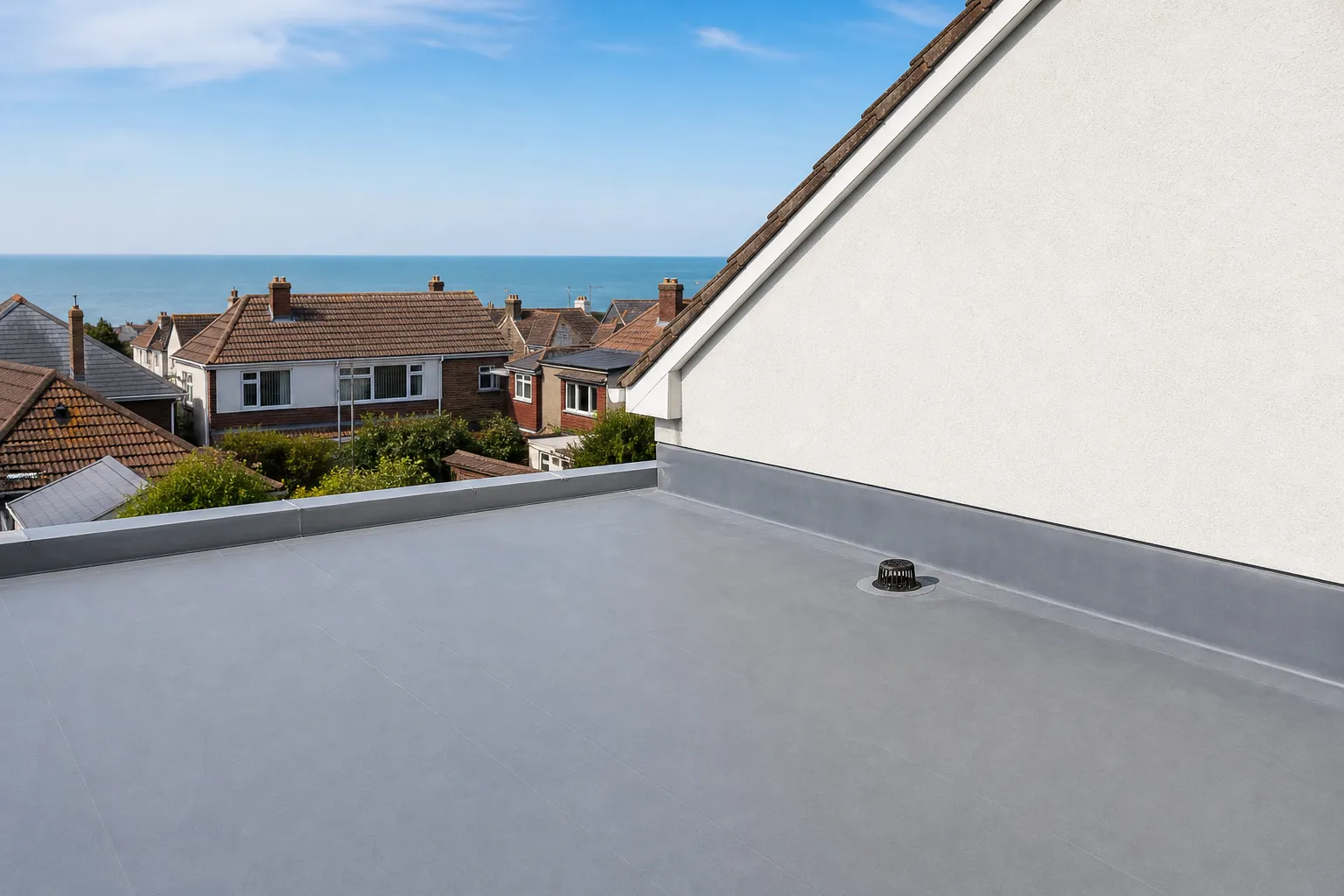
Shape matters almost as much as size. A plain duo-pitch shed is quick to sheet. A building with several valleys, a hipped end, a lean-to against the neighbour or a sawtooth profile takes longer, produces more offcuts and needs more flashings, which are metal or lead strips that close the gap where a slope meets a wall or an upstand. Roof edges are worth a look as well. Where the roof drains into a parapet gutter, a box gutter between two slopes, the outlets and the lining cost real money to renew and are often the first thing that has failed.
Height and what is underneath
A roof eight metres up needs different protection from one at three, and a roof over live production space needs a careful plan for dust and falling debris. We also look at what the covering sits on. Steel purlins, the horizontal beams that carry the sheets, can be rusted at the ends. Timber decking under a flat roof may be wet. Insulation that has soaked up water for years has to come out, and none of that is visible until the old covering is lifted or a survey cuts a small test opening.
This is why a figure given over the phone from a postcode means very little. The first reliable price comes after someone has walked the roof and looked at it from inside as well as above.
The covering you choose changes the figure
On a commercial building the main options are profiled metal sheets, single-ply membrane and built-up felt, and each is priced differently. Metal sheeting is quick to lay on a large span and has a long record on sheds and workshops. Single-ply is a factory-made sheet, usually EPDM, a synthetic rubber, or a PVC-based membrane, laid over insulation on a flat deck. Built-up felt is layers of bitumen felt, often torched on or stuck down on site. Our guide to roofing for warehouses, workshops and offices compares them in more detail.
National cost guides do not publish industrial rates, so the only numbers we can responsibly quote are domestic flat-roof figures. They are a reference point for the covering alone, on a small roof, and a large commercial job will not follow them exactly.
| Flat-roof covering (domestic) | Typical UK range per m² |
|---|---|
| Felt | £70 to £100 |
| EPDM | £90 to £130 |
| GRP | £95 to £150 |
| PVC | £95 to £140 |
| Lead | £150 to £200+ |
These are typical UK ranges for home flat roofs from MyBuilder (updated 21/08/2026). Treat them as a starting point for thinking, not a quote for a unit. Insulation, upstands, edge trims and the removal of the old layer all sit on top of the covering itself, and on a big roof they make up a large share of the sum. Rooflights, outlets and plant bases each need their own detailing as well, so a roof with many of them costs more than a clear expanse of the same area. How long each lasts also feeds into cost over the years: MyBuilder gives 15 to 30 years for flat roofs generally, and our written quote is set after we have surveyed your building.

Access, scaffold and edge protection
Getting safely onto a roof and keeping everyone safe while the work goes on is often the biggest single cost after the covering itself. A low shed may need a few ladders and a cherry-picker for the edges. A taller building or one with a public footpath alongside will usually need scaffold with edge protection and a covered walkway for passers-by. For a standard two-storey house, MyBuilder gives around £850 to £1,200 for scaffolding, a domestic reference point. A large commercial perimeter will cost more because there is more of it.
A scaffold that blocks the footway or the carriageway needs a written licence, which the scaffold firm has to request. In Worthing and Adur the licensing body is West Sussex County Council, which wants at least 10 working days between application and erection. A firm start date therefore waits for the licence. Our page on the scaffold licence explains how that works.
Why access shifts the plan, not just the price
Where a yard is full of stock, vehicles come and go all day or the loading bay cannot close, the work is phased. Phasing can mean sheeting one bay at a time, which takes longer but keeps the business running. It also changes how many days of scaffold hire the job needs. When you read a quote, check that it says what access is included and for how long, and that any extension period is understood before work starts.
We work out the access plan during the survey, because a good plan cuts rework and keeps the figure from drifting later.
Fragile roofs and asbestos cement
Many older industrial roofs are made of cement-based corrugated sheets, and some of those contain asbestos. HSE guidance is plain on the point: for a building was built or refurbished before 2000, assume there is asbestos in it until it has been checked. Its guidance note A14 adds that asbestos cement roofs are always fragile, meaning someone can go through them. That single fact changes the cost of the job, because the work cannot be done by standing on the sheets.
Under HSE guidance, taking off asbestos cement sheeting carefully and whole counts as non-licensed work. If the sheets have been substantially damaged or are broken up, the work becomes notifiable non-licensed work, and a notice has to be given before it starts. Either way the sheets have to be double-wrapped, labelled and taken away as hazardous waste, with lockable skip arrangements, and that handling adds to the figure. HSE also asks the obvious question first: could a new non-asbestos covering go over the old sheets and spare you the removal? That option, where the structure and the building rules allow it, can save a good deal.
A survey that finds asbestos cement does not mean the job cannot go ahead. It means the plan, the waste route and the order of work need to be settled before a price is fixed, and any quote that skips the question deserves a second look.
MyBuilder puts the average cost of asbestos removal at around £2,000, which is a domestic reference, not a commercial one. For a large industrial roof the area alone makes the figure far higher. Fragile sheets and hidden damage are the reasons an owner is better off starting from the wider commercial roofing service and a survey than from a price list.
Repair, overlay, refurbishment or full replacement
The price also depends on how much of the roof is being changed. A repair that tackles a failed outlet or a split seam is the smallest job, and we start by asking whether a small repair is all the roof needs. Beyond that sit three bigger choices, and each costs differently.
An overlay lays a new weathering layer over the old one. It avoids stripping and disposal, so it is usually quicker, but the existing roof needs to be sound enough to carry the new layer and the extra weight. A refurbishment keeps the roof structure and strips or recovers the failing layers, often adding insulation. A full replacement takes everything back to the structure and rebuilds. It costs the most and gives the cleanest start, and it is the right answer where the deck has rotted, the insulation is saturated or the sheets have reached the point where repair no longer pays.
How the survey chooses between them
We look for the signs that decide it: ponding water on a flat roof, rusted fixings and sheet laps on a metal roof, wet insulation, blocked outlets and failed rooflight kerbs. A thermal survey can pick out wet insulation under a flat roof, and MyBuilder gives a typical UK range of £300 to £500 for one. If the damage is local, a patch or a section replacement can hold for years. If it is widespread, repeated repairs cost more in the end than recovering the roof once.
Our pages on commercial flat roof refurbishment and how long a commercial roof lasts help you weigh the options before you commit. Whichever you choose, ask what is being done about the old insulation and the outlets, because both are easy to overlook when the focus is on the new covering.
VAT, trading disruption and reading the written quote
For a business, VAT is a question to settle early, because it changes the number you compare. The standard VAT rate is 20 per cent, according to GOV.UK. Whether a business can reclaim VAT depends on its own registration and the use of the building, which is a matter for your accountant. When you collect quotes, check that every quote states if VAT and scaffolding are in the total, so that you compare like with like.
Trading disruption also has a cost, even when it is not on the invoice. Noise, dust, blocked loading bays and shifted stock all cost a business time. A roofer who plans the order of work around your working day, and says in advance which bays will be closed, saves you that money even though no line on a quote shows it.
What a good quote tells you
Once we have surveyed, the written quote reaches you as one total price, with photographs taken on your roof. It describes the covering, the insulation, the access arrangements, how waste will be handled and what happens if hidden damage turns up once the old layer is lifted. We keep the figure good and fair, and the written figure states plainly whether VAT and any scaffold hire sit inside it.
If a price arrives without a visit, or without any mention of access, asbestos or waste, treat it as a guess. Send the address, a rough roof size and some photographs, and we will arrange a proper look. The quote form is the quickest route.