A commercial roof is rarely just a roof. It sits over stock, machinery, staff and customers, and a mistake on it interrupts trading as well as letting in water. That is why the usual advice to get three prices and take the middle one falls short. Two contractors can quote for the same sheets on the same building and be planning very different jobs, one with a sound method for working safely at height and the other with a ladder and a hope.
The questions that separate them are not about badges or slogans. They are practical. How will the work be done without anyone going through a fragile surface? What is the plan if the old sheets turn out to contain asbestos? Who stands behind the finished roof, and in what form? Can you see another roof they have finished? Each has an answer that a capable contractor gives easily and a careless one avoids.
What follows takes those questions in the order you are likely to meet them, from the first visit to the signed quote. Use it with any roofer, ours included. Our guide to what drives commercial roof prices is a useful companion when the quotes come in.
Begin with a visit, because a roof cannot be priced blind
The first test comes before any paperwork. A contractor who prices a commercial roof from a postcode and a phone call has not looked at it, and the number is a guess in a confident voice. Someone sensible will ask to see the roof from above and from inside. Inside tells them about condensation, wet insulation, daylight through lap joints and rusted purlin ends, the steel beams that carry the sheets. Above tells them about the state of the fixings, the ridge, the outlets and the rooflights.
Notice what they photograph and what they ask about. A thorough visit covers how the roof drains, whether there is a parapet gutter or box gutter, what plant stands on the roof and who goes up to service it, whether any part has been repaired before, and what the building is used for beneath. It also covers the awkward questions. Is the roof fragile? Has anyone checked it for asbestos? Where do deliveries and staff come and go? Those answers shape the plan, and a roofer who does not ask them will meet them later, at your expense.
What you should receive afterwards
Photographs of your own roof are the plainest proof that a survey took place. Ours come with the written quote, and you should expect the same from anyone. Pictures of cracked sheets, rusted laps, blocked outlets or lifted flashings let you see the problem for yourself and let your surveyor, landlord or insurer see it too.
If a contractor says the roof needs replacing, the photographs should show why. If they say a repair will do, they should show what the repair is expected to fix and what it will not.
The method statement and the plan for working at height
A method statement is a short written plan that sets out how the work will be done and how people will be kept safe while doing it. For a commercial roof it is the single most useful document you can ask for before work starts. It need not be long. It should say who will be on the roof, how they get up and down, what edge protection and covers are going in, how fragile surfaces will be handled, where materials will be stored, and what happens to waste.
Fragile surfaces are the heart of it. Old fibre-cement sheets, weathered plastic rooflights and thin metal liners can all give way under a person's weight, and a rooflight painted over with moss or reflective coating is invisible from above. HSE guidance calls asbestos cement roofs always fragile, and the same caution is sensible for any old roof of unknown condition. A plan that depends on walking carefully is not a plan. It should name the protection that will be used, such as crawling boards, covers over rooflights, edge barriers or a mobile platform.
Signs of a plan that is real
Ask who wrote it and whether it describes your building, not a building like it. A real one mentions your loading bay, your boundary, your neighbour and the days your staff are in. A template with the wrong address on it tells you the contractor did not think about the job.
Ask to see the method statement before you sign, and ask what changes if the roof proves more fragile than expected. A contractor with a sound plan answers in a sentence.
Our own approach to working over live premises is covered on the page about commercial roofing in Worthing and West Sussex.
Asbestos: ask before work begins, not after it has started
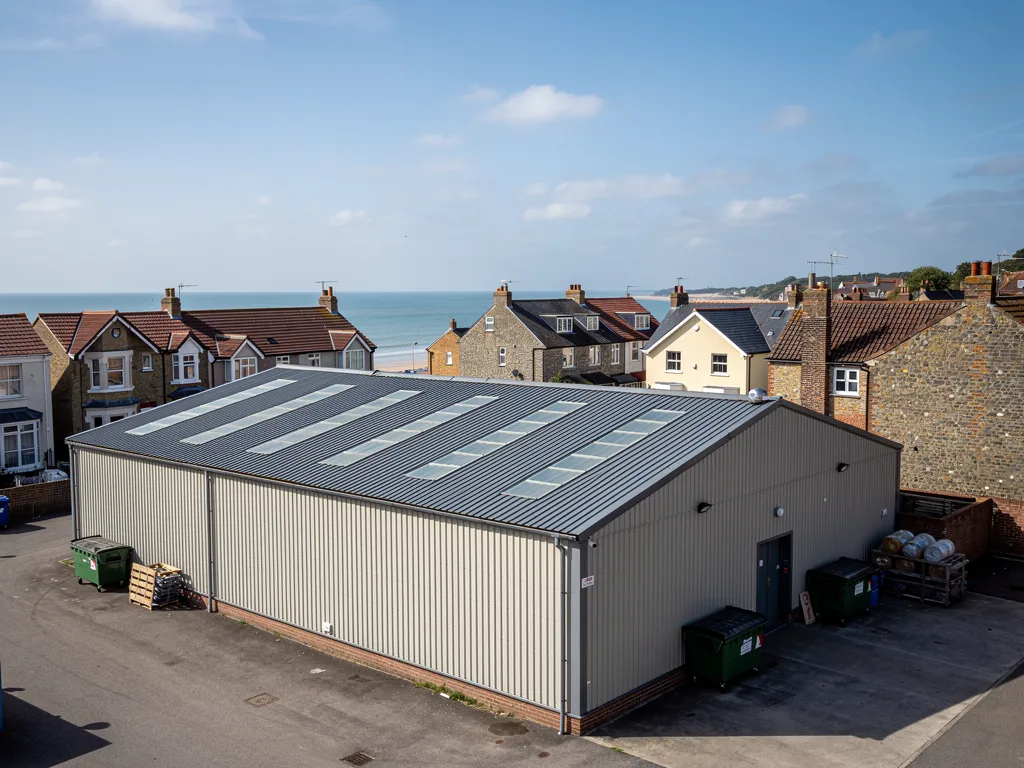
HSE's advice for a property that dates from before 2000, built or refurbished, is to presume it contains asbestos. For a commercial owner, that makes the question of asbestos part of choosing a roofer, not an afterthought. Asbestos cement sheeting is common on older sheds and workshops, and soffits on some buildings can contain asbestos insulating board, a different material that HSE treats as higher-risk work.
In HSE's categories, lifting asbestos cement sheets off carefully and intact counts as non-licensed work. Sheets that are substantially damaged or breaking up move the job into notifiable non-licensed work, where a notice goes in before the first sheet is touched. Most removal of insulating board is licensed work. Those categories matter to you because they decide who may do the job and how it is done. A contractor should be able to say which category the work falls into and who will carry it out.
What to ask a roofer about asbestos
- Has the roof been checked, and by whom? An asbestos report or survey answers it.
- If the material is asbestos cement, can it be overlaid with a non-asbestos covering instead of removed? HSE raises that option itself.
- If it is being removed, how will the waste be wrapped, labelled and carried away?
Asbestos waste has strict handling rules. HSE says to double-wrap and label it and to use a lockable skip for cement sheet, and anyone carrying construction waste should be registered as an upper-tier waste carrier, which you can check on the GOV.UK register. A contractor who is vague about all of this is giving you information about how the rest of the job will go. Our page on industrial asbestos roofs goes through the options.
Guarantees: who stands behind the finished roof
Roofing guarantees come in different kinds, and a business owner should know which one is on offer. A workmanship guarantee covers the quality of the installation: how the sheets, flashings and seams were put on. A manufacturer warranty covers the product itself, such as a membrane or a coated sheet, against defects in the material. They are not the same thing, and one does not cover the other. A product warranty also says nothing on how long a roof will last, which depends on exposure, installation and upkeep.
When you are given a guarantee, read three things. First, who gives it. A promise from the contractor is only as good as the contractor's ability to honour it years later. Second, what it covers and what it leaves out, since many exclude storm damage, movement of the building, damage by other trades and any roof that has not been maintained. Third, what you have to do to keep it valid, which is often an inspection or a clear gutter run once or twice a year.
The term and the wording are the parts worth comparing between contractors, since no single one settles a choice.
Lifespan is not a guarantee
Typical lifespans are ranges, not promises. MyBuilder gives 15 to 30 years for flat roofs generally, and the real figure depends on the covering, the detailing and the maintenance. A roofer who tells you a roof will last a fixed number of years is selling you a prediction. Ask instead what the roof is built to resist and what inspection pattern will keep it healthy. Our page on commercial roof maintenance plans covers that side.
References you can visit, not testimonials you must trust
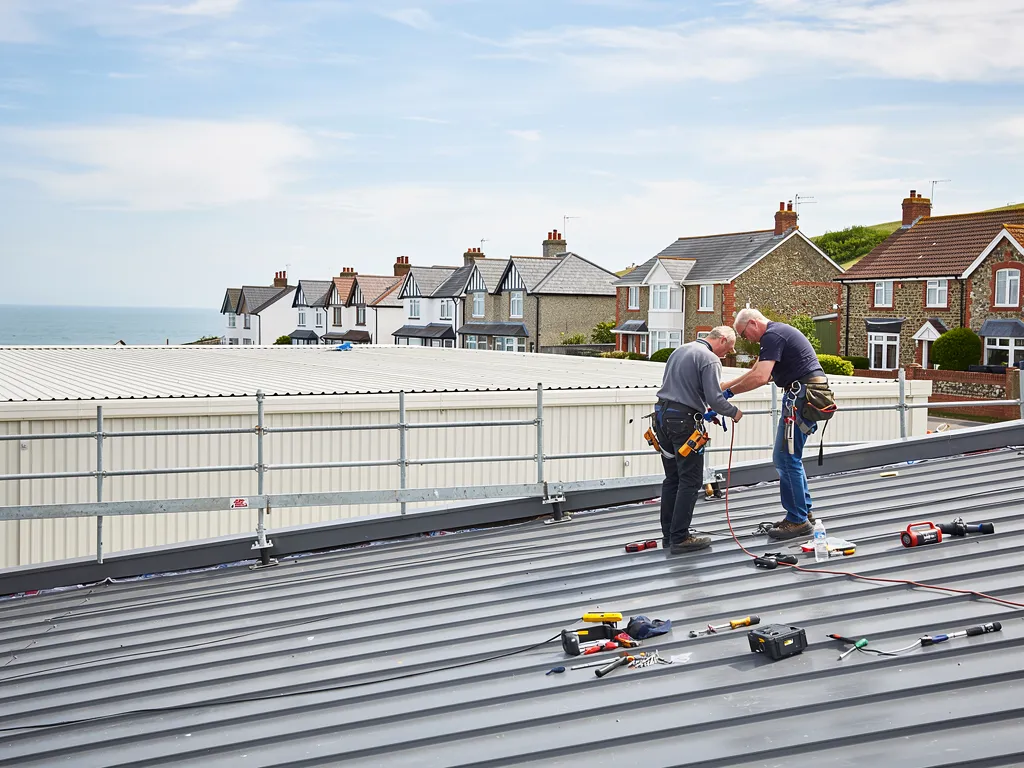
Any contractor can quote a happy customer. What helps you is a finished roof you can look at, ideally of a similar kind to yours and a few years old, with a name you can ring. Ask for two or three addresses of comparable commercial roofs and, if the owners are willing, for a contact. Then use them. A short call tells you whether the programme was kept, whether the site was left clean and whether the roof has needed attention since.
Ask the owner specific things. Did the contractor turn up when they said? Was the roof kept watertight overnight while the old covering was off? Did the final account match the quote? Was anyone hurt or nearly hurt? Were their staff and customers kept clear of the work? Those questions get honest, detailed replies, where a general one gets a general nicety.
Look at the work, not the paperwork
If you can see a finished roof, look at the details that fail first. Check the laps and fixings, the flashing at walls and upstands, the way outlets and gutters are connected and the tidiness of the edges. Neat details usually mean careful installation. Messy sealant, patchy flashing and inconsistent fixing are worth noting.
Be wary of anything that presents itself as proof but cannot be checked. A logo on a van, a list of names on a website or a handful of unattributed comments says very little. Rules on fake reviews have been in force since 6 April 2025 under the Digital Markets, Competition and Consumers Act 2024, which is one more reason to trust things you have seen yourself over things you have only read.
We would rather you looked at a finished roof and spoke to its owner than took our word for the quality.
Reading the quote and the terms before you sign
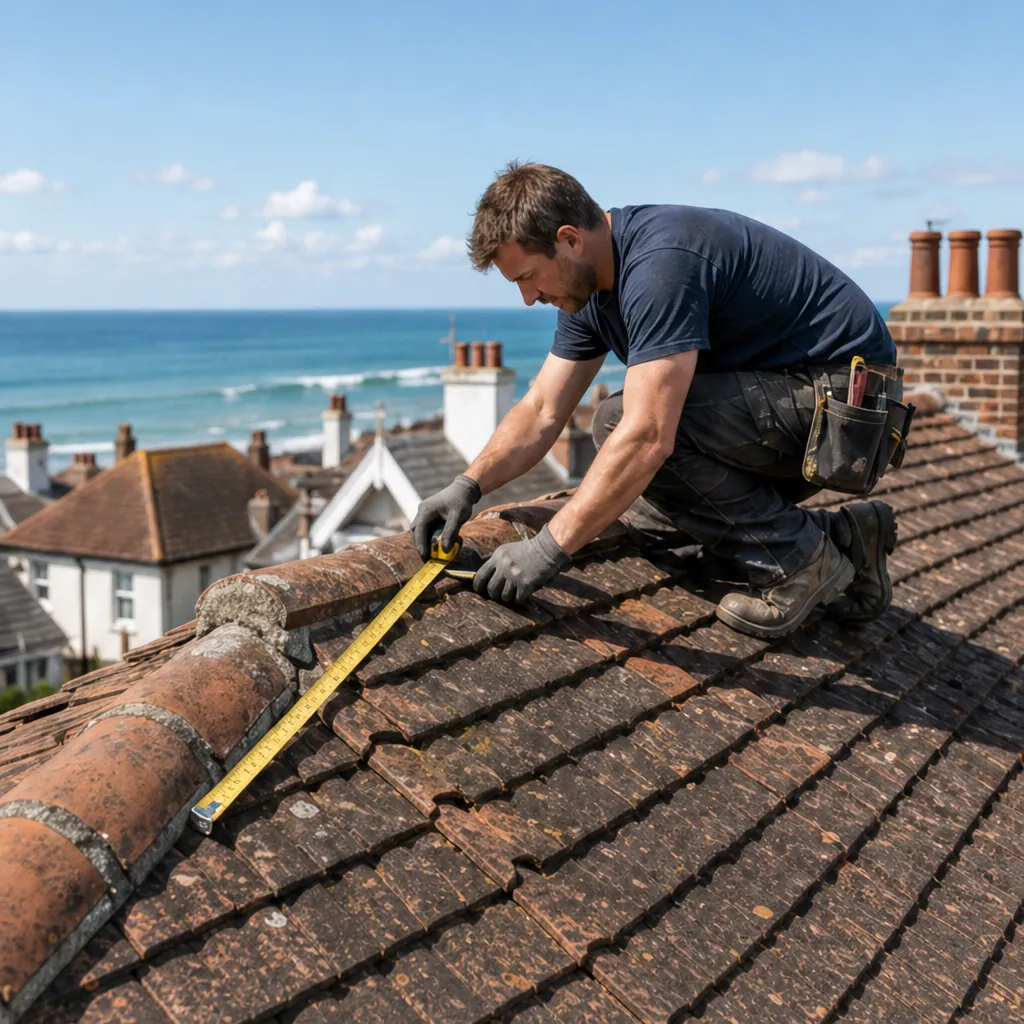
With the answers to the earlier questions in hand, the quote becomes easier to read. The first thing to check is what the price covers. It should describe the covering, the insulation if there is any, the access arrangements, the removal and disposal of the old material and the time the job is expected to take. Ask whether it includes VAT and whether it includes scaffolding, because a quote without either can look cheaper than one with both. Our page on VAT on commercial roofing covers how the rate applies.
Then look for the gaps. What happens if hidden damage is found when the old layer comes off? How will any extra work be agreed, and in writing? How are payments staged, and what has been done at each stage? What is the plan for keeping the building weathertight overnight, in rain, if the job runs over? A clear answer to each is a good sign. Silence on any of them is a risk to your budget.
Compare the plans, not only the totals
Two prices for different jobs cannot be compared. If one roofer plans an overlay and another a full strip, the totals reflect different work. Ask each to explain the difference, and ask what the survey found that led to the choice. If a quote turns up without a visit, treat it as a rough guide at best.
The roofer you want gives you a written quote after the survey, shows photographs of your roof, explains the method and tells you plainly when a smaller job will do. Send us the building address and a few photographs through the quote form, and we will arrange to look at the roof. Our page on roofing systems for warehouses, workshops and offices sets out the options we are likely to discuss.