
Question answered
Blocked outlets on a commercial roof
The short answer
A blocked outlet on a commercial roof stops rainwater leaving, so it backs up, ponds and spills over the nearest low point or upstand, often into the building. Outlets block with leaves, silt, moss, nest material and debris from other trades. Clearing them is the first fix. If water still stands afterwards, the fault is in the falls and needs a survey.
A blocked outlet turns a flat roof into a shallow tank. Rain has nowhere to go, and the water finds the weakest edge, joint or upstand to leave by.
How an outlet fills and what the water does next
An outlet is the hole that drains the roof. It is often covered by a grate or a domed guard that stops big debris entering the pipe. That same guard catches leaves, silt, moss, feathers and anything dropped by contractors, and once it is half covered, the flow slows. In a heavy shower the roof then fills faster than it empties.
The water rises until it reaches something it can pass. On a flat roof that is often the junction with a wall, the lap of a membrane or a rooflight upstand. Seams and details are the parts of a covering designed for normal drainage, not for holding a depth of water against them.
Inside the building the first sign can be a stain on a ceiling tile after rain, usually some distance from the real fault. Tracing the way in starts on the roof with the outlets, because a blocked one is the quickest cause to rule out. The sources of debris are often obvious once you look up, such as an overhanging tree or a roost above a parapet; see bird proofing a commercial roof.
Ponding after the outlet is clear
Clearing the outlet answers one question. If puddles remain a day or so after rain, the problem is not the blockage. It is the falls, the gentle slope that carries water to the outlets. IKO, citing the 2018 edition of BS 6229 (since revised), gives 1:80 as the minimum finished fall on a flat roof, and says the design should aim for 1:40 so that tolerances and deflection do not eat the margin.
That design figure is the gap between a roof drawn on paper and one built on site. Decking sags, joists deflect and laps add thickness, so a roof designed to the minimum can end up with hollows. A hollow holds water, and standing water leaves a tide mark of silt and attracts moss.
Persistent ponding is a survey matter. The options range from local re-sloping to a new covering over tapered insulation, depending on the structure underneath. Repeated ponding also bears on the system's cover, as manufacturer warranties explains.
Where the water goes when the main outlet fails
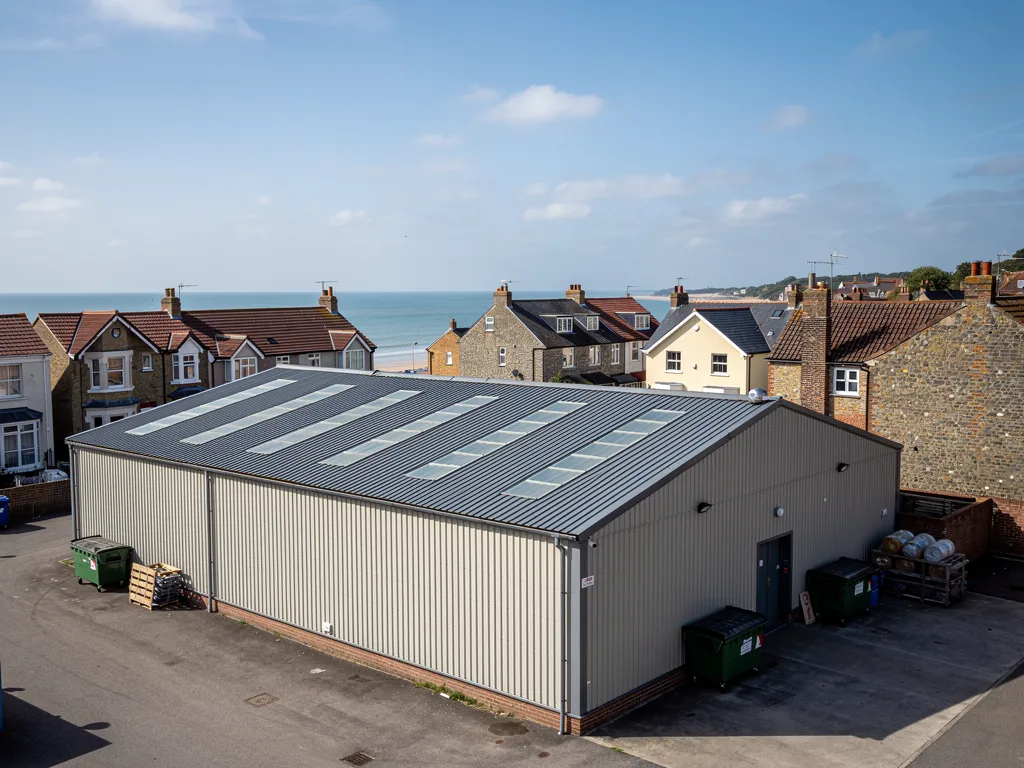
A roof edged by parapets has no eaves to spill over. Every drop must leave through an outlet or a scupper, which is an opening through the parapet wall. If the only outlet blocks, there may be nowhere else for water to go except into the building through a joint or over a threshold.
That is why a second route is worth asking about. A roof can carry an overflow outlet set slightly higher than the main one, so a blockage shows itself as a visible discharge on the outside wall before water reaches the finished interior. Whether yours has one is easy to spot from the roof, and its absence is something to raise at the next survey.
Look at the whole path as well as the grate. A clear grate over a blocked pipe still floods a roof. Tracing the run down to the main drain, where that is reachable, completes the picture.
Gutters on industrial units and shop fronts
Many commercial buildings drain to gutters rather than outlets, including pitched metal units and canopies. The same logic applies. A gutter that cannot clear a downpour spills over the front or the back, and if it spills behind, water runs into the wall or the eaves. Box gutters tucked behind a parapet cause the most surprises, because nobody sees them fill.
Fall and fixing matter. Makers of plastic systems suggest a slight slope towards the outlet, somewhere between 1:600 and 1:350 depending on the system, and Brett Martin wants its brackets no more than 900 mm apart. A run that has dipped between brackets keeps a pool of water even when it is perfectly clear.
A sagging line is often a sign that something has been loaded or that the brackets have fatigued. The condition of the whole run, not only the blockage, is what a survey notes. Longer-term, the state of the drainage also shapes how long a commercial roof lasts.
A clearing routine that fits the building
The right frequency depends on the building. A roof under trees or beside a roost needs more attention than a clean, open one. As a rule, check outlets after storms and before the leaf-fall months, and write the date down. Photographs before and after show whether a problem is building up.
Access is the real hazard. Clearing an outlet means walking the roof, sometimes near an edge or across a fragile surface. Read fragile roof safety before anyone goes up, and never send a member of staff up without edge protection and a plan.
Budget for the clearing as routine upkeep rather than a repair. If the work is done under a maintenance contract, ask about VAT treatment; the page on VAT on commercial roofing sets out the basics. After any visit, ask for photographs of each outlet, because they give you the evidence if a leak does appear. If outlet clearing is part of a wider package of commercial roofing upkeep, agree the frequency in writing so nothing slips between visits.
Outlets, puddles and cover: a pair of answers
How can I tell whether ponding is a blockage or a fall problem?
Clear the outlet first and watch the next rain. If the roof drains and the puddles go, it was the blockage. If water still stands a day or so later around the same spots, the falls are the cause and a survey should record where. Photographs after rain are the most useful evidence.
Is a blocked outlet covered by a roof warranty?
Do not assume it is. Many warranties expect the owner to keep drainage clear, and standing water caused by a blocked outlet may sit outside the cover. Read the terms, and keep dated records of clearances so a later claim has a clear history behind it.
Tell us about your roof
Describe what is happening and we will call you back to arrange a visit.
- Photographs of what we find
- A written quote with one total price
- Or call 01903 299063
10-year workmanship guarantee, in writing.