GRP stands for glass-reinforced plastic, and it is better known as fibreglass. On a flat roof it is not delivered as a finished sheet. The roofer lays glass matting on the deck, soaks it in liquid polyester resin, and the resin sets hard to leave a rigid, waterproof shell with no overlaps. A coloured topcoat finishes it. Because the covering is made in place, it follows the shape of the roof, round corners, up kerbs and across a balcony, with no seam to seal.
That strength is also the source of its weakness. A cured GRP shell is stiff, so it does not stretch the way rubber does. If the timber below moves, the shell above has to take it, and the result can be a hairline crack along a board joint. Understanding that one trade-off explains most of what goes wrong with fibreglass roofs and most of what a careful installer does to prevent it.
This guide follows the work from deck to topcoat, looks at the weather the job needs, and sets out what GRP costs and how long it lasts. Our flat roofing hub has the wider picture, and the comparison of torch-on felt shows the traditional alternative.
What goes into a fibreglass roof
Three ingredients make a GRP roof. The first is the glass matting, a mat of short glass strands that gives the finished layer its strength. The second is the resin, a liquid that is mixed with a hardener or catalyst just before use and that cures into a solid. The third is the topcoat, a pigmented layer on the surface that gives the colour and takes the weather and the wear.
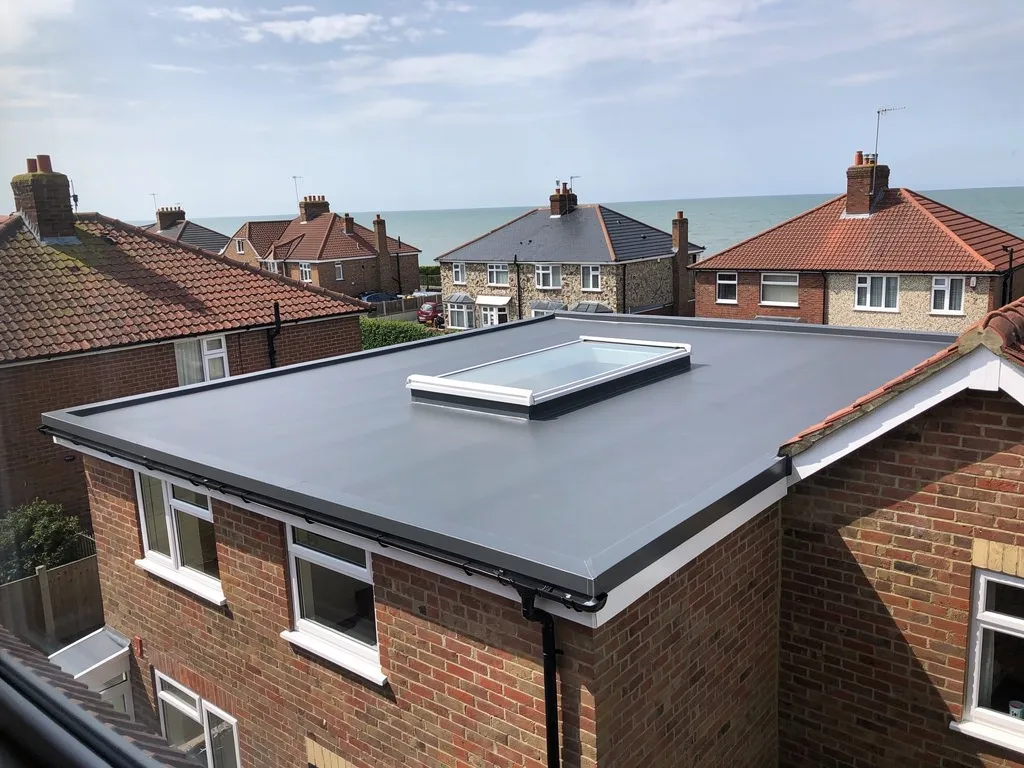
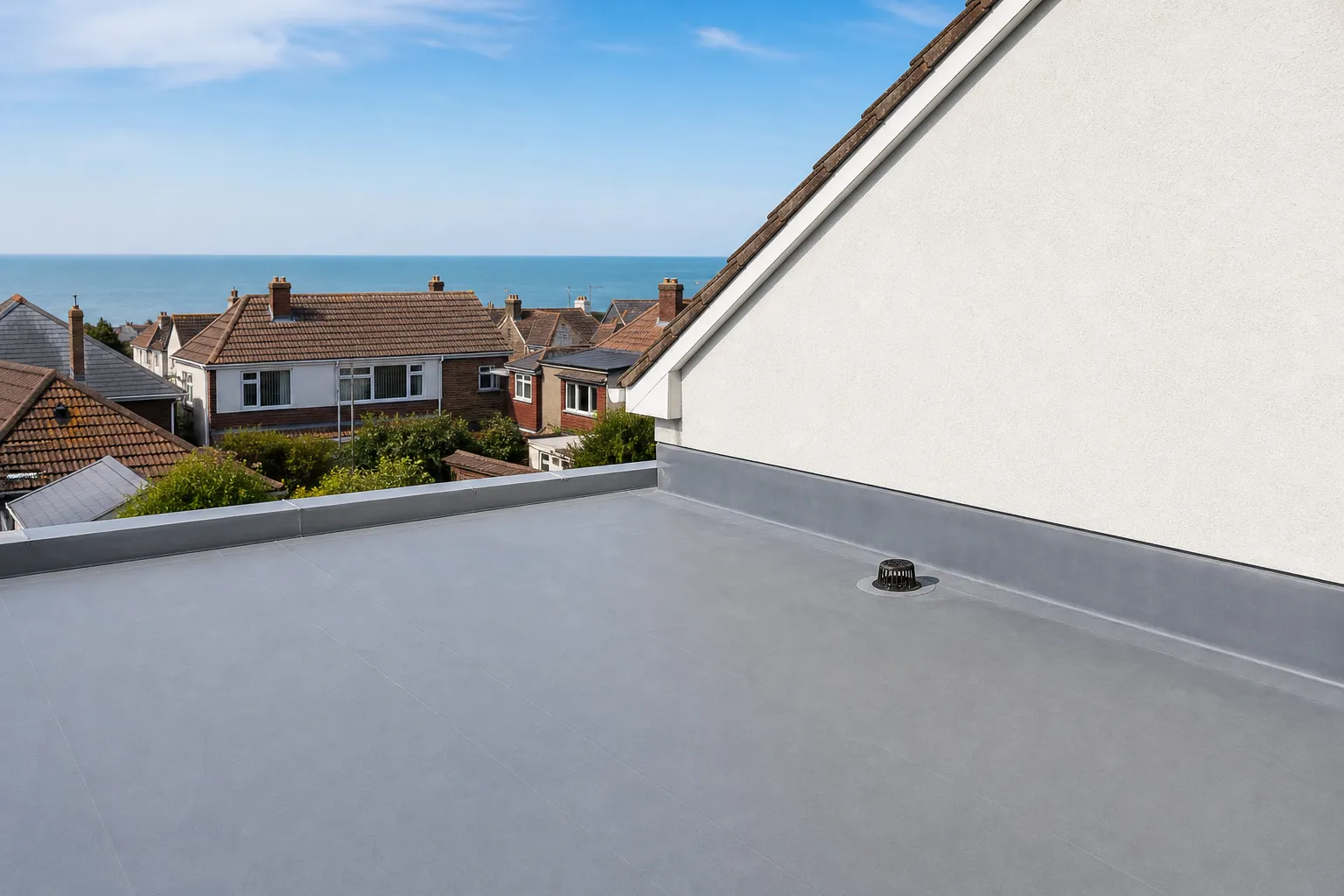
Once cured, the matting and resin form a laminate, one continuous skin fixed to the deck. It has no overlaps and no tape, so there is nothing to peel at an edge. That continuity makes it a natural choice where the roof has a complicated outline, such as a balcony with a rail post, a dormer cheek or an extension roof with a rooflight kerb in the middle.
The finished surface
The topcoat is smooth and can be tinted, with greys and slate tones the commonest. Fine grit can be added for grip on roofs that are walked on, and for a balcony this is a sensible addition. The surface is hard-wearing, though a sharp object dropped on it will chip the topcoat and it is worth repairing a chip promptly before water finds the laminate beneath.
Typical UK pricing for GRP, according to MyBuilder's flat roof cost guide (updated 21/08/2026), is £95 to £150 per m². Its garage roof guide gives around £125 per m². That puts it above felt and level with or slightly above EPDM, and for how the two compare, see our guide to EPDM rubber roofing.
Laminating: the sequence on site
A GRP job follows a fixed order, and each step depends on the one before it.
Deck and preparation
The deck must be sound, flat, clean and dry. Boards that are rotten or springy are replaced, because the laminate will crack over movement. Board joints are made tight and level, and many installers lay a tape or a strip of matting over them. Water has to drain, so the falls are set at the design stage. IKO, citing the 2018 edition of BS 6229 (since revised), gives a design fall of 1:40 for a finished minimum of 1:80, and GRP needs a roof that drains because a pool of water sitting on resin shortens its life.
Trims and edges
Before any resin goes down, the edge trims go on. A drip edge at the eaves sends water into the gutter, and a trim along the open edges gives the laminate a clean termination. Fillets, small angled strips, are fixed where the deck meets a wall, so that the matting turns the corner in a curve rather than a sharp fold that could crack.
Resin, matting and topcoat
The resin is catalysed and brushed or rolled across the boards, then the matting is pressed into the wet resin and rolled to drive out air. A second coat of resin saturates the matting from above. Once that coat has cured, any rough spots are cleaned off and the topcoat goes on. Done properly, the laminate should look even, with no white dry patches where the matting has not been wetted.
The work is skilled and cannot be hurried. Resin mixed for one patch is used within minutes of mixing, and the installer works in small areas so that each batch is applied before it begins to gel.

Weather and curing: why timing matters
Fibreglass roofing is more weather-dependent than any other flat roof covering, because the resin is chemistry that happens on the roof itself. It needs a dry deck, dry matting and a dry sky while it cures.
Rain on uncured resin can spoil the surface, leave it cloudy or stop it bonding. Cold slows the cure and can leave the resin tacky and weak, while hot sun can make it set faster than the installer can work it. Damp in the deck is a quieter problem, because moisture trapped beneath the laminate can blister it later. That is why careful installers watch the forecast, cover the work if showers threaten and are ready to stop and pick up another day. In a seaside town where weather turns quickly, a firm that insists on the right conditions is acting in your interest, even if it delays the start.
Early morning dew and sea mist can leave a deck damp when the day looks clear, so the deck is checked before work begins and not assumed dry.
What cured means
The roof is not ready the moment the surface feels hard. The installer will tell you when it is safe to walk on and when it has fully cured, and you should keep foot traffic off until then. A topcoat applied too early over uncured resin can trap solvent and leave a soft finish.
Ask any installer how they handle a forecast that turns, and what they do with a half-finished area. The answer tells you how they work.
Cracks, blisters and other common faults
Because the shell is rigid, GRP faults tend to follow a handful of patterns, and recognising them helps you tell a minor blemish from a roof that needs attention.
The most familiar is the straight crack that runs along a board joint, often in a line across the roof. Timber moves with moisture and temperature, and when the boards underneath shift, a stiff laminate cannot take the movement. Cracks also form at the junction between roof and wall, where the roof moves one way and the wall another, and at the corners of a rooflight kerb. A crack that is only in the topcoat can be dressed and recoated, but one that goes through to the matting lets water in and needs a laminate repair.
Blisters and bubbles
A blister is a raised bubble in the surface. Small ones, caused by air trapped as the resin went on, are cosmetic. Larger ones can mean moisture or fumes pushing up from below. If a blister is soft or it weeps when pressed, water is already inside.
Fading and wear
Strong sunlight dulls the topcoat over the years. A dull surface is usually a cosmetic matter, though a worn topcoat leaves the laminate exposed, so a fresh topcoat is part of keeping the roof going. Chips and scratches from ladders and furniture should be repaired before they let water in.
None of these faults is peculiar to GRP, and all of them can be repaired. On any flat roof, the water has to be traced to its entry point before a repair makes sense, because it can run under the surface and appear a long way off. Our survey photographs of your roof show the cracks and the joints we found, so you can see them for yourself.
Lifespan and what affects it
Published lifespans for GRP are generous. Less (March 2026) puts it at 25 to 40 years, and CORC says it can last 25 years or more. As with every covering, those are typical ranges and not promises, and a manufacturer's cover on the resin says nothing about workmanship. Ask any roofer what they will put in writing about the laying, the edge trims and the upstands.
Several things move a roof towards the short or the long end. The quality of the deck is first, since movement is what cracks a rigid shell. The installation conditions come next, because resin laid in damp or cold weather is weaker. The topcoat's condition matters, as does whether the roof is walked on and whether the outlets are kept clear so that water does not pool. Regular checks catch a small crack before it grows into a leak.
Warm and cold roofs under the GRP
The resin is only the weatherproofing. What sits beneath it affects both comfort and condensation. In a cold roof, the insulation fits between the joists and a ventilated void sits above it. A warm roof puts the insulation over the boards, directly beneath the covering. Which of the two is right for your house is the subject of our guide to warm and cold flat roofs.
Under Approved Document L a replacement flat roof membrane renovates a thermal element, and above 50% of the surface the whole element is expected to reach the 0.16 W/(m²·K) improved value. The insulation question therefore often arises during a re-cover. We deal with the Building Regulations notification where the work is notifiable.
Where GRP suits, and what else to weigh
GRP earns its place where the roof is awkward, walked on or visible. Balconies, dormer tops, bay roofs, extension roofs with several upstands and small areas where felt laps would be fiddly all suit a continuous laminate. It also suits a roof that will carry a deck or paving on supports, since the shell is hard enough to take the load, though the structure beneath must be checked for the extra weight.
It is less happy on a deck that moves a lot, such as a large span of thin boards or an old extension whose timber has not settled. In those cases a flexible membrane may serve better. Our page on the drawbacks of EPDM sets out the other side of that argument, so you can weigh both fairly.
Cost and quotes
MyBuilder's typical UK range for GRP is £95 to £150 per m², and the bill depends on area, access, the state of the deck, trims, rooflights and insulation. A first-floor roof needs scaffold, which MyBuilder puts at around £850 to £1,200 for a standard two-storey house, so see that scaffold and VAT are covered in whatever quote you hold. A re-roof attracts VAT at 20%, while the insulation element may be treated differently depending on how the work is supplied, which the written quote explains.
When you compare quotes, ask which resin and topcoat system is used, how board joints are treated, and what the plan is if the weather turns mid-job. Those questions tell you more than the bottom-line number does.
To get a view on your own roof, tell us what you have now and how it is used, and we will suggest whether GRP, EPDM or felt fits it.