Gutters are easy to forget because they only work when it rains, and by then you are indoors. A clear gutter takes water from the roof edge and sends it down the pipe. A full one holds it, and the weight of wet debris pulls on brackets, bows the run and tips the water over the front or the back. The back is worse, because the overflow runs down behind the fascia board and into the soffit and the top of the wall, where it can sit unseen.
How often you need to clean depends less on a calendar than on what is around the house. A house under a tree sheds into its gutters all autumn. A house on an open road with a clean roof might go longer. A roof in shade grows moss that washes down in lumps. A flat-roofed extension with a small gutter can fill in a single storm.
This guide sets out a sensible rhythm for the year, what the seaside adds to the mix, how to do the job without risking a fall, and what a good clear-out should tell you about the roofline. It is one part of our gutters, soffits and fascias work.
A rhythm for the year
There is no single date that suits every house, but the year has two natural moments. The first is late autumn, once the trees have dropped most of their leaves. Clearing too early means doing it twice, because the last leaves arrive in the first gales of winter. The second is spring, when catkins, seeds and the winter's silt need to go before the roof sees heavy summer storms. Those two visits cover most houses.
Add a third look after any severe gale. Wind strips twigs and leaves from trees that are not even in your garden, and it can knock a joint loose or lift a bracket. It takes a few minutes to look from the ground with binoculars for sagging, overflow marks or debris sitting proud of the gutter edge.
When to go more often
Some houses need extra visits. A garden with conifers drops needles that form a dense mat. A silver birch or sycamore overhanging the roof can fill a gutter in weeks, because its seeds are small and sticky. Roofs of concrete tiles shed grit as they weather, and the grit settles at the low end of the gutter in a sludge. A hipped bungalow with short gutter runs and one outlet may fill faster than a long gabled run that has outlets at both ends.
A low-pitched or flat roof leaves less room to flush debris away, since the water moves slowly. In those cases check more often through winter and after every storm. If you cannot get a clear view from the ground, a long-handled camera or a drone survey can show the gutter without a ladder.
Watch for the warning signs between visits: water spilling over the front edge in rain, green or dark streaks on the wall below a joint, and plants growing in the gutter. Any of those means it is time.
What blocked gutters do to a house
Overflowing water is the obvious result, but the slower damage is what causes the bills. Water that spills over the front of a gutter lands on the ground beside the wall and splashes back on to the brickwork. Water that spills over the back runs behind the fascia into the roof edge. Either way, the timber and boards at the eaves stay wet for longer than they should.
That wetting is where soffits turn green and fascias soften. Paint blisters first, then the timber under it takes up water and begins to rot at the ends of the boards. On old buildings with asbestos insulating board soffits, a damp, flaking board is also a reason for care, as explained in our guide to asbestos soffit boards.
Weight, frost and failure
A gutter full of wet leaf mould weighs far more than the empty plastic or metal it hangs from. Brackets bend, the run sags between them and then water pools in the dip. In freezing weather the standing water turns to ice, which expands in the joints and splits them or pushes the run off its brackets. A gutter that was sound in autumn can be in pieces by February.
Damp in the wall is the other consequence. A house that is repeatedly splashed at one corner will show damp patches inside at skirting height, or peeling paint above a window where water has tracked sideways.
The cost of putting this right is much larger than the cost of regular cleaning. For the comparison, MyBuilder (updated 21/08/2026) gives a typical UK range of £30 to £70 per metre for guttering replacement. Our page on gutter replacement cost explains what moves the figure, and the same cost drivers apply to a whole roofline, covered in roofline replacement cost.

Coastal trees, grit and salt
A seaside house has its own list of gutter contents. Trees along the Sussex coast are shaped and stripped by the wind, and a gale in autumn or spring will tear off leaves and small branches that would stay put inland. Evergreens near the sea shed steadily through the year, so a gutter beneath one never really gets a quiet season.
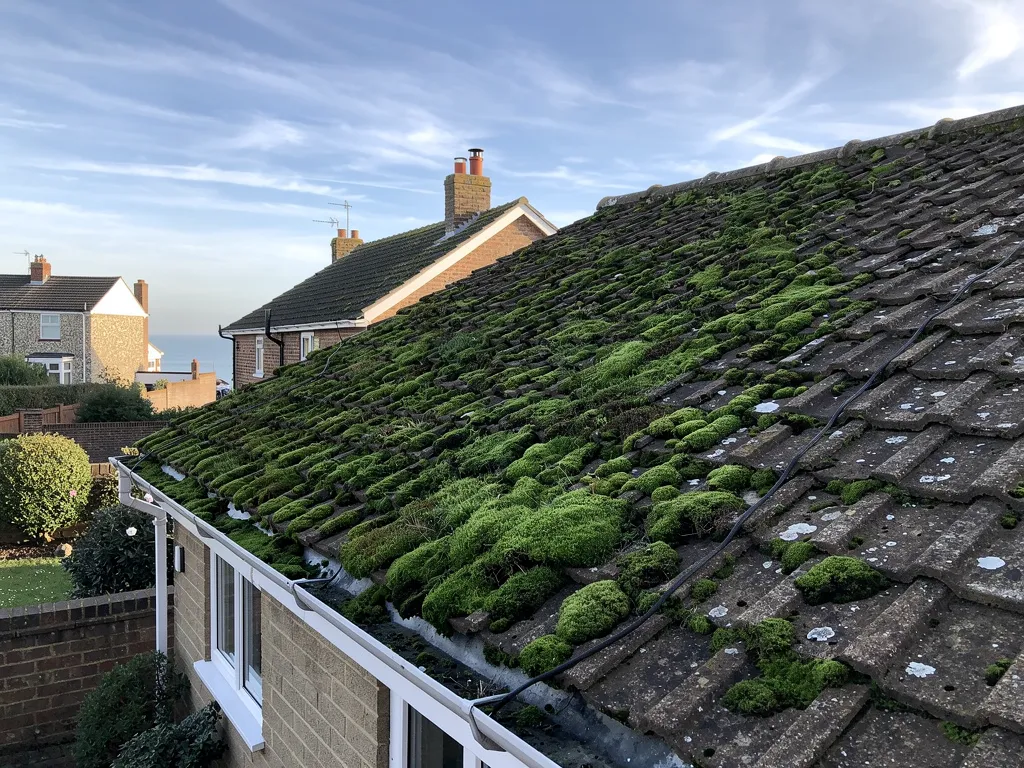
Wind also carries fine sand and grit from beaches, car parks and building sites on to roofs, where rain washes it down into the gutter. It settles into a silt that holds moisture, grows moss and seeds, and sets hard in dry weather. Gulls and other birds nest on roofs and use gutters as perches, leaving droppings and nesting material that mat together. Moss from shaded slopes, especially the north face, arrives in clumps after rain.
The salt layer
The air near the sea carries salt, and HomeBuilding points out that sea air leaves salty deposits on soffits and fascias, which sit too sheltered for rain to rinse them. A gutter under the eaves is a little more exposed to the weather, but the fixing brackets, the underside of the run and the joints collect the same crust. It is damp, mildly corrosive and shows as white bloom on metal and a dull film on plastic.
The practical answer is a rinse. After clearing the debris, run clean water along the gutter and over the bracket arms, and wipe the fascia and soffit with a damp cloth where you can reach. That keeps deposits from building into a layer that holds moisture against the paint. Our guide to salt air and the roofline says more on that.
If you are near a beach front or the harbour at Shoreham, check more often in autumn and again after storms with sea spray, since the buildup is faster than it would be a mile inland.
Doing it safely
The ladder is the real hazard in gutter cleaning, so plan the whole job around it. If you have any doubt about heights, do not do it yourself. A professional with proper access equipment is a sensible choice, particularly for a second storey or a roof over a conservatory.
If you do use a ladder, set it on firm, level ground and at a safe angle, with both feet resting evenly. Never lean it against the gutter itself: the plastic will crack and the ladder will slide. A stand-off arm that rests on the wall either side of the gutter spreads the load and keeps you clear of the gutter edge. Have someone foot the ladder, keep three points of contact at all times and do not carry buckets in your hand while climbing. Hang a bucket from a hook on the ladder instead and use a small trowel or gloved hand.
Things to avoid
Stay clear of overhead power lines and service cables, which often cross the front of a house. Do not stretch sideways from the ladder to reach further: climb down and move it. Keep off the roof. A fragile roof surface such as old cement sheeting or polycarbonate over an extension will not take your weight, as our guide to roof repairs and checks explains.
Wear gloves, because gutter silt can hold sharp grit, bird droppings and moulds. Eye protection stops debris flicking up as you scoop. Do not scrub old boards or scrape cement gutters on a pre-2000 building, since either could be asbestos, and treat them as suspect until identified.
Ground-based tools reduce the risk. Pole-mounted gutter vacuums and hose attachments reach upper gutters from below. They do not clear everything, but they keep your feet on the ground.
How the job is done properly
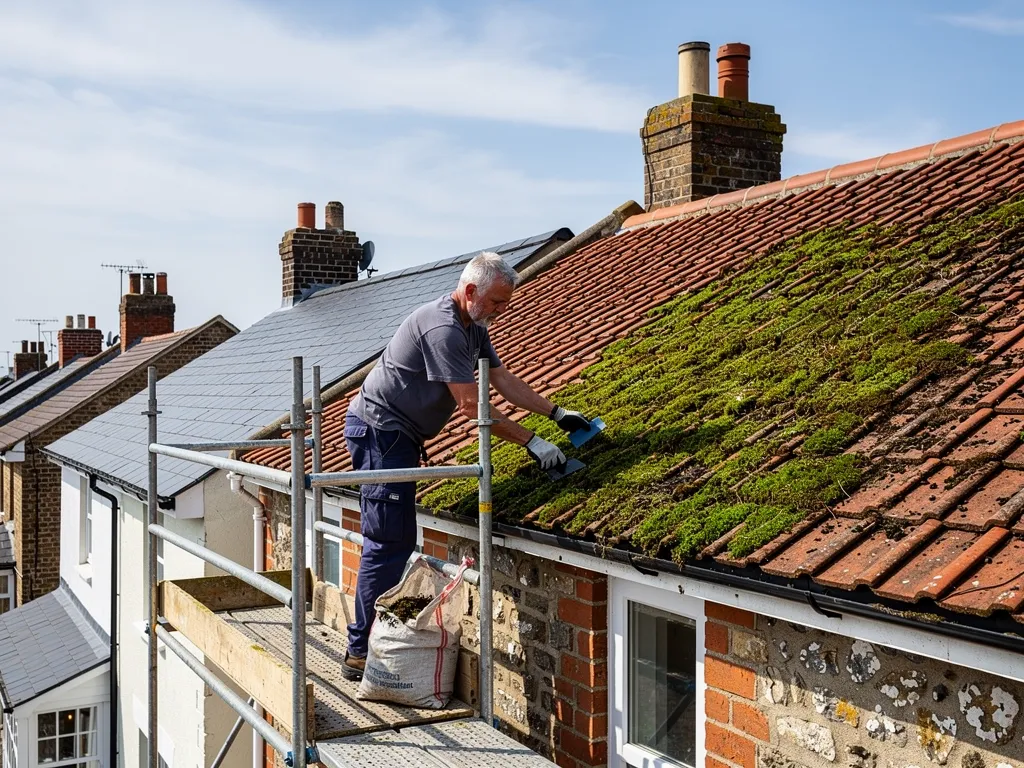
Cleaning is a sequence. Start at the end furthest from the outlet and work towards it, so debris moves with the water and you do not push it into the pipe. Scoop the bulk out by hand into a bucket or a bag, then scrape the residue from the base of the gutter with a plastic scoop.
Once the loose material is out, flush the gutter with a hose, starting at the high end. Watch the water as it flows. It should run steadily towards the outlet without pooling. If water stands in a patch, the gutter has dropped or the fall has been lost, and cleaning alone cannot cure that. Guttering makers usually specify a shallow slope down to the outlet, roughly 1:600 to 1:350 depending on the system, which the eye barely registers.
The downpipe and the outlet
Do not wash debris into the downpipe and hope. Check the outlet is clear, then flush the pipe and watch the bottom to see that water leaves freely. A silted gully or a bend full of grit will back the whole system up. Our page on a blocked downpipe covers the steps if the water does not clear.
Bag the waste and take it away. Left on the lawn, it blows back into the gutter.
Some people fit gutter guards, which are meshes or brushes that sit in or over the gutter. They reduce the amount of leaf matter that gets in, but fine silt, seeds and moss still pass through or sit on top, so they cut the number of visits without removing the need to look.
What a clear-out should tell you
The best reason to clean thoroughly is that it gives you a close look at the whole roofline. As you work along the run, check the things that cleaning cannot fix. Brackets should be firm and evenly spaced. Brett Martin advises a spacing of no more than 900mm between supports, so a wider gap would explain a sag. Joints should be dry when you pour water through, and if one weeps, the seal has failed. The back of the gutter should sit tight against the fascia with no gap where water can slip through.
Look at the fascia boards as well. Paint that flakes in sheets, timber that is soft when you press it with a thumbnail and dark staining at the joints all point to long-term wetting. On the underside, check the soffit for staining, mould and cracks.
Cleaning, repair or replacement
A gutter that is clear and level but weeps at one joint needs a new seal or a new union. A run that has dropped needs rehanging or new brackets. A gutter that is cracked, brittle or rusted through in several places has run its course, and patching it only delays the bill. Where the fascia and soffit are also failing, doing the whole roofline at once costs less in access and scaffolding than doing it piece by piece.
We survey the roofline and photograph each fault, so you see what we see. After the survey you receive one written total, and access, length of run and our findings decide where it lands. Where a replacement section is needed, it is fitted with the correct fall towards the downpipe and the mess is cleared as we go.
If you simply want a clear-out, send us a photo of the gutters and tell us the height of the eaves. We will say what the job involves and whether anything needs repairing.