The cost to replace fascias, soffits and guttering comes down to two things: how many metres of roofline your house has, and how high the scaffold has to go. National price guides quote each part by the metre. That is useful once you know your own length and not much use before.
MyBuilder (updated 21/08/2026) gives a typical UK range of £80 to £150 per metre for fascia, £100 to £180 per metre for soffit and £30 to £70 per metre for guttering replacement, and a combined figure of around £150 per metre when fascia and soffit are fitted as a pair. Those are national averages from a third-party guide, not Watertight prices.
Below, we turn per-metre figures into a sum for a real house, explain what the scaffold adds, list the things that move a price up or down, and say what to check on any quote you are handed. Our gutters, soffits and fascias service begins with a survey. You get photographs of the eaves as they are today, and a written quote giving a single sum.
What the per-metre ranges cover
Per-metre pricing exists because a roofline is a long, thin job, and the cost grows in a straight line with its length. Each metre of old fascia comes off and each metre of new board goes on, while the soffit beneath it and the gutter in front of it follow the same line. Cost guides therefore list the parts one at a time.
| Part of the roofline | Typical UK range per metre |
|---|---|
| Fascia board | £80 to £150 |
| Soffit board | £100 to £180 |
| Fascia and soffit together | around £150 |
| Guttering replacement | £30 to £70 |
Source: MyBuilder, updated 21/08/2026. Read the combined figure with care. It is lower than the two separate ranges added together, so treat it as a rough centre and not a ceiling. A plain white uPVC job on a low, easy roof will sit towards the bottom of each range. Timber, coloured finishes and awkward heights push towards the top.
What a metre includes
A metre of fascia means the board, its fixings and the fitting. A metre of soffit means the panel that covers the underside of the overhang, plus any vents set into it. A metre of guttering covers the channel, the brackets and the joints, and downpipes are normally counted separately. Whoever quotes should be able to say which of these their total includes.
On the same guide, fascias and soffits are normally replaced after 10 to 20 years. That makes the spend a long-term repair to the roofline, which is a good reason to get the board, the vent and the gutter right in a single visit.
From metres to a figure for your house
The sum itself is simple. Walk round the house with a tape and measure each eaves run, which is the horizontal edge where the roof overhangs the wall. Add the lengths together, then multiply by the range. Two worked examples show the scale. They are arithmetic on the published figures, not houses we have priced.
Twenty metres of fascia and soffit at MyBuilder's figure of around £150 per metre multiplies out to £3,000. Twenty metres of guttering at £30 to £70 per metre comes to £600 to £1,400. A longer run scales up in the same way, and a shorter one scales down.
Why house shape changes the length
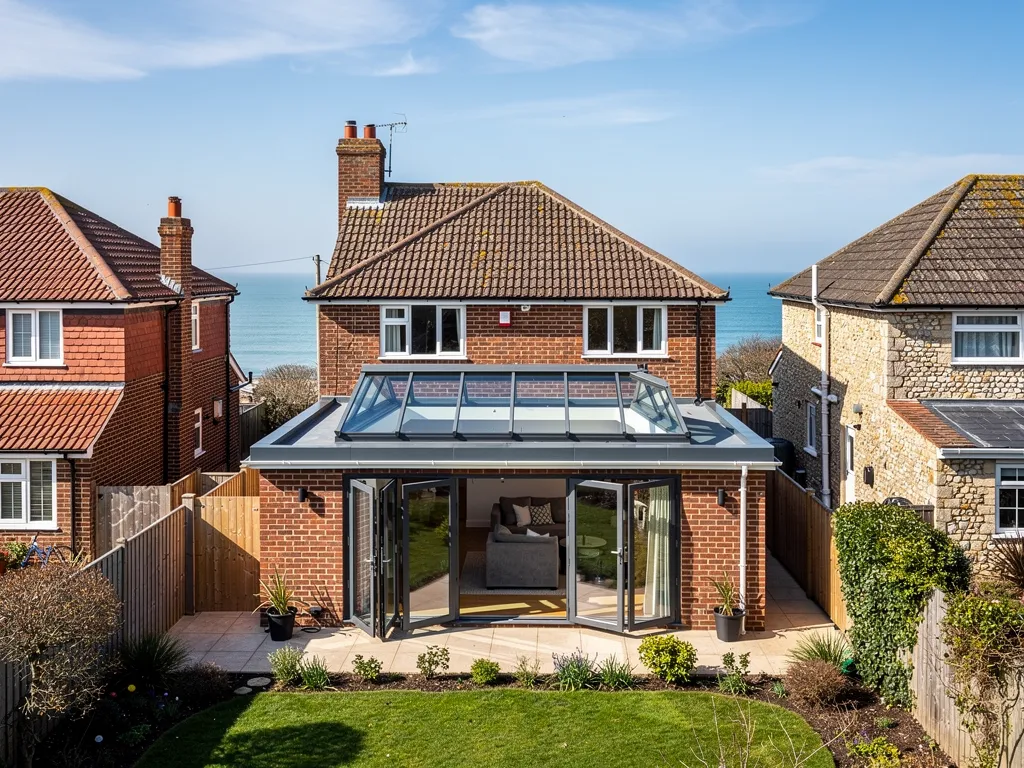
A gable-ended house has eaves on two sides only. A hipped roof overhangs on all four, so the same floor area carries more fascia, more soffit and more gutter, with corners to turn at each hip. Hipped roofs are common on the coast's bungalows, so measure all the way round rather than guessing from the front elevation.
A terrace is different again. The runs are short, but the gutter is often shared at the party wall, and the work has to be agreed with next door. Any shared run needs checking at the survey.
Height matters as much as length
A single-storey eaves can often be worked from a low platform. A three-storey end of terrace cannot. Height decides whether the job needs scaffold, and scaffold is the largest single item on many roofline quotes, which is what the next section looks at.
If you want a rough check before anyone visits, measure the runs with a tape or a measuring app, note the number of storeys, and send us a few photographs of the eaves from the ground.

What scaffold adds to the bill
Taking a full run of fascia boards off and putting new ones on from a ladder is slow and awkward, and above bungalow height it is not sensible. Boards are long, they have to be held level while they are fixed, and the old ones come off in awkward lengths. Most two-storey roofline jobs therefore go up on scaffold, and the scaffold has a price of its own.
On scaffold, MyBuilder (updated 21/08/2026) quotes around £850 to £1,200 for a typical set-up on a home of two storeys. Checkatrade's October 2026 guide instead gives a monthly hire figure of around £875 for a semi. The two guides measure the job differently, which tells you that scaffold prices vary with the hire period as well as the house.
Why one visit is better than three
Fascias, soffits and gutters all sit in the same strip of wall, so they share the same scaffold. Replace the gutters one year and the fascias the next and the scaffold is paid for twice. Doing the whole roofline in one visit also means the new board can be fitted behind a new gutter, with the soffit vent and the tile overhang set correctly at the same time.
The scaffold licence
If the scaffold stands over the pavement, a licence is needed before it goes up. The scaffold firm arranges it with West Sussex County Council (the city council in Brighton and Hove), and the county asks for 10 working days' notice at least. A street with no driveway may therefore wait longer than a house with its own forecourt.
When you compare quotes, check whether scaffold is in the total price and whether VAT is.
What moves the price up or down
Past length and height, a handful of things shift the number, and none of them can be read from a price guide. Most of them become clear only once the old boards are off, which is why the survey looks for them first.
Material and finish
White uPVC is the usual starting point. Coloured and woodgrain finishes, aluminium and cast iron cost more per metre. Each has its own strengths, and the survey can talk you through the choice for your house.
What is behind the board
The fascia hides the rafter ends and the eaves. If water has been running behind a failed gutter for years, the timber underneath may need cutting back or replacing before new boards can go on. A survey can see signs of this from the ground and the loft, but only the removal of the board confirms it.
Old soffits
Soffit boards on older houses can be asbestos insulating board. HSE names external soffits as a place asbestos turns up, and it advises assuming asbestos is present in a house built or refurbished before 2000. Leave old soffit board unbroken and undrilled. Our guide to asbestos soffits explains what happens next, and any such work changes both the method and the price.
Downpipes and drainage
Old downpipes are often cracked, loose or discharging against a wall. Replacing the gutter and leaving the pipe usually leaves the problem in place, so the quote should say whether downpipes are included.
Waste is the last item, and it is easy to forget. Old boards and gutters have to be taken away, and clearing the site is part of how we work.
Repair, clean or replace
The best-value fix is the one that properly solves the fault, and sometimes that is not a replacement at all. We advise doing the smallest amount of work that cures the fault, and the written quote explains why.
When a clean is enough
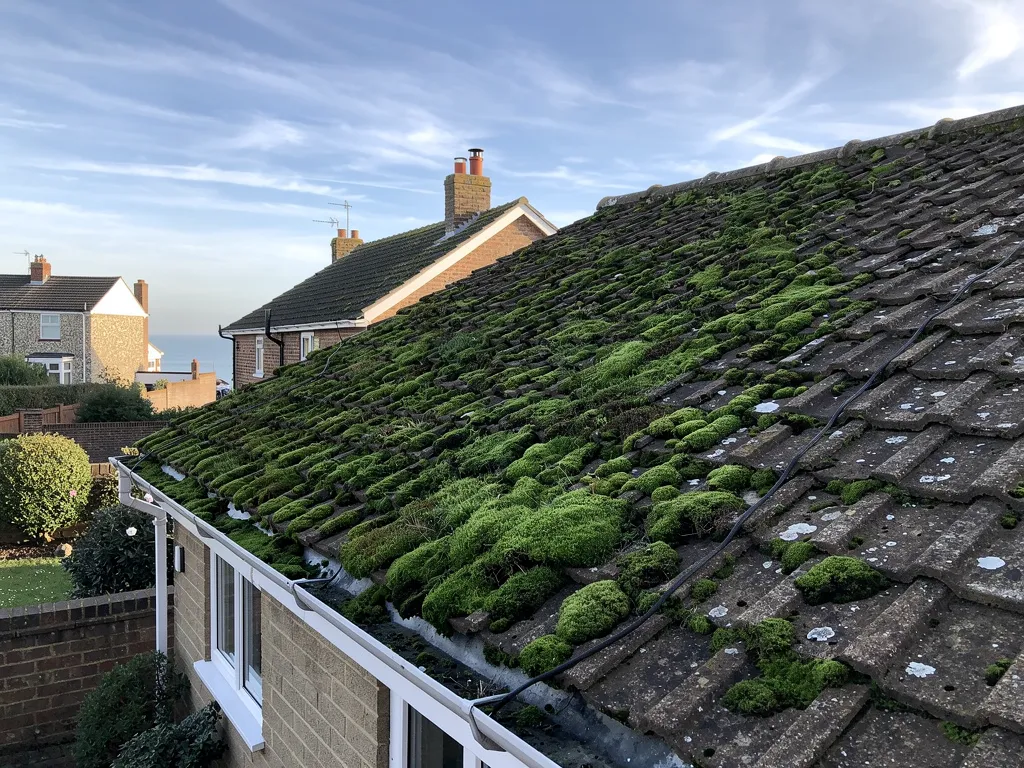
Gutters that overflow in rain are very often just blocked. Moss, silt and leaves in the channel can be cleared in a visit without touching the boards. Our guide to gutter cleaning covers how it is done and when it is due, so read it before pricing a full replacement.
When a repair is enough
A single leaking joint, a loose bracket or a short length of rotten board can be dealt with on its own, provided the timber behind is sound and the rest of the run is in decent order. Repair stops being sensible when the same fault keeps coming back in different places, or when several metres of board are soft.
When replacement is the better answer
Replacement makes sense when boards have split, warped or rotted along most of a run, when gutters have lost their fall, or when the roof is due a new covering in any case and the scaffold is standing already. Soft, flaking or split boards, and gutters that have pulled away from them, are the signs we look at first.
It is worth knowing how the roofline fits together before you decide, because a fault in one part often shows up in another. Our explainer on what fascias and soffits do is a good starting point.
Whether insurance responds to roofline damage depends on the cause and the policy. Our guide to gutter insurance sets out the questions to ask your insurer.
Reading a quote for roofline work
A good roofline quote is easy to read, and it should leave no doubt about what you are paying for. Our quote is on paper, comes after the survey and gives a single total, and your own eaves are photographed to go with it.
Whatever the source of a quote, a few checks are worth making before you accept it.
- Is VAT in the total or added afterwards?
- Is scaffold in the total, together with the scaffold licence if the poles stand over the pavement?
- Does it cover fascia, soffit and gutter, or only some of them?
- Are downpipes, stop ends, corner units and vents in the price?
- Is the removal of the old boards and gutters included?
- Does it explain the position should rotten timber turn up behind the old fascia?
Ask what the contractor will do if the rafter ends are soft once the fascia is off. A clear answer before work starts avoids an argument on the scaffold.
Prices from a national guide give you a sense of scale and nothing more. Your roofline will be priced on its own length, height, materials and condition. For the other half of the picture, see our page on the cost of replacing gutters, which covers the per-metre guttering range in more detail.
Photographs of the eaves, the number of storeys and a rough length are the best place to start a conversation about the survey.