Most roofline failures are slow. A gutter fills with silt over a few autumns, the water spills behind the board, the paint lifts along the lower edge, and three winters later the fascia is soft. Nothing in that sequence is sudden, and that works in your favour: a few minutes of looking each year catches the problem while it is still cheap to put right.
You do not need a roofer to start. Most of the checking can be done from the ground, with a pair of binoculars on a dry day and a note of what you see. The work that needs a ladder, such as clearing a gutter or probing a board, can be done safely only with the right set-up and a second person, and plenty of homeowners sensibly leave it to someone else.
Below is the routine we would follow on our own house: when to look, how to clear a gutter, what fascia damage looks like, what to check on the soffit, and when it is time to stop repairing. For the full picture of how the parts fit together, see our gutters, soffits and fascias hub.
A yearly routine that catches faults early
Two moments in the year do most of the work. The first falls in late autumn, after the leaves are down and ahead of the winter gales. The second is the spring, when the worst of the weather has been and any damage from it will show. Add a look after any severe storm, because a gale can lift a bracket or shift a length of gutter overnight.
Choose a dry, bright day and walk slowly round the house. Look up at each elevation from a few metres back, because a long, shallow view shows sags and gaps that a close look misses. A pair of binoculars, or your phone camera zoomed in, helps on a higher roofline.
Faults you can spot standing in the garden
- A gutter that dips, leans away from the wall or sits unevenly against the fascia
- Staining or dark streaks on the brickwork below a joint, a corner or a downpipe
- Vegetation growing from the gutter, which means silt has built up
- Paint that is flaking, bubbling or peeling on the fascia
- Soffit boards that look bowed, stained or open at the joints
- Water pouring over the front of a gutter in heavy rain, or down the wall behind it
Rain is the best inspector. Standing outside under a porch during a downpour shows you instantly where a gutter overflows, which joint weeps and whether the downpipe is coping. Make a note of each place and take a photograph, as the pictures help whoever puts it right.
Keep the notes from year to year. A small stain that has doubled in size since last autumn tells you more than any single look.
Clearing gutters without a fall
A clogged gutter is the most common roofline fault, and one that a careful homeowner can often deal with. The risk is the ladder, not the gutter, so it deserves a short plan before you start.
Setting up safely
Put the ladder on firm, level ground, tilt it at a safe angle and tie it off at the top where you can. A ladder stand-off keeps the weight off the gutter, which is not built to carry it and will crack or pull away from its brackets. Never lean the ladder on the gutter itself. If the eaves are higher than a ladder can reach comfortably, or you are not steady on one, this is a job for a professional with the right access.
The method
Work from one end towards the outlet. Scoop the debris out by hand or with a small trowel into a bucket, wearing gloves. Do not rake it into the outlet, where it will block the downpipe. Once the channel is clear, flush it with a hose to confirm that water flows to the outlet and runs freely down the pipe.
While the water runs, watch the joints and the bracket line. A drip at a joint or a puddle that stays after the flush tells you the fall or the seal has failed.
Check the outlet and the top of the downpipe by hand, since that is where leaves, moss and the occasional tennis ball lodge. If the pipe stays blocked, water backs up and overflows behind the fascia. A pipe that discharges at the wall base should drain away freely.
Gutter guards cut down the leaf load in some gardens, but they still need to be checked. Where trees overhang the roof, expect to clear more than once a year.
Signs of fascia damage
Fascia damage tells its story in a predictable order, and the earlier you read it, the smaller the fix.
Early signs
The first sign is usually paint. It lifts, flakes or goes dark along the lower edge and at the joints between boards, where water sits longest. Next the grain opens up and the timber takes on a spongy, grey look. On plastic, the early signs are different: discolouration, a chalky surface, and boards that bow or no longer meet cleanly at the corners.
Advanced signs
The screwdriver test is quick and gives a clear answer. Press the tip of a screwdriver gently into the underside or lower edge of a timber fascia. Sound wood resists. Rotten wood gives way, crumbles or feels like wet cardboard. Other advanced signs are boards that have split along the grain, nail heads that have worked loose, gaps between the fascia and the soffit, and a gutter that has begun to sag because the screws no longer bite.
Look as well at the ends of the boards. A corner joint that has opened lets water straight into the roof edge. Daylight, or a dark gap, behind the fascia is a bad sign.
Bear in mind that a failing fascia can hide a bigger problem. If the rafter feet behind it are wet, they can soften too, and that changes the job from a board swap to a carpentry repair. We look for that on every survey.
Our page on signs your fascias need replacing goes through the warning signs one by one, with the pros and cons of fixing each.
Looking after the soffit and the airflow
The soffit gets the least attention and is often the first to be forgotten. It hangs overhead and rarely draws a glance, yet it does two jobs: it closes the roof edge against weather and animals, and it lets air into the roof space.
What to check
Look for sagging, staining and open joints. A stained patch usually points to water coming from above, from a gutter leak or a defect in the eaves. A board hanging down, or a gap at the wall, lets wind-driven rain into the roof space and gives birds a way in. If you find nesting birds or bats, stop and take advice before anything is disturbed, as both are protected.
If the board has vents, check that they are open and not painted over. From inside the loft, you can see whether insulation has been pushed against the eaves and shut off the airflow. Marley's summary of BS 5250 gives a continuous 10mm opening along the eaves for pitches above 15° with a high-resistance underlay, and 25mm for pitches of 15° or less, so there should be a visible gap and not a wad of insulation.
Older boards and asbestos
Soffit board on an older house could be asbestos insulating board, and looking at it will not tell you. HSE names external soffits as one place it is found, and treats anything built or refurbished before 2000 as possibly containing it. Do not scrub, sand, drill or break old board, and do not pressure wash it. Our page on asbestos soffits explains the next step.

Repair or replace: where the line falls
People often expect replacement, yet repair frequently suffices, and replacement only becomes the answer once repairs keep failing. The deciding question is whether the material underneath is sound.
Jobs that repair well
A leaking gutter joint can be cleaned out and resealed or the seal replaced. A loose bracket can be refixed into good timber. A short length of rotten fascia can be cut out and a new piece spliced in, with a primer and two coats of paint on every cut face. A sagging run can sometimes be re-hung to a proper fall, with new brackets at the right spacing. Our page on a sagging gutter explains how we decide.
Jobs that need replacing
Replace the fascia when rot runs along most of a board, when several boards have split or warped, or when screws will not hold. Replace gutters when most of the joints weep, when the channel has cracked or warped, or when the run cannot be re-hung at a proper slope. When a roof is being re-covered, or when scaffold is going up anyway, it makes sense to renew a tired roofline at the same time, since the access has already been paid for.
Fitting a new capping over old boards is sometimes offered as a cheaper option. It works only if the timber under it is sound, because a cover over wet wood hides the rot and carries on.
The right job is whichever one properly fixes the fault. We trace the cause, show you photographs and recommend the smallest job that will hold.
How materials change the upkeep
The upkeep a roofline needs depends on what it is made of, and swapping material is one way to lighten the workload.
Painted timber
Timber fascias and soffits are repaired and repainted rather than replaced, if they are kept up. The cycle is simple: when the paint begins to fail, rub back, spot-prime and recoat before water reaches bare wood. Left too long, rot follows. Cut ends and the underside are the weak points.
uPVC
Plastic boards need little more than a wash with warm soapy water. MyBuilder gives a typical replacement interval of 10 to 20 years for fascias and soffits, and the board itself will tell you its age by the chalking, the colour loss and the brittleness at the edges. Our guide to uPVC against timber fascias compares the two.
Aluminium and cast iron
Aluminium needs washing and little else. Cast iron gutters need a clear channel and repainting, particularly inside the channel and at the joints. See our page on gutter materials for how the types differ.
Near the sea
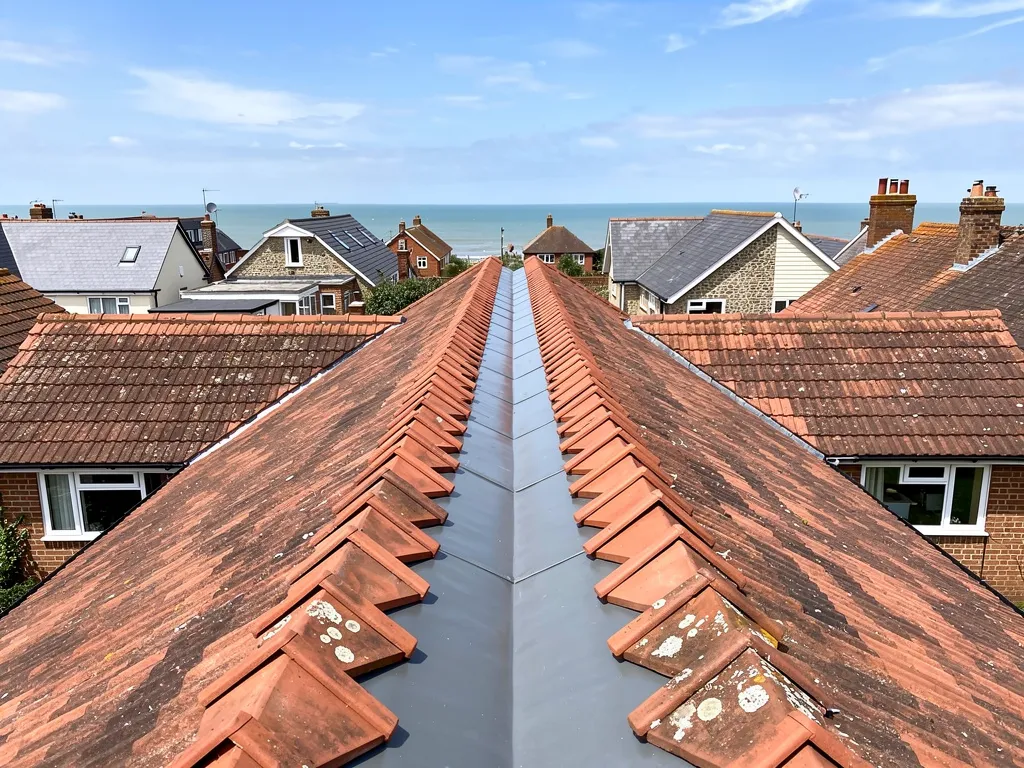
Salt carried in sea air lands on sheltered surfaces, and HomeBuilding picks out soffits and fascias as collecting it. Rinse them with fresh water from a hose at ground level now and then, as part of your yearly look.
For the bigger picture, our explainer on what fascias and soffits do shows how each part protects the others. A note of what was fitted and where makes the next inspection quicker.