The only published price we can point to for stone slate is a national one. Checkatrade's cost guide, last updated in September 2026, gives around £160 to £210 per m² as the typical UK range. It is not a Horsham figure, and it is best held loosely, because a roof of true Horsham slabs behaves differently from the general run of jobs behind a national average.
Horsham stone is a heavy, hand-sorted covering with slabs of random size, and it sits on timbers built to carry it. Whether a roof is relaid, patched or replaced, the cost turns on things a square-metre rate cannot see: how much of your own stone can go back, what the frame needs, how the scaffold goes up, and any listing or conservation area status the building carries.
This guide puts the published number beside the factors that move it, so you can read a stone roof quote with some confidence. None of it is our price. Ours is a single written figure for the whole job, sent after surveying the roof and photographing the stone and timbers.
What the national figure covers and what it leaves out
Checkatrade's number is a general UK range covering stone slate, quoted per square metre of roof. It is a useful marker for the order of magnitude and a poor predictor of any single job. A published average blends roofs of different stone, different pitch, different access and different condition, so your own roof can land well either side of it.
For context, MyBuilder (updated 21/08/2026) gives a typical UK range of £100 to £180 per m² when re-covering a roof in slate, and Checkatrade's repair guide (last updated June 2026) lists natural slate repair at £150 to £220 per m², exclusive of VAT. Stone slate sits at the upper end of that company, which is what you would expect of a heavier material that takes longer to lay.
Square-metre rates also hide what a stone roof asks of the people working on it. The slabs are random in size, so each one is picked out and placed rather than set to a fixed gauge. That choosing is slow work, and a national rate smooths it into an average.
Treat any per-m² number, ours or anyone else's, as a way of checking that a total price lies in a sensible region. It cannot stand in for a survey, because the survey is where the stone, the timbers and the access get looked at.
Check too whether a figure includes VAT. Checkatrade states its repair rates exclusive of VAT, so a total built on them rises once VAT is added. Before weighing one price against another, make sure both rest on the same basis, and ask whether scaffolding is in each.
The rest of this guide covers what moves a stone roof away from the average, starting with the work itself. Our hub page on Horsham stone roofing gives the wider picture.
Why laying stone takes longer than laying tiles
A tiled roof is made of identical pieces fixed to a regular gauge. A Horsham stone roof is made of slabs that differ in size and thickness. The Stone Roofing Association describes the working method as sorting the pile by size, so the biggest pieces go low on the roof and the smaller ones are saved for the higher courses. Every course involves a decision about which slab goes where.
That has three effects on price. The first is labour time, because sorting, trimming and fitting stone by eye is slower than nailing tiles to battens. The second is wastage: a slab that cracks while being handled is one you may not easily replace. The third is the skill involved. Laying graded courses is a craft of its own, and the work is priced accordingly.
Single lap adds a further step
Some Horsham roofs were laid by a second method, in which the gaps between slabs are covered by small Welsh slate pieces bedded under every joint. Each of those pieces is cut and placed by hand. A roof built that way needs the same detail repeated over the whole slope if it is relaid in the same manner, so it adds hours that a per-m² figure does not show.
Our guide to single-lap and double-lap Horsham stone roofs explains the two systems and why the choice touches both cost and consent.
None of this makes stone an unreasonable choice. It explains why a stone roof is priced as specialist work, and why a quote that lands very close to ordinary slate prices deserves a polite question about exactly which stone is being used and how it will be laid.
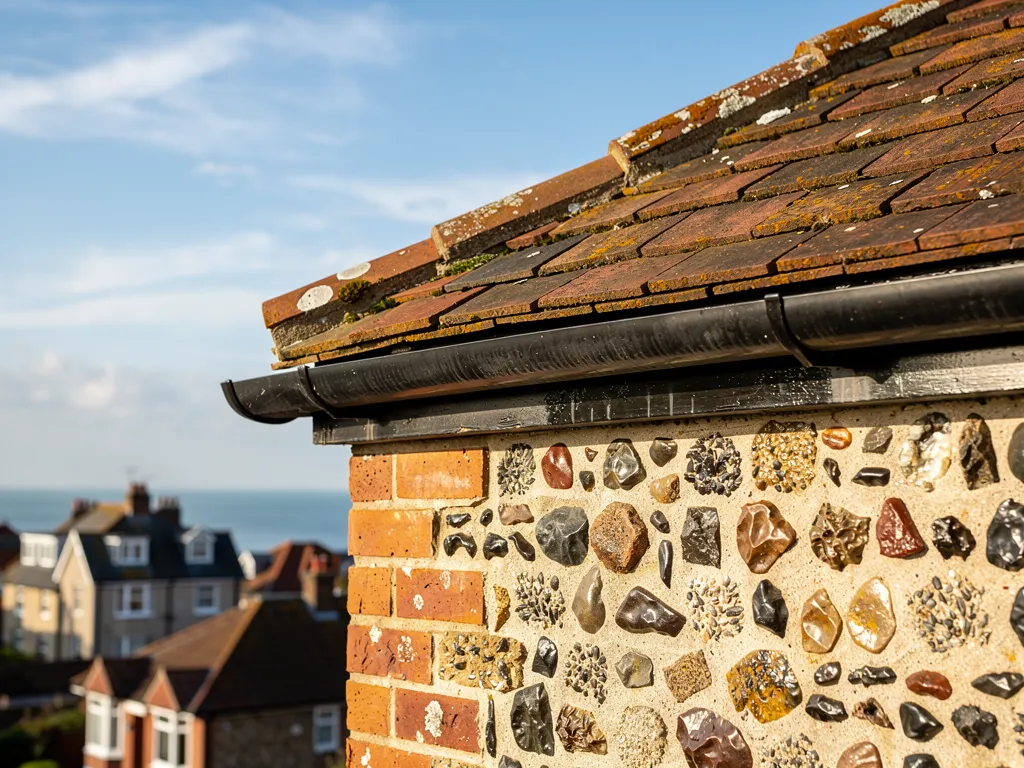
Reusing your own stone, and where the saving sits
The Stone Roofing Association is firm about priorities on a Horsham stone roof: the slabs already on the building come first. For cost, that matters more than any other idea on this page, because the stone itself is the scarce and expensive part of the job.
A roof that is stripped, sorted and relaid with its own stone needs labour, fresh battens where the old ones have failed, a new underlay, and replacement slabs only for those that have broken. A roof re-covered with stone bought in carries the price of that stone on top of the labour. That gap is why a careful relay can cost a good deal less than starting again with a different covering.
The saving has limits. Slabs that have flaked into layers or split right through cannot go back. A sound-looking slab can also snap on its way down, so a survey allows for some loss. How much stone is left after sorting decides how many replacements the job needs, and that count is only known once the roof is open.
Where replacements are needed, the Association prefers freshly cut Horsham slabs to salvage, if suitable ones can be had. Where they cannot, stone from other buildings is a possibility, though it brings concerns of its own, set out in our guide to reclaimed Horsham stone slates.
For the whole process of lifting and relaying a roof, see relaying a stone slate roof. A relay survey records how many slabs look sound and how many look doubtful, so the figure matches what is really up there rather than a guess.
Access, scaffold and the weight on the timbers
Horsham District Council's appraisal of its own town notes that the stone roofs there are steep and rest on heavy timber frames. Steepness and weight both push up the cost of reaching the roof and working on it safely.
Scaffold is the clearest example. MyBuilder (updated 21/08/2026) puts scaffolding for a house of two storeys at around £850 to £1,200, with chimney scaffolds at £400 to £900. A stone roof on a tall cottage with an awkward footprint, a lean-to or a long run of eaves can need more than that, and a steep stone slope is no place to improvise. Ask each firm if scaffolding and VAT sit inside its total, because the two together can move it considerably.
Where scaffolding stands on or over the pavement, the highway authority has to grant a Highways Act licence, and whoever erects the scaffold applies for it. That is an additional step, and on village streets with narrow footways it can be an additional cost.
Timbers and the loading question
The Stone Roofing Association notes that moving a roof from one lapping system to the other forces a fresh look at what the structure can bear. Even when nothing is being converted, an open stone roof gives the first proper view of rafters, purlins and wall plates that have carried stone for decades. Timber repairs found at that stage are priced on what the opened roof reveals, and we tell you before the work starts, not after it.
We do not quote a weight per square metre for Horsham stone, because none is published in the guidance we rely on. The survey judges the frame by looking at it.

Consents that shape the budget
Cost on a stone roof is not only labour and materials. Where the building is listed, covering the roof in anything other than matching materials needs listed building consent from the local authority, and the Stone Roofing Association says listed Horsham roofs cannot be altered without it. Patching in situ with like stone is another matter, but it is sensible to check with the council before work begins.
Conservation areas and the South Downs National Park add questions rather than automatic costs. Re-laying the existing covering rarely raises a planning question, though listed status and Article 4 directions can change that. Steyning's conservation area appraisal, for instance, calls mortared joints on relaid Horsham slab an inappropriate repair. Your own council's planning officers can say which authority covers your address: Horsham District, Adur & Worthing or the South Downs National Park Authority.
Where a roof is converted from one lapping system to the other, the Association says the work needs approval from the building control body, and a church needs a faculty. A listed building also needs consent for that change.
These tasks fall to the owner as much as the roofer, and they take time. Build that time into the plan, and ask any contractor you speak to who will handle each notification. We tell you which consents apply and handle any Building Regulations notification the job requires.
Any fees for consents are set by the councils, so ask them for the current position before you plan the budget around a particular figure.
Reading a stone roof quote when it arrives
A quote for a stone roof should make plain what is being done to which part of the roof, and what becomes of your existing slabs. Start with the stone. Is the plan to reuse what is on the roof, to add new stone, or to bring in slabs from other buildings? The answer changes both the price and the character of the finished roof, and the Stone Roofing Association says stone of a different rock type must never be mixed in with the sandstone.
Next, look at the method. Is the roof being relaid double lap or single lap, and are the courses being kept in graded order from low to high? A quote that offers only a number of square metres, without naming the stone, is missing the detail that decides the cost.
Then look at what is and is not included. Scaffolding, VAT, waste removal and any timber repairs are the usual points of difference between two quotes that look unlike each other. Ask for them to be confirmed in writing, so the total you are comparing is the total you will pay.
Finally, ask about the guarantee. Any guarantee you are offered should be in writing, with what it covers and for how long.
You can send photographs of your roof through the quote page to start, and the survey follows. For how stone compares with other coverings, the costs page sets the other typical ranges side by side.
The aim is a stone roof priced on what it needs, with the cause of any fault shown to you on your own slabs before a figure is agreed.