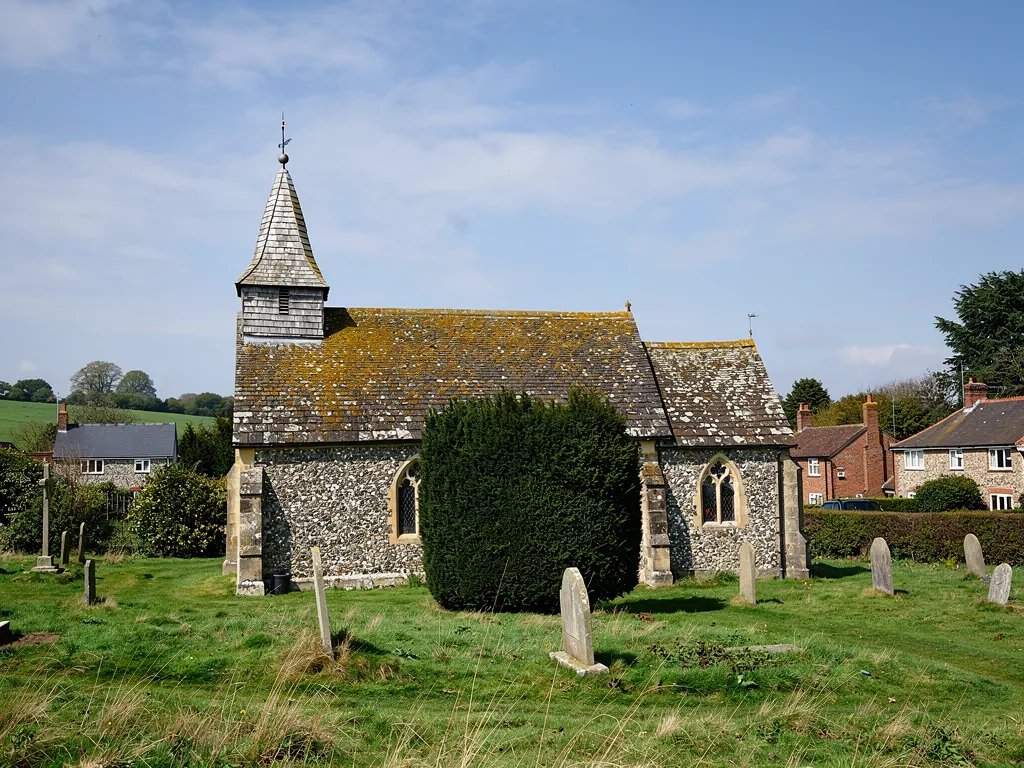
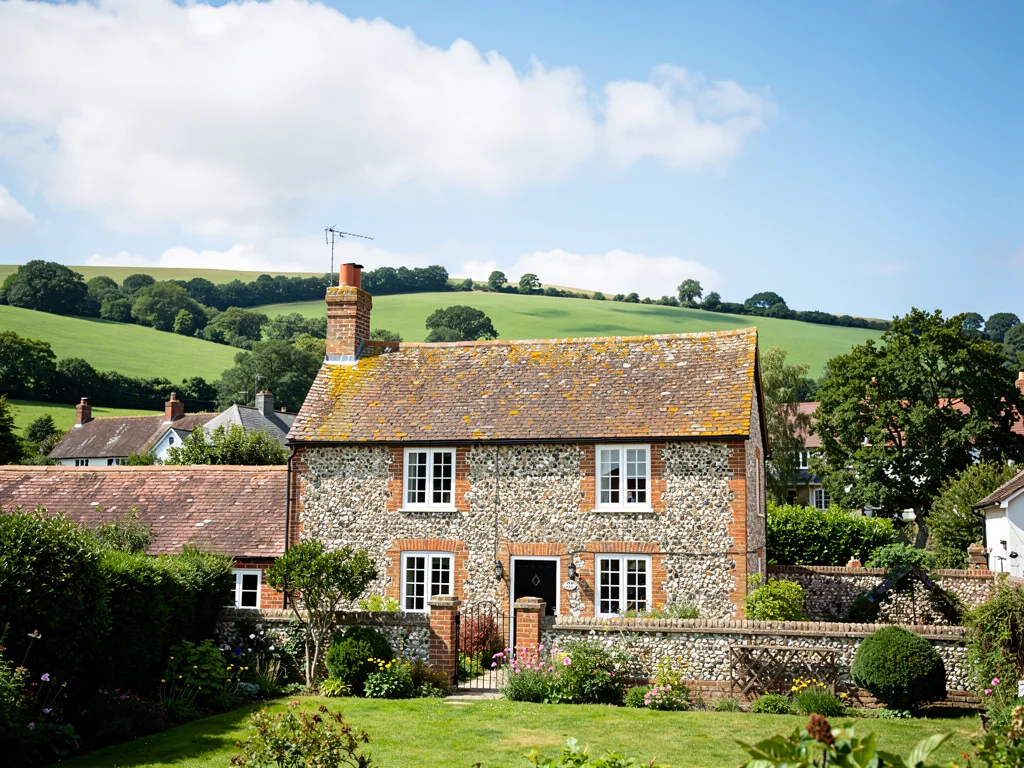
Drive through the Weald villages of West Sussex and you will pass roofs that look unlike tile or slate: broad, uneven, grey-brown slabs that have weathered until they seem to melt into one another. That is Horsham stone, and it is one of the best-known regional roofing materials in the south of England.
In geological terms it is a stone with a particular habit. The Stone Roofing Association, in its guide to Horsham stone roofs, calls the slates or flags calcareous, flaggy sandstones. Each word in that phrase says something about how the material behaves overhead, and why it is repaired differently from anything else we work with.
The slabs are thick and heavy compared with slate, they come in random sizes, and they are laid in a pattern that looks irregular but follows firm rules. Because the stone comes from a limited area and has no ready substitute, a roof of it is a large part of what gives an old building its look.
This guide covers what the stone is made of, where it comes from, how it is laid, where it survives around us, and what that means for anyone who owns a roof covered in it. It is a starting point, and the linked guides go further.
Calcareous, flaggy and sandstone: reading the description
Start with the last word. Sandstone is rock built from sand grains cemented together, which gives the slabs their gritty surface and their warm, muted colour. It is a different family from the thin, dense, blue-grey slate that comes from Wales or Cornwall.
Calcareous means the stone contains lime. That lime content is part of what the Stone Roofing Association's description is telling you: this is a sandstone with a chemical character of its own, and not simply any sandstone sold as a roofing slab. Our short answer on what rock type Horsham stone is takes that further, because the question comes up often and the sourced answer is careful.
Flaggy describes how the stone breaks. Rock that is flaggy splits along its bedding into broad, flat, fairly thin pieces. Those pieces are called flags, flagstones, slabs or stone-slates, depending on who is talking and how thick they are. A roofer splits and dresses them rather than cutting them to a pattern, which is why no two slabs are quite alike.
Why the three words matter on a roof
Taken together they explain the behaviour. A flaggy stone gives you a covering that is naturally flat enough to shed water. A sandstone texture gives it weight and grip. A calcareous nature means it has its own way of weathering, and it is one reason the Association insists on keeping different rock types apart on a single roof. Matching like with like is not fussiness; it keeps the roof ageing evenly, slab beside slab, without one patch breaking down faster than its neighbours.
If you want the practical consequences of all this, the hub page on Horsham stone roofing shows how the material shapes repairs, relays and surveys.
Where the stone is quarried: the Sussex Weald
Horsham District Council's conservation area appraisal for the town places it among the wooded clay vales of the Sussex Weald. Close by, just outside the built-up area, lie the patches of ground that yield Horsham Stone, and the appraisal says those patches are where the roofing stone comes from. The material carries the town's name because the town sits in the middle of the ground that produces it.
That gives the stone a very local story, and it is why examples gather in and around the market town. A 2019 trade report adds that roofs of this kind also appear across the wider countryside of Surrey and East Sussex.
There is a limit to what can be said about the workings today. Supply was the subject of concern in 2019, when the thin roofing slabs were reported to be running out at their usual source in the quarry. We have not tested the present position, and we do not guess at it. If you are planning work, the useful question is what stone is actually obtainable for your project at the time, which a survey and a conversation with a supplier will answer.
Geography also explains the character of the colour, and it is worth a moment because colour is often what an owner notices first. Stone from one belt of ground tends to weather to a related range of tones, which is why a village roofed in it can look so consistent from the hill above.
For how supply affects an individual roof, read our guide to Horsham stone supply.
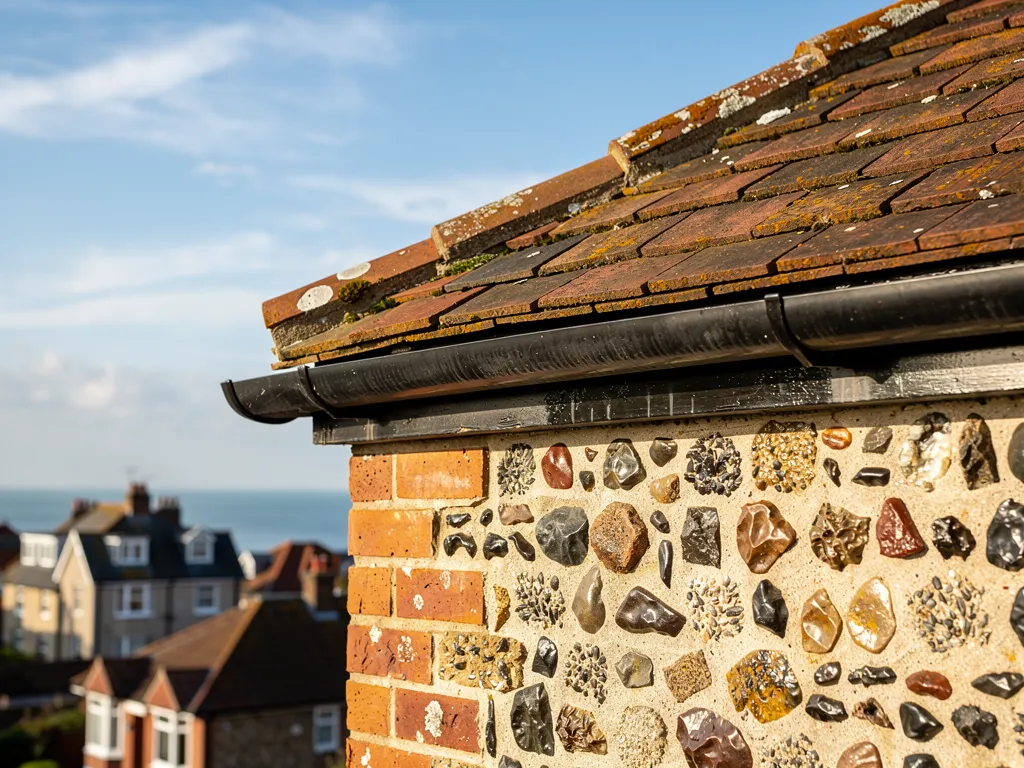
Slabs, flags and stone-slates: why the names vary
People use several names for the same thing, and they are worth untangling because different documents use different ones. A council appraisal will often write Horsham slab. The Stone Roofing Association writes stone-slates or flags. A builder may say Horsham stone tiles, and an auction catalogue may say stone slates. They all describe one family of roofing pieces.
Size is the other source of confusion. The word slab suggests something heavy and thick, and Horsham stone roofs can feel that way when you handle the pieces. Yet the stone is sorted by size and laid in order. The biggest pieces go along the lowest edge, where the covering needs the most weight and the most cover, and the pieces become smaller as the courses climb. Roofers call this arrangement diminishing courses, and it is one of the signs by which a genuine stone roof can be told from a distance.
The slabs are not uniform in thickness either. Some are far thicker than a roofing tile, others are quite thin. The guide to diminishing courses explains how they are sorted and laid.
If you are reading a survey, a listing description or a conservation area appraisal, treat these names as interchangeable until the text says otherwise. What matters is whether the roof is genuinely Horsham stone, how it is laid and what condition the slabs are in. A roofer who knows the material can establish each of those on a single visit, usually from the ground with binoculars and then from the loft, and a good survey records all three with photographs of the roof itself.
Two ways of laying it: double lap and single lap
The Stone Roofing Association identifies two roofing systems. One is the ordinary double lap method, which will be familiar from slate and tile roofs: each course covers part of the course beneath it, so water always meets a second thickness. The other, which the Association calls single lapping and says belongs to Horsham stone alone, is different in principle.
In single lapping the slabs sit alongside one another instead of overlapping in the usual way. Under each gap sits a thin strip of Welsh slate, a shadow or shade, held with mortar so that it carries the water across. In both, the slabs are irregular and are sorted so the roof steps down in size as it rises.
The distinction matters because it changes how a roof is repaired, how heavy it is and which consents may be needed to alter it. A roof laid in one system cannot casually be turned into the other. The Association's advice leans towards double lap where there is a choice.
The full explanation, including loading and consent, is in our guide to single-lap and double-lap Horsham stone roofs.
Many older roofs combine both. Council appraisals describe patching over the years that has left the two methods together on one roof, with slate shadows turning up wherever stone ran short. Identifying what a particular roof is made of, and where it has been mended, comes first in any survey, and we record it slope by slope.
That record is also useful to you later, if you are planning more work, selling the house or asking a conservation officer what would be appropriate.
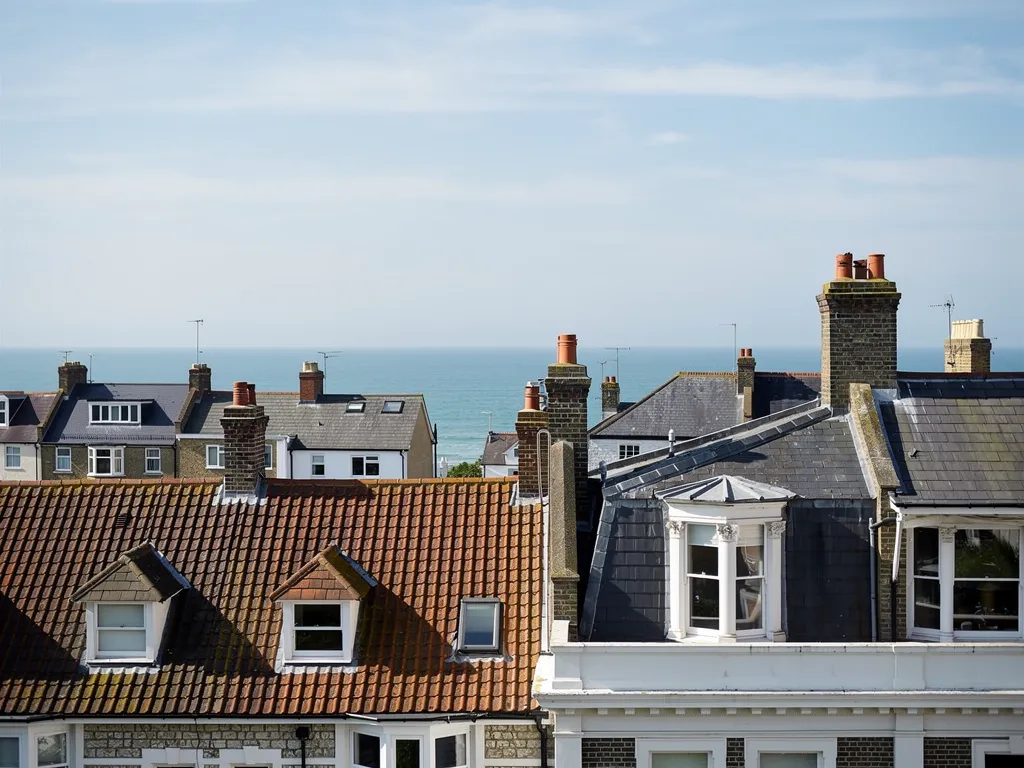
Where Horsham stone survives around Worthing
Our work covers the coast, the Downs and the Weald, so we meet the stone in several settings. Council appraisals give a sourced picture of where it turns up, and they show a clear pattern.
Inland it is a regular feature. Steyning's appraisal says older buildings are typically roofed in Horsham slabs or clay peg tiles, and that slab roofs survive in large numbers there. Henfield's records peg tile as the usual covering, with stone slates less often. Storrington's lists some slab roofs alongside brick, flint and clay tile, and names Church Street among the places to see them.
Closer to the sea the stone is rare. The Kingston Buci appraisal describes the Old Rectory's roof as Horsham slab, a type found across West Sussex though uncommon in Adur. North Lancing has patches of it, notably at the church and Grant's Manor, while Old Shoreham counts a few among its slate roofs.
For a fuller tour, Horsham stone in the Sussex villages goes through the settlements one at a time. The pattern is useful for one reason. If your house stands near one of these places and carries a slab roof, it belongs to a tradition the local councils have written down, and that can affect which repairs are appropriate.
It also means the surrounding buildings give a clue about what your roof was originally made of. Where a street still has several stone roofs, a council officer will expect repairs to respect them, and a roofer who knows the area can usually tell you what has been accepted before, which saves a good deal of back and forth with the planning team.
If you are unsure what covers your own roof, the quickest answer is a set of clear photographs from the ground.
What the stone means for the person who owns the roof
These roofs pitch steeply and sit on heavy frames, because the covering is substantial. As they weather, the slabs can seem to merge into one skin. That is a fair picture of ownership: a durable covering that needs a particular kind of care, from people who know how it was put together.
The first rule from the Stone Roofing Association is to make the roof's own stone do as much work as it can. When stone runs short, freshly cut Horsham slates are preferred for the gap if suitable ones are available, and salvage from other buildings is discouraged, because demand for it can lead to the loss of historic roofs. We cover this in reclaimed Horsham stone slates.
The second rule is about mortar. Steyning's appraisal counts mortared joints on a relaid slab roof as an inappropriate repair. Mortar on stone is a subject that deserves its own explanation, which you will find in mortar on stone slates.
The third is cost. Stone is slower to lay and harder to source than most coverings, and a national price guide cannot capture that. Our guide to stone slate roof costs sets out what is published and what is not.
If you own a roof like this and are unsure what you have, send us photographs through the quote page. We survey the roof, photograph any fault we find on the stone itself, and send the quote in writing afterwards.
We also tell you plainly when a repair will do and when a larger job is justified, because a repair is right when it removes the cause and goes no further.