
Question answered
How much do roof slates cost in the UK?
The short answer
A natural slate re-roof typically costs £100 to £180 per m² installed, according to MyBuilder's slate roof guide (updated 21 August 2026). That figure covers the work, not just the stone. Checkatrade puts natural slate repair at £150 to £220 per m² excluding VAT. Man-made slate usually costs less than natural, and the final figure is set after a survey.
The slates are only part of the bill. Most of what you pay for a slate roof goes on fixing them, on access and on the timber and lead around them.
Material price against installed price
People searching for slate prices usually mean one of two things. The first is the price of the slates themselves, bought from a merchant. The second is the price of a finished roof. They are very different numbers, and mixing them up is the commonest reason a quote looks high.
The published figures are for installed work. MyBuilder's slate roof guide, updated on 21 August 2026, gives £100 to £180 per m² as a typical UK range for slate re-roofing. That covers removing the old covering, labour, new slates and fixings, and the associated roof work. The price of slate alone varies with origin, size, grade and thickness, and merchants quote it by the pack or by the tonne rather than by the square metre.
For that reason, a pile of slates priced at the merchant is not a basis for judging a roofer's quote. The stone is typically the smaller part of a slate roofing bill, and the labour, access and extras make up the rest, which is why two roofs of the same size can be priced quite differently.
What sets the price of natural slate
Natural slate varies by quarry. Welsh slate has a long reputation and regularly lasts over a century, MyBuilder says, while Spanish slate is quoted at a lifespan of 75 to 100 years. Grades differ within each, and a thin, rough slate costs less than a thick, even one.
Size matters too. Larger slates cover more area with fewer nails, but they need a larger headlap to keep out water, and the roof's pitch, its exposure and the batten spacing all affect which size is right. Cupa Pizarras gives the minimum pitch for natural slate as 20 degrees at moderate exposure, using a 500 mm slate and a 115 mm overlap, so a shallow roof limits the choice.
See Welsh against Spanish slate for a fuller comparison of what you get for the money.
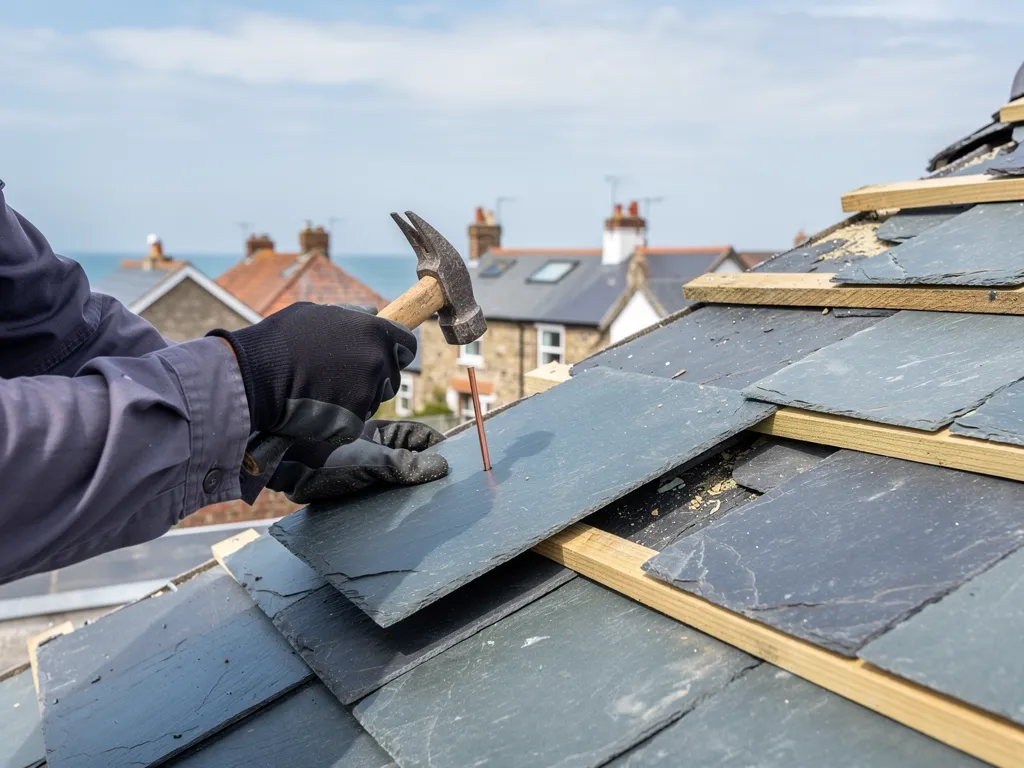
Natural against man-made slate
Man-made slate, sold as fibre cement or composite slate, is made to look like the real thing at a lower price. It is lighter, more uniform and easier to cut, which can reduce the cost of laying it. It tends to cost less than natural slate for a similar roof, but it does not weather in the same way and its lifespan and look are not those of natural stone.
On a listed building or in a conservation area, planners may expect natural slate, and the council can decline an alternative. Check before you assume man-made slate is allowed. The planning team at Adur & Worthing Councils can say what is acceptable for your address.
Where you want the look at a lower sum, ask your roofer which products they would use and what their makers say about life and fixing. Our guide to natural against man-made slate compares them in more detail, and the question of how long the real thing lasts is answered in how many years a slate roof should last.
The other costs on a slate roof
Slates do not sit on bare rafters. A reslated roof also needs new battens where the old ones are weak, an underlay, lead for flashings and valleys, ridge tiles and fixings. Scaffolding is a significant sum: MyBuilder gives approximately £850 to £1,200 for a standard two-storey house setup.
Lead work is often the part that surprises people. MyJobQuote, in its leadwork guide (updated 22 September 2026), prices a full chimney lead replacement at £350 to £460 without scaffold and £700 to £920 with it. Roofs with several chimneys, valleys and abutments add up quickly.
Check what any quote covers. Ask whether it includes VAT, scaffolding, waste removal and new battens, and what happens if the timbers are found to be worse than expected. The honest answer to the last question is usually that a survey in the loft reduces the surprises.
Getting a firm figure for your roof
The published ranges show the scale of a slate job, not your own bill. The size of the roof, the slate chosen, the number of chimneys and the access decide the total. A survey with photographs comes first, then our written quote gives a single total.
If you only have a few slipped slates, the sums are different, and repair costs are covered on the page about why slates slip. Small-scale pricing, including the reason a single slate is charged as a visit, is explained in what a roofer charges per slate.
For a bigger job, read our reslating guide to see how a stripped and relaid roof is sequenced. The tingle repairs page explains a cheaper fix that suits isolated faults. A photograph from the road and a chimney count are enough for us to say where the survey will begin. Our slate roofing page describes the full range of work, from one slipped slate to a complete strip and relay, and the kind of access each needs.
Slate prices: two more questions
Is slate more expensive than concrete tiles?
Typically yes. Checkatrade's repair table lists natural slate at £150 to £220 per m² against £90 to £120 for concrete and £110 to £160 for clay, excluding VAT. The longer life of slate narrows the gap over time.
Can I buy the slates myself to save money?
You can, but most roofers prefer to supply their own, because they then stand behind the match, the grade and the quantity. Buying wrongly is easy, and surplus or wrong-sized slate is hard to return.
Tell us about your roof
Describe what is happening and we will call you back to arrange a visit.
- Photographs of what we find
- A written quote with one total price
- Or call 01903 299063
10-year workmanship guarantee, in writing.