
Question answered
Slate roof valleys: lead, mitred and swept
The short answer
A slate valley is the inward corner at which two slopes join, taking water from each. The three common forms are the lead-lined open valley, the mitred valley where slates are cut to a diagonal over a lead or soaker base, and the swept valley, where slates curve round the angle. Leaks usually come from worn lead, debris or cut slates that no longer lock together.
In a valley, two slopes meet in a trough, and the rain that lands on each ends up flowing down it. On a slate roof it can be dressed three ways, and each has its own strengths and its own ways of failing.
How a valley works and why it leaks
Two slopes tilt towards each other along the valley, so it gathers water from both and delivers it to the gutter in one narrow stream. In a downpour a great volume squeezes through a small channel. If anything goes wrong in the valley, the leak is often the first the household sees.
Valleys fail for ordinary reasons. Leaves, moss and broken slate pile up and divert the flow sideways under the slates. Lead wears, splits or lifts. Fixings fail and the cut edges of slates beside the valley slip. Water then runs under the covering and stains the ceiling some distance from the real fault.
Because so much water passes through it, a valley needs a sound base, a clear channel and a wide enough cover. Our guide to matching old slates helps when a repair needs the courses beside it to look right.
The lead-lined open valley
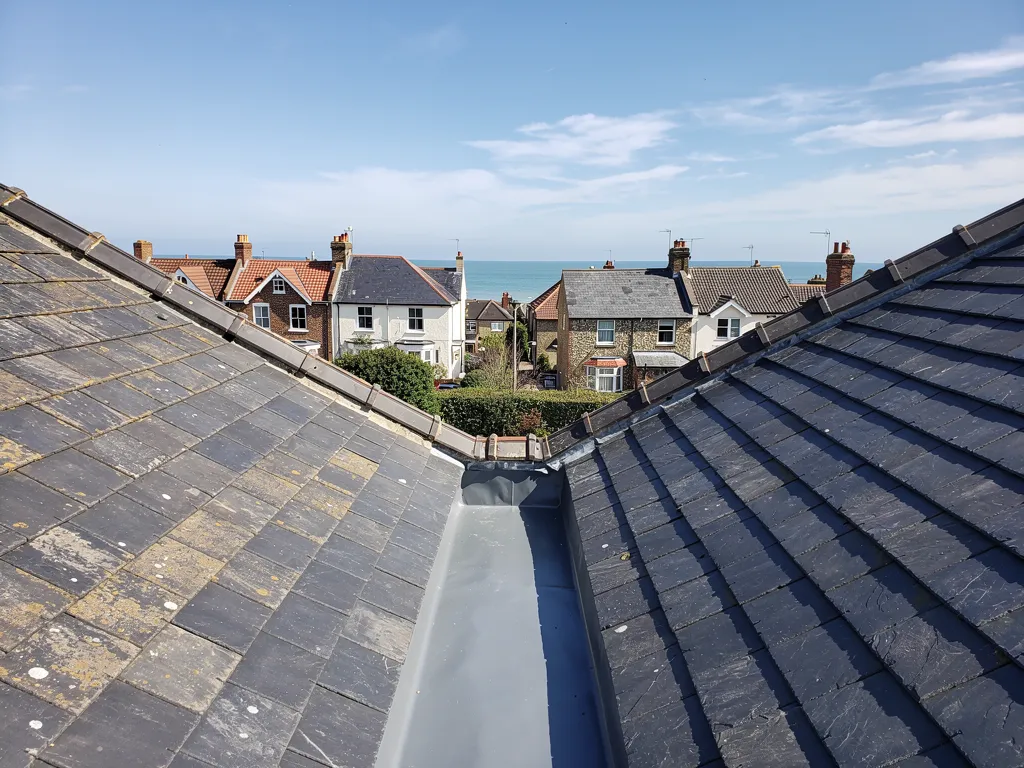
In this form, a strip of lead sheet is laid in the angle between the slopes, and the slates stop short of the centre, leaving a visible channel of metal. Water runs down the lead, which is wide enough to carry it, and the slates on each side overlap its edges.
Lead is popular because it is long-lasting and easy to shape. Leadworx points to code 4 for everyday flashings and code 5 for general pitched work, and MyJobQuote puts lead flashing at over 80 years, and over 100 for higher codes. Those are typical figures, not promises, and workmanship matters as much as the metal.
An open lead valley should be clear and sit flat. Failures include cracks from movement, holes from foot traffic, and lead that has crept down the slope. A clear channel, with the lead intact and properly lapped, is the sign of a good valley.
The mitred valley
A mitred valley hides the metal. The slates from both slopes are cut along a diagonal line where they meet, and the cut edges butt together, so the roof looks continuous. Underneath is a lead strip or a set of lead soakers that actually carries the water, with the cut slates resting on it.
Soakers are small pieces of lead, bent to sit under the slate at one side and up against the other, and Leadworx recommends code 3 for lead soakers only. The detail is skilled work: each soaker must lap the one below correctly, and each cut slate must hold firmly without crushing the lead.
The look is neat, but the repair is harder. A cracked or slipped mitre slate lets water straight onto the lead below, and the valley cannot be seen to check it from the ground. For that reason a mitred valley wants inspecting from time to time, and repairs should lift the cut slates and examine the soakers underneath.
The swept valley
In a swept valley the slates are not cut to a mitre. Instead, special tapered slates, laid in decreasing widths, curve round the angle in a smooth sweep, one course after another. There is usually a lead or board base beneath for security.
The effect is a rounded, flowing valley with no visible metal and no cut edges, and the system is associated with careful, traditional slating. It takes more slates and more skill than the other types, and it needs the right sizes of slate to start with.
If swept slates have slipped or one has cracked, a like-for-like repair can be hard, because the replacement must fit the taper. For some roofs, the roofer rebuilds a section instead. Cost is the other side, which our page on slate against tile cost and the slate roof cost guide look at for the wider roof.
Finding a valley fault and getting it repaired
From the ground, look along the valley for moss, plants or leaf mould in the channel, slipped slates beside it and gaps where the lead meets the slate. In the loft, look for staining on the timbers under the valley line. Do not go onto the roof; our page on walking on slate explains why.
A repair might be as simple as clearing the channel, or it might call for new lead, new soakers, or rebuilding a mitred section. We chase the water back to where it enters before pricing anything, because it often travels, and a stain in the bedroom may start a metre or two away.
Photographs of your own valley come with the quote, a written document giving one overall figure. If a clean-out is all that is needed, that is what we advise. A new valley is only worth proposing when the old one cannot be made sound. For the wider picture, see our slate roofing page.
Valley questions, answered
Can a leaking valley be sealed with a roofing compound?
A compound might ease a drip for a spell, yet it conceals the fault and tends to crack as the lead moves. Reworking the lead or soakers is the lasting repair, so sealing is not a method we would rely on.
Do all three valley types suit every slate roof?
No. The choice depends on the pitch, the slate size, the house and any conservation requirements. An open lead valley is the simplest to inspect and repair, while a swept valley needs tapered slates and more skilled work.
Tell us about your roof
Describe what is happening and we will call you back to arrange a visit.
- Photographs of what we find
- A written quote with one total price
- Or call 01903 299063
10-year workmanship guarantee, in writing.