
Chapter one
Salt air on Pagham's coastal roofs
On this coast the first things to fail are often the parts the rain never washes: soffits, fascias and the fixings above them.
The Victoria County History says the tidal lagoon of Pagham Harbour lies on the south of the parish, and that land here was constantly being eaten away by the sea. It also records a reclamation of 700 acres of the harbour in 1876 that the sea took back in December 1910. Few places make the point so plainly: this is a shore where water wins in the end. Roofs here are not under the same strain as the harbour wall, but they live in the same air, which carries salt and spray, and they take the gales that come off the water. So on every survey we look at what the weather has already done to that particular roof.
At a glance
- Soffits and fascias gather salt the rain misses
- Zinc suits the coast if it is rinsed
- Low pitches are pulled harder by wind
1.1 The parts the rain does not wash
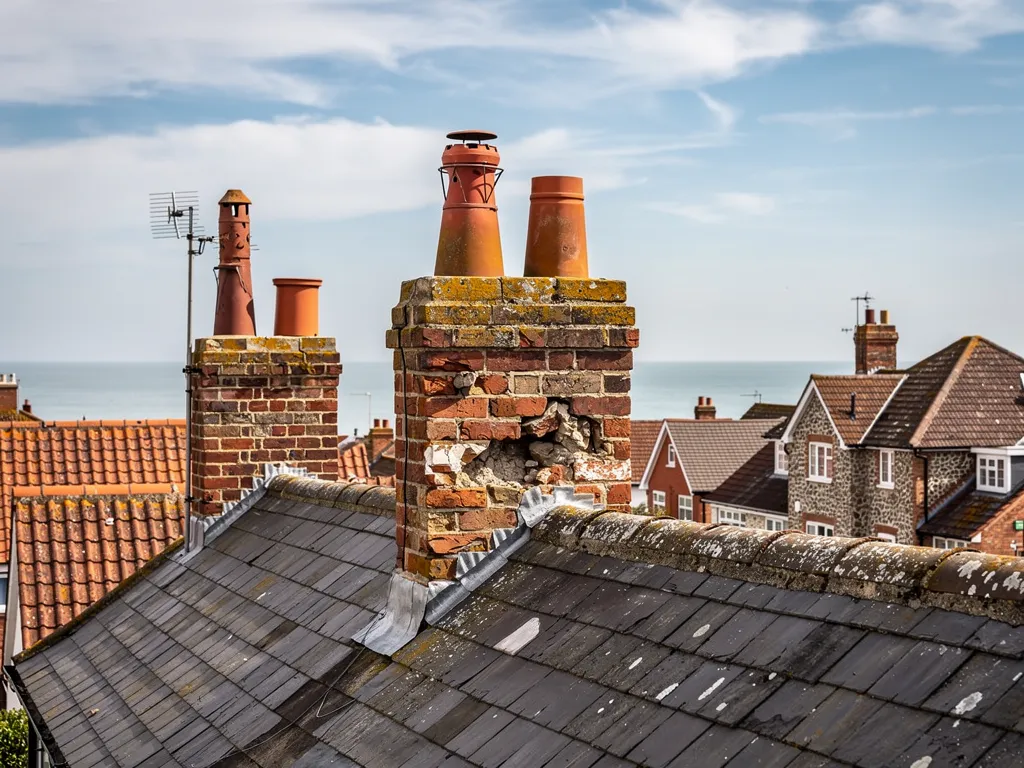
HomeBuilding notes that sea air is laden with salt, and that it settles on soffits and fascias, where no rain ever reaches to rinse it away. That matches what we find: flaking paint on the boards beneath the eaves, rusting brackets, gutters that sag where a fixing has let go. Where the roofline is uPVC, the deposits can be wiped away, and a regular wash is worth doing. On timber, repainting early stops rot reaching the rafter ends, the sloping timbers that hold up the tiles. We photograph the roofline at every survey, because it is the least costly part of a roof to put right when caught early, and the part most likely to be neglected because it is out of sight from the garden.
1.2 Fixing the covering to resist the sea
A shallow roof is the worry. Marley points out that below 30 degrees the windward side of the roof can be pulled hard by moving air, which is how a gale lifts tiles that look secure. Wienerberger expects each tile of the single-lap kind to be nailed or clipped at least once, to a fixing plan for the site. Ridge and hip tiles have been fixed mechanically, not left to mortar alone, since BS 5534 was revised in 2014. One zinc maker says its metal performs extremely well in coastal environments, and that a wash with clean water every six months or so keeps salt deposits down. See our gutters, soffits and fascias page for roofline repair and replacement.
Salt, wind and the roof edge
- Soffits and fascias
- Collect salty deposits that rain cannot rinse (HomeBuilding)
- Zinc
- Performs well on the coast; rinse it at least twice a year (zinc maker's guidance)
- Pitch under 30 degrees
- Windward side can be pulled hard by the wind (Marley)
- Interlocking tiles
- At least one nail or clip per tile (Wienerberger)
- Ridge and hip tile fixing
- Fixed mechanically since the 2014 revision of BS 5534
Source: HomeBuilding; zinc maker's FAQ; Marley; Wienerberger; BSI, fetched October 2026