
Chapter one
Brick chimneys on West Dean's flint cottages
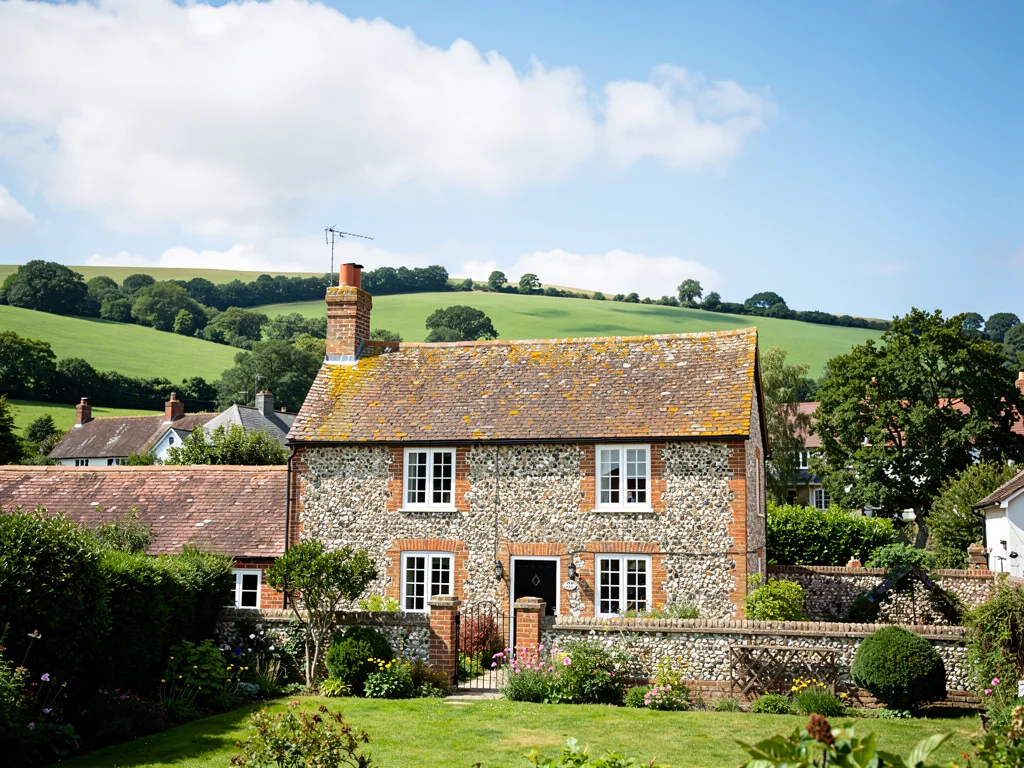
Seventeenth-century flint-and-brick houses here carry brick chimney-shafts, and the lead around each base decides whether the roof stays dry.
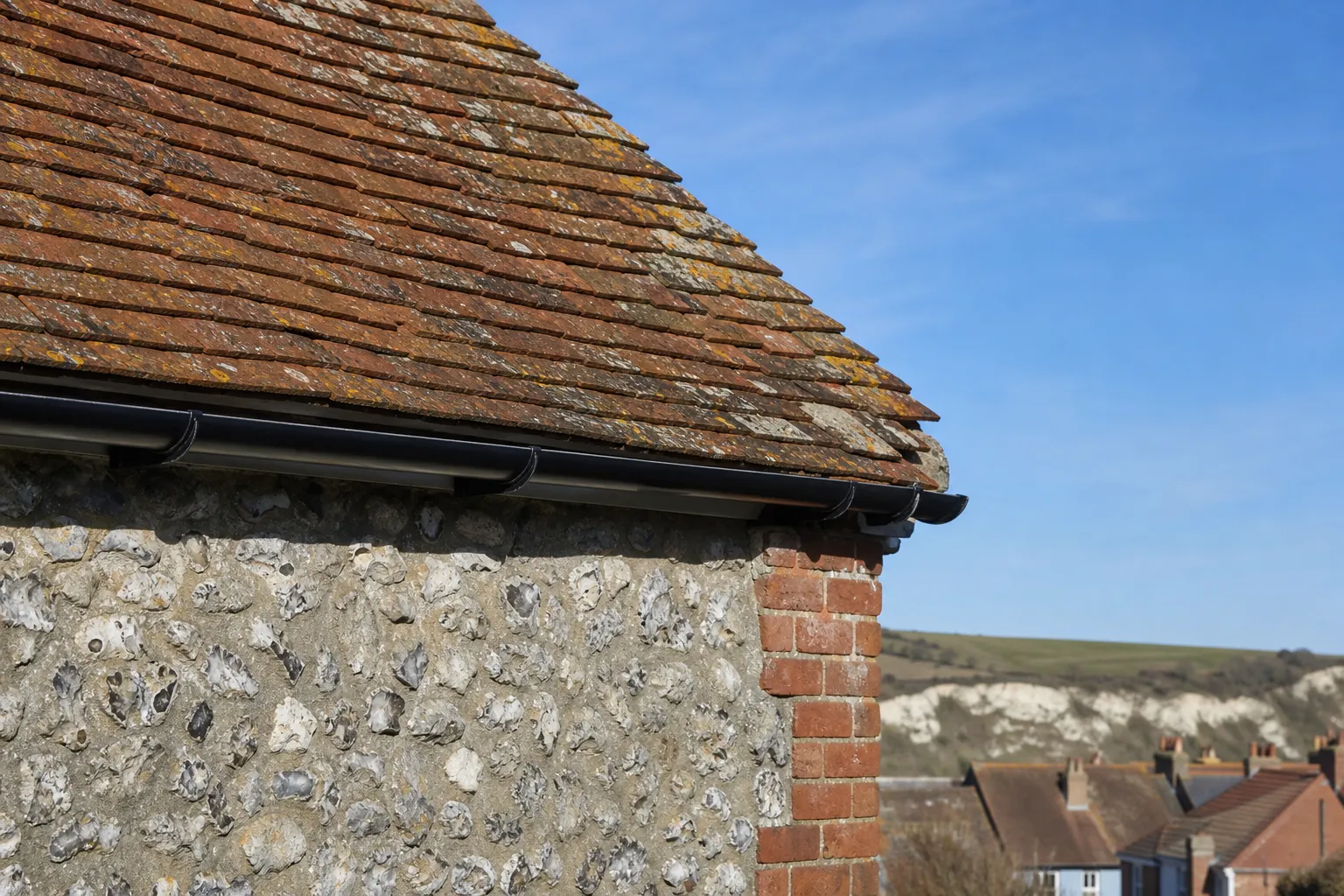
According to the Victoria County History, West Dean village lies on the right bank of the River Lavant at about 200 ft, in the south-east corner of a parish that is mostly downland. Its cottages include 17th-century flint-and-brick houses with brick chimney-shafts, and most later buildings also have flint walls. Flint walling is thick and heavy, which suits a long-lived roof, but it leaves little room to hide a bad detail. Wherever the roof stops at a wall or climbs a stack, a hand-made seal holds the two together, and that is where we begin.
At a glance
- Village cottages include 17th-century flint-and-brick houses
- One cottage is thatched, half timber-framed and half flint
- Lead code 4 is the everyday flashing weight (Leadworx)
1.1 Where a brick shaft leaves the roof
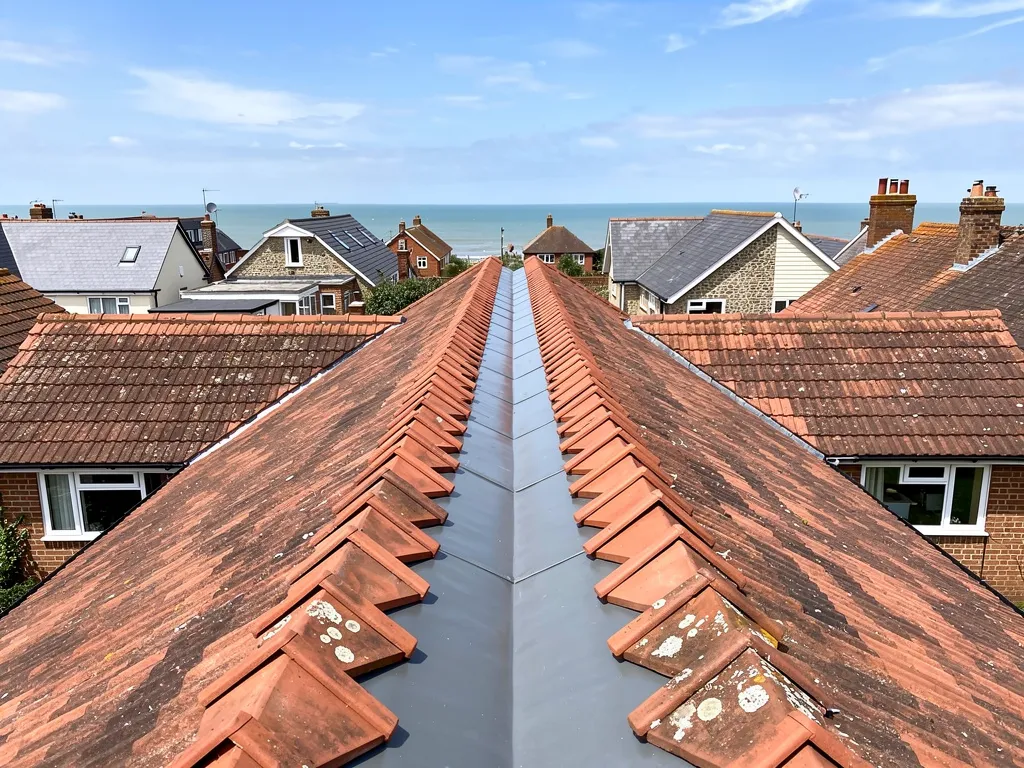
A cottage chimney is wrapped in lead at its base: an apron across the lower face, stepped pieces up the sides, and a back gutter behind the stack so water runs round it rather than pooling. Small lead soakers are threaded between tiles or slates alongside. Each piece is set into a chase raked out of the brickwork, so the quality of the mortar around the chase matters as much as the metal. Old chimney shafts also lose mortar from the top down, and a cracked crown lets rain into the flue. We look at both ends of the stack and every join between.
1.2 Choosing the lead
Leadworx lists code 3 as soaker lead only, and names code 4, at 1.80 mm, as its everyday flashing weight, with codes 5 and 6 kept for heavier-duty positions. Checkatrade's typical UK prices for lead flashing, before VAT, are £50 to £70 per metre for code 5 and £80 to £120 per metre for stepped flashing (updated October 2026). Chimney scaffold typically costs £400 to £900, MyBuilder says (updated 21/08/2026), which is why we try to deal with stack and lead in one visit. Our lead roofing page explains codes and dressing in detail, and our chimney repairs page covers the stack above it.
1.3 Around the thatch
Where a chimney rises through a thatched roof, the seam between brick and thatch is the weak point, and any work there is planned alongside whoever maintains the thatch itself. Where thatch is involved, the flue guidance in Approved Document J calls for extra clearance, so a new stove in a thatched cottage needs its chimney height checked first. We survey the shaft, the flaunching and the lead from the ground and the loft, and send photographs so that you can see the fault before we price it.
Lead sheet codes for cottage flashings
- Code 3, 1.32 mm
- Soakers only, in light positions
- Code 4, 1.80 mm
- Everyday weight for general flashing
- Code 5, 2.24 mm
- Heavier flashings on pitched and vertical faces
- Code 6, 2.65 mm
- Larger roofs and heavy exposure
Source: Leadworx and Royston Lead, fetched October 2026