Pointing is the mortar visible between the bricks, the thin line that keeps water out of the joint. On a chimney stack it works harder than anywhere else on the house, because the stack is tall, narrow and wetted from every side, and it dries unevenly in the sun and wind. After some decades the surface of the mortar has eroded back from the brick edges, and the joints are open pockets that collect rain and hold it.
Repointing is the repair for that. Loose mortar is raked back to a fixed depth, then each joint is brushed clean, and fresh mortar is packed in and finished. Done properly, it is a modest job that protects the bricks, stops damp showing on the chimney breast inside, and delays a far more expensive rebuild. Done badly, with the wrong mortar or on a stack that was already too far gone, it fails within a few winters.
This guide takes the job in the order it happens on site, from the first look at the stack to the mortar mix and the access it needs. Throughout, we look for the least work that properly solves the problem. Part of that is knowing when repointing is not enough. Our hub for chimney repairs covers the other jobs a stack may need.
Telling whether the stack needs repointing
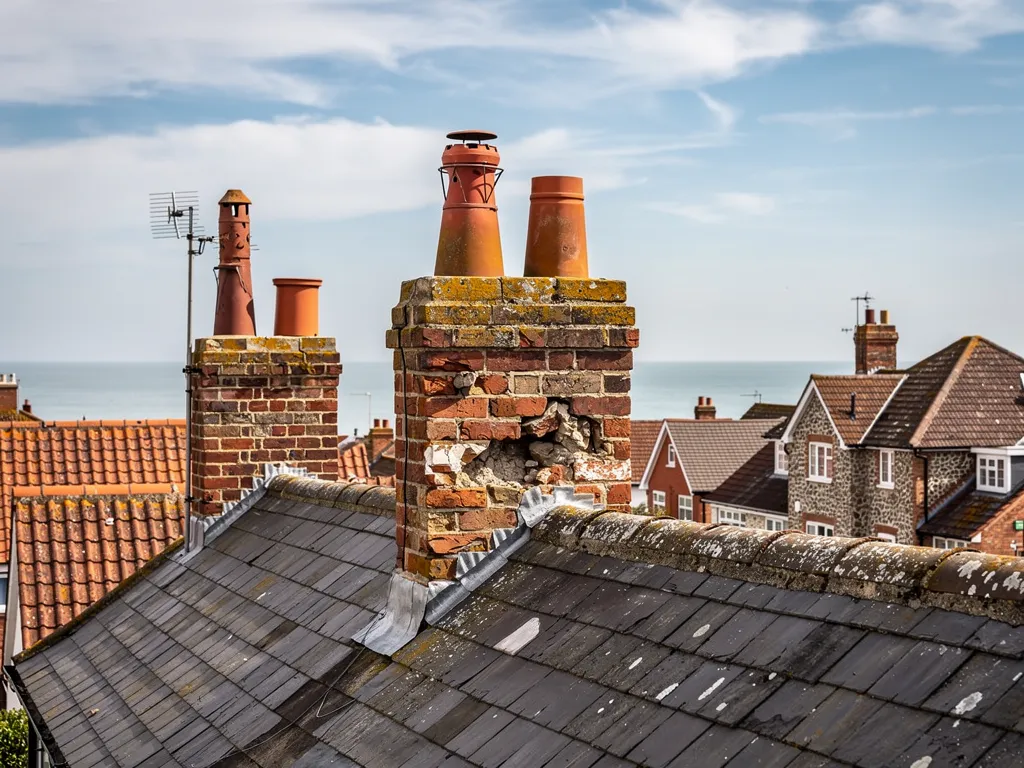
Most signs can be seen from the ground by someone who knows where to look, and binoculars do the rest. Joints that have turned from a clean line into a hollow groove are the first sign. Sandy grit gathering on a flat roof, in the gutter or below the stack is another. Brick faces that are still sound but sit in joints that have gone soft or sandy are a classic repointing case.
Inside the house, damp patches on the chimney breast, especially after wind-driven rain, can start with open joints high above, though flashings and flaunching can cause the same stain. For that reason the whole stack is checked at the survey, not just the joints. A fault in the lead or the cap may be doing the damage while the pointing gets the blame. Our guide to why a chimney leaks covers how to tell them apart.
Signs that repointing is not enough
Repointing helps only where the bricks beneath are sound. If their faces are flaking off in layers, if the stack leans or bows, or if horizontal cracks run through several courses, fresh mortar will not hold the structure together. Those faults point towards rebuilding part or all of the stack.
A careful survey sorts the two cases early. We photograph the stack from the scaffold or the roof, show you the joints and the bricks side by side, and say plainly which job it is. Where a repair will properly do it, a repair is what the quote contains. If it will not, you hear that plainly, with the evidence. Either way you see the evidence first, and the price follows it.
Raking out: the step that decides how long it lasts
Most of the skill in repointing lies in the preparation. New mortar only sticks well to a clean, sound, slightly damp joint, so the old material has to be removed first. This is called raking out. The joints are cut back by hand or with a small tool, back until the mortar left is firm and the edges of the brick are bare.
The cut has to be square at the back. A shallow scrape that leaves a thin skin of old mortar gives the new filling nothing to grip, and it will drop out in the first hard frost. Equally, an angle grinder pushed too hard can chip the brick arris, the sharp outer edge of each brick, and leave a ragged line that no mortar will hide. On soft old bricks we favour hand tools for that reason.
After raking, the joints are brushed out and the dust is cleared, then the stack is damped lightly so the old brick does not pull the water out of the new mortar too fast. Mortar that dries too quickly turns weak and powdery.
Working from the top down
The work proceeds downwards from the crown, so that debris and mortar splashes fall onto work still to be done and not onto work that is finished. Pots, the flaunching and the pointing around them are looked at first, because they drain water onto everything beneath. If the flaunching has cracked, it is renewed in the same visit, as explained in our guide to chimney flaunching.

Choosing the mortar
Mortar is not a single material, and choosing the wrong one is the commonest cause of repointing that fails or does harm. As a rule, the mortar should be slightly softer and more porous than the brick. Moisture then leaves the stack through the joints, which are cheap and easy to renew, and not through the brick faces, which are not.
A modern cement-rich mix is hard and dense. On a stack of soft, old, low-fired bricks it can trap moisture inside the brick, and frost then pushes the faces off. This is the damage called spalling, and it is the usual result of cement repointing on old stacks. Many Victorian and Edwardian houses near the seafront in Worthing, and the older flint-and-brick cottages up on the Downs, were originally built with a lime mortar for exactly this reason. Matching that softness matters more than matching the colour.
On newer brickwork, such as a post-war stack or a 1930s semi, a standard sand and cement mix is usually acceptable, provided it is not stronger than the brick. We check the brick type, its age and its hardness at the survey before choosing, and where the house is a listed building or lies in a conservation area, the mortar specification can be a planning question as well. The survey notes which mix suits your brickwork.
Colour and finish
A good match to the original joint profile and colour keeps the stack looking like the rest of the house. A flush joint, a slightly recessed one and a weathered one each suit different brickwork, and the survey notes which fits yours.
Access, scaffold and working safely at height
A chimney stack is among the hardest places on the house to work at, and for repointing the access matters as much as the mortar. Ladders are not a safe way to rake out and point a stack for several hours. Scaffold, or a properly braced tower on a lower roof, gives a stable platform, lets the work be done with both hands, and keeps tools and debris from falling.
MyBuilder (updated 21/08/2026) gives chimney scaffolding as a typical UK range of £400 to £900. Where it stands on or over a public footway or road, the scaffold firm must hold a licence from the highway authority under the Highways Act 1980 section 169. Around Worthing and Adur West Sussex County Council issues the licence, and wants a minimum of 10 working days from application to erection. Planning that early avoids delay once the repointing itself is agreed.
Hence a small stack with awkward access can cost more to repoint than a bigger stack with an easy roof.
Weather and timing
Repointing is best done in settled, mild weather. Fresh mortar needs several days without hard frost or heavy rain to cure. Late spring and early autumn are often the easiest windows on this coast, though the work can go ahead in other months when the forecast allows. Windy days are a problem for different reasons, since it is unsafe to work on a stack in strong gusts, and we reschedule rather than take the risk.

Typical published ranges for repointing
Cost is usually the first question, so here are the published figures, with their source and date. MyBuilder (updated 21/08/2026) gives a typical UK range of £500 to £2,000 for repointing a chimney, with an average of around £750. The same guide breaks that down by house type.
| House type | Typical UK range |
|---|---|
| Bungalow | £200 to £700 |
| Semi-detached, side stack | £600 to £900 |
| Semi-detached, central stack | £900 to £1,500 |
| Detached | £700 to £900 |
These are national figures, so they are a rough guide, not a price for any particular house. What narrows them down is the height of the stack, how much of it needs raking out, which mortar the bricks call for, and whether the scaffold is included. Always ask whether the figure on a quote covers scaffolding and VAT, since that one point can explain a wide gap between two prices.
Two further points sit behind the numbers. A stack that serves several flues has more brickwork and more pots to work around than a single-flue stack. And a stack that shares a wall with the house next door brings extra care over where the work stops. None of that shows up in a national average, which is exactly why the survey comes before the price.
For a fuller walk through the numbers, including rebuilds and lead, see our guide to what chimney repair costs.
Once the survey is done, you receive a quote in writing as one total, priced fairly, alongside photographs of the joints and the bricks so you can see what the price is for. Nothing is added later without being shown to you and agreed first.
Height, pots and what repointing leaves alone
Repointing renews mortar and nothing else. It does not alter how tall the stack is, which flues it serves or where the pots stand, which matters if you have come across talk of rules about chimney height. The 3-2-10 rule mentioned on some websites is an American rule of thumb and not a requirement here. Our short guide to the 3-2-10 rule explains what applies in England.
Approved Document J sets outlet heights for wood and solid-fuel flues in England: a flue passing through within 600mm of the ridge, for instance, should end at least 600mm above that ridge. Any change to the height of a stack is a separate job from repointing, and it needs to be checked against the appliance it serves. If a stack is out of use, that is also worth telling us at the survey, since capped and unused flues have different needs.
Looking after the work afterwards
Fresh pointing needs little attention, but a look every year or two from the ground, with binoculars, catches a new gap early. After a hard winter, check again for crumbs of mortar in the gutters. Moss on the north face of a stack holds moisture against the joints, and gentle removal helps. High-pressure jets do not, because they cut into the mortar and can drive water into the brickwork.
If you want a stack looked at before deciding, send a few photographs from different angles, and those usually show whether the stack calls for repointing or for something larger.