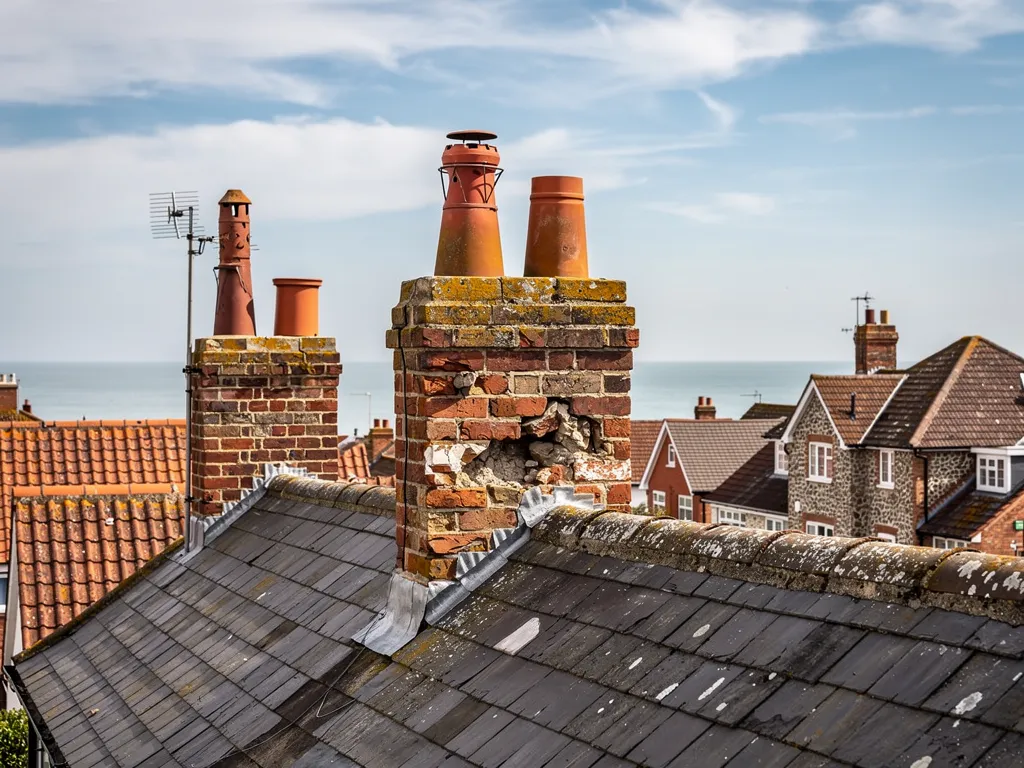
Look up at a chimney and the pots seem to sit on top of the brickwork by themselves. They do not. Each one is bedded in a thick, sloping collar of mortar that fills the gap between the pot and the edge of the stack. That collar is the flaunching, and it does two jobs at once: it holds the pots upright, and it turns the top of the stack into a small roof of its own, shedding rain outward and away from the flues.
Placed right at the crown of the stack, flaunching takes the full force of sun, frost, wind and rain with nothing above it. Mortar in that position is bound to crack in the end. When it does, rain finds the cracks, runs down between the pot and the stack, and soaks the brickwork inside, often showing as a tide mark on the chimney breast in a bedroom or the loft.
This guide explains what good flaunching looks like, the faults to watch for from the ground, and how a proper replacement is carried out. Flaunching is one of the cheaper parts of a chimney to put right, but also one of the most often missed, and it is a common cause behind a leaking chimney.
What flaunching does at the top of a stack
A chimney pot is a clay or terracotta tube that extends the flue upward and improves the draw. It has to be fixed firmly, since a loose pot is a hazard to anyone below, and it also has to be sealed against rain. Flaunching achieves both. A bed of mortar is built up around the base of each pot, and the surface is shaped into a smooth slope that falls away from the pot towards the edge of the stack.
The shape is the important part. A well-made flaunching is thickest next to the pot and thinner at the rim, and it finishes with a small overhang, called a drip, that throws water clear of the brickwork under it. Without the slope, water would sit in pools around the pot. Without the overhang, water would run back under the lip and into the top courses of brick.
Several pots on a wide stack usually share one flaunching bed, so the cap is a broad surface and not a series of little collars. A flue that has been capped and is no longer in use may have a slab or a ventilated cap, which is bedded in the same way and has the same weak spots.
Flaunching and the other seals on a stack
Flaunching works alongside two other water barriers. The pointing between the bricks seals the sides of the stack, and the lead flashing seals the stack where it leaves the roof. If any of the three fails, water gets in, and a failure in one often hides a failure in another. For that reason we check all of them whenever one is in question. The repair of the middle layer is covered in our guide to repointing a chimney stack.
Why flaunching cracks and fails
The cause is nearly always the same: mortar is a hard, brittle material in a place where everything around it moves. Clay pots and brick expand and contract at different rates as they heat in the sun and cool at night. Over many years that movement opens a hairline gap where the mortar meets the pot, and a second gap where it meets the brick.
Frost does the rest. Water that gets into a hairline crack freezes and expands, and the crack widens a little each winter. On a coastal stack, where the top is wetted often and dried quickly by sea wind, that cycle can run many times in a single season.
Other faults come from the original work. A mix with too much sand and too little binder will crumble, and one that was laid too thin can shrink and break away from the pot. Flaunching built with no slope holds water instead of shedding it. Some older caps were finished with a smear of cement or bitumen that has long since cracked.
Why a patch rarely lasts
Fresh mortar smeared over cracked flaunching does not bond to the old surface, because the old surface is dusty and loose. It might look sound for a season. In practice it falls off in the next hard frost and leaves the same gaps behind it. The same goes for sealant squeezed into cracks, which lets the stack stay wet beneath and fails as the gaps move. A lasting repair means taking off the weak material and starting again with a clean base.

Spotting cracked flaunching from the ground
You can learn a good deal from a pair of binoculars, or the zoom on a phone camera, without going near the roof. Look first at the line where each pot meets the mortar. A dark gap, a visible crack or a rim of mortar that has pulled away from the clay all suggest the seal has gone. Pieces of mortar or small grit lying on the roof slope below the stack are another giveaway.
Next look at the shape. A cap that has lost its slope, with patches missing or chunks broken from the edge, is no longer shedding water. Moss, grass or small plants rooting in the mortar mean it holds moisture and has already cracked. A pot that leans, or moves in a gale, is a more serious sign, since the bed beneath it has failed.
Inside the house, watch for damp or brown staining on the chimney breast, usually highest in the upper rooms and the loft, and worst after driving rain from the coast. Salts can bloom on plaster as a white powder. Wallpaper may lift on the breast, and the smell of damp may follow.
When to act quickly
A loose or leaning pot should be dealt with at once. It can fall in a gale and hurt someone below or damage the roof, so keep people clear of that side of the house until it is secured. Cracked flaunching with no sign of movement is less urgent, but it should not be left for years, because the water it admits works on the brickwork all the time. We prioritise leaks and make the stack safe first, then repair the cause properly once the weather and the access allow.
How flaunching is replaced properly
Replacing flaunching is a short, skilled job, but it depends on doing the preparation properly. Work starts from safe access, either a scaffold or a tower, because a ladder is no safe place to stand while breaking out mortar around pots. The old mortar is chipped away from around each pot until sound brick and a clean pot are exposed. If any pot is loose or cracked, it is lifted off at this point, so that its seating can be checked.
The top course of brick is inspected next. If the bricks beneath are loose, or the bed has been soaked for years, that part of the stack may need rebuilding before a new cap is worth fitting. The bricks and old joints are brushed clean and dampened a little, so the new mortar will bond properly instead of drying out too fast.
The new flaunching is then built up in a workable mix, firmly packed against the pot and the brick, with the surface sloped away from the flue. The overhanging drip is formed at the edge, and the finish is smoothed so water will run off and not settle. Pots that are in good order are reset in the fresh bed, and any that are damaged are replaced.
Curing and the weather
New mortar needs time to cure. Fresh flaunching dries slowly if shaded and faster in sun and wind, and strong frost or heavy rain in the first days can damage it. We plan the work for a spell of settled weather where we can, and cover the work if the forecast turns. Because the scaffold is already in place, this is a sensible time to deal with pointing or lead on the same stack. Where the brickwork below proves to be past saving, the route is covered in our page on chimney rebuilds.

Pots, cowls and what sits in the flaunching
The pots and their fittings are part of the same repair, so it pays to look at them when the cap is open. Clay pots can crack from the inside as flue gases and frost work on them, and a hairline split can widen until a section drops away. A pot with a chipped rim is usually fine, but one with a vertical crack should be replaced while the bed is exposed.
If the flue is in use, the pot may carry a cowl, a cap that stops rain falling down the flue and helps keep downdraught under control. An unused flue should be closed over at the top but still ventilated, so the damp inside the flue can escape. Capping it with a solid, sealed lid and no vent invites condensation, and that can show up on the chimney breast as a stain with no obvious source.
A bird guard, a wire cage that keeps nests out, is also bedded in the flaunching or fixed to the pot. It should be checked at the same time, because a blocked flue is a danger for any fire or boiler it serves. Nesting birds are protected, so if a nest is found in use, work on that flue is timed around it.
Matching what is already there
On Victorian and Edwardian terraces and villas, which are common near the seafront, the pots are often a feature, tall, decorative and sometimes grouped in sets. Where a pot is cracked beyond saving, we aim to match its type and height. Where the whole group is sound, we reset it as found and renew the mortar around it, so that the skyline of the house does not change.

Deciding between a repair and something larger
Most cracked flaunching can be solved with a straightforward renewal, which is the smaller job and the right one for that fault. The bigger decision comes when the survey shows the damage is not confined to the cap.
Look at what the water has already done. If the top courses of brick are sound, a new cap and perhaps a little repointing is usually all that is needed. If the water has run down the stack for years, the brick faces below may have flaked, the joints may be gone, and a section of the stack may have to be taken down and relaid. That is the point at which a repair stops being enough.
We show you what we find. Photographs of the cracked cap, the open joints and the state of the bricks accompany the written quote, so the reason for each proposed job is plain. The price is set by the access, the number of pots and flues, the state of the brickwork beneath and whether other work is done at the same time. The quote is one written total after the survey, and the figure is a good, fair one.
What to ask a roofer
Ask whether the old flaunching will be taken off fully and not simply covered. Ask what mix will be used and how the slope and drip will be formed. Ask whether the pots will be checked and reset. And ask how the stack will be reached. Those four answers say a lot about how long the repair will last.
We leave the roof and garden clear of rubbish when we go, and the old flaunching comes down with us. More on the wider range of work is on our chimney repairs page.