No other part of the roof faces as much weather as the stack. It rises clear of the slope, wet on every face, with warm smoke gases rising inside it and sea weather pushing at it from outside. Most years it asks for little more than fresh pointing, a check of the flaunching and a look at the lead. Now and then the damage runs deeper than the joints, and a surface repair only buys a few months.
Rebuilding means taking the stack down, usually to the roof line or to sound brickwork just beneath it, and building it back with the same bricks or close matches. It costs more than repointing, so it helps to know when it is the right job and when it is not. The tests are simple. Is the stack out of line? Are the brick faces breaking away? Does the mortar crumble right through the joint, or only at the surface?
We trace the fault before we quote, show you photographs of your own stack, and propose the least work that fully cures it. Sometimes that is repointing. Sometimes it is a rebuild, and this guide explains how we tell the difference.
Signs that repointing will not be enough
Start from the ground, with binoculars if you have them, or from an upstairs window, and look at the stack as a whole before you look at any single joint. A stack that needs rebuilding usually shows several signs together, and they tend to worsen together.
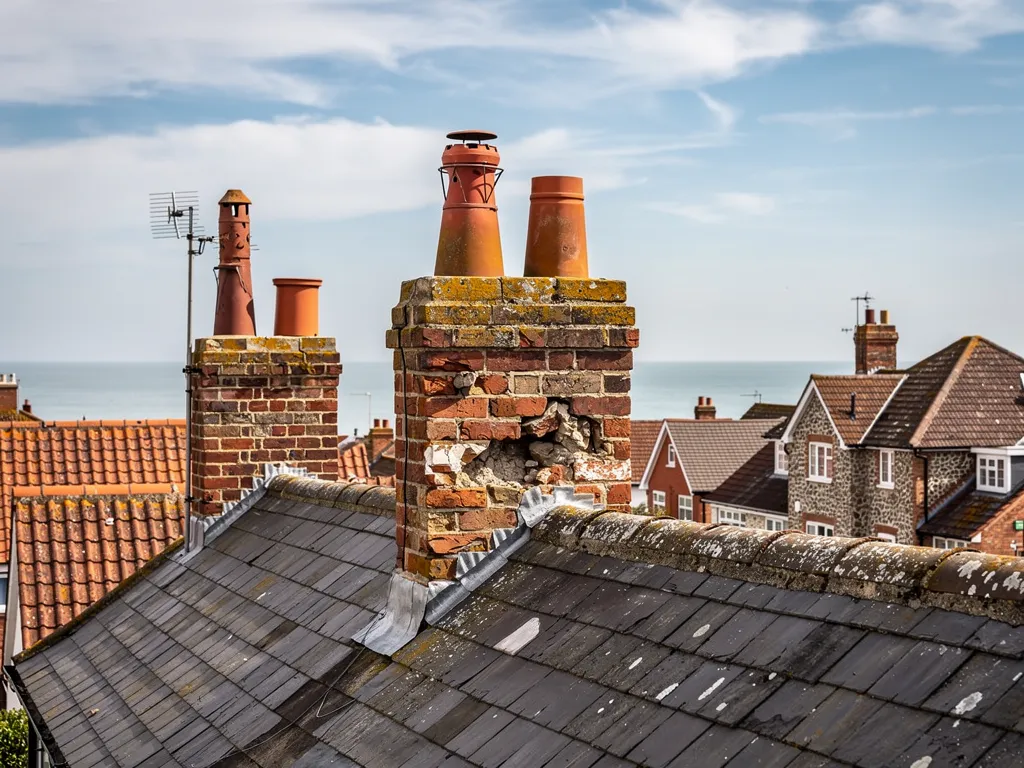
Look at the line first. Hold your arm out and compare the edge of the stack with a door frame or a downpipe. If it bows, steps out at one course or tilts as a single piece, the trouble is structural rather than cosmetic. Look next at the brick faces. Where the outer skin has flaked away in layers and left rough, powdery surfaces, the bricks themselves are failing, and new mortar between them will not hold them together. Look at the joints last. Pointing that has worn back by a finger's width is a repointing job. Mortar that has turned to sand and drops out when you rub it, or that has gone from so many courses you can almost see daylight through the stack, is a different grade of fault.
What the house itself tells you
The loft and the chimney breast carry clues too. Damp patches that return on the breast every winter, brown staining on the wallpaper and crumbling plaster near the ceiling suggest water is running down inside the stack instead of around it. Grit and flakes of mortar in the grate tell you the flue lining or the inner brickwork is breaking up.
No single sign settles the question, which is why we go up and look before anything is priced. One failed course on an otherwise sound stack can be taken down and rebuilt on its own, a smaller job than a full rebuild. Our guide to why chimneys leak covers the water paths that look like structural damage but are not.
A stack that leans or bulges
Leaning is the clearest reason to rebuild, because a stack that has moved once will keep moving. The usual cause on a stack that has served a coal fire or an oil boiler is sulphate attack, which our guide to a leaning chimney stack explains in full. In brief, flue gases carry sulphur compounds, these react with the cement in the mortar, and the mortar expands. The joints on the wetter side swell more than those on the drier side and push the stack out of line, a little more each winter.
A slight lean in an otherwise sound stack can sometimes be put right by taking down and rebuilding only the top few courses. Beyond that, the whole stack above the roof is rebuilt, because mortar that has been through sulphate attack has lost its strength all the way down, not just where you can see it.
Look for a horizontal crack across the stack, usually just above the roof line or at the level of the pots. A step where one course has slid sideways is a more serious sign again. So is a stack that visibly sways when the wind gets up, or a pot that has shifted in its flaunching.
Why waiting costs more
A stack is heavy, and it sits on a slope above rooms people use. If brickwork comes down it can go through tiles, into a gutter or into the garden below. We make a damaged stack safe first, taking it down to a level that is stable, and we do not leave a worsening lean for the next gale to settle. Rebuilding while the stack still stands is also kinder to the roof, because the timbers, tiles and ceilings underneath stay intact.

Spalling bricks and the damage frost does
Spalling is the word for a brick face that breaks away in flakes or sheets. On a chimney it happens because the stack is wetter and colder than the rest of the house. Rain soaks in from every side while the flue warms the inside, so the bricks go through repeated cycles of wetting, drying and freezing. Water frozen inside a brick expands, and the surface gives way. Our page on spalling chimney bricks looks at the causes in more detail.
One or two bricks that have lost a face can be cut out and swapped for matching ones, and that is a repair. The balance tips when spalling has spread across a whole face or through several courses. A brick that has lost its hard outer skin soaks up water faster, so it spalls faster, and the damage speeds up. Setting a few new bricks into a stack of failing ones only leaves the old ones to fail beside the new.
Hard mortar on soft brick
Cement pointing is a common reason bricks spall. Cement is harder and lets less moisture out than many older bricks, so water leaves through the brick faces instead of through the joints, and the faces take the punishment. A stack pointed hard over soft brick may look fine for a few winters and then shed its faces quickly. If your house is older, the guide to lime mortar on old chimneys explains the gentler alternative.
Bricks for the rebuild are chosen to match the originals in size, colour and texture. Where the old bricks are still sound we clean them and reuse them, and only the failed ones are replaced, so the stack keeps its character and the new work blends in once it has weathered.
Mortar that has failed right through
Pointing is only the outer face of a joint. Behind it the mortar bed does the real work of holding the courses together and keeping the stack upright. When that bed has dried out, perished or washed away, the joint looks acceptable from a distance but carries nothing, and fresh pointing laid over it simply sits on a void.
We test this by raking out a few joints at the start of a survey. If the mortar comes out cleanly to a sound edge, repointing is the right answer. If it falls out in handfuls well beyond the surface, or the bricks can be moved by hand, the bed has failed and the courses need lifting and relaying. That is the point at which repointing turns into a rebuild, even if the bricks themselves look healthy.
The parts around the brickwork
The parts around the brickwork carry equal weight. The flaunching, the mortar collar sloped around the pots, sheds water off the top. When it cracks, rain gets in at the very top and works down. Our page on chimney flaunching covers when that alone is the fault. Lead flashings and trays, which seal the stack to the roof, can lift or split and send water into the brickwork underneath. A stack that has been wet from the top and the base for years often needs the whole thing renewed together.
Where a flue is no longer used, a rebuild is also the moment to decide how it is finished. Capping a chimney with a ventilated cap keeps rain out while letting the flue breathe, and it is easier to do properly while the top is open than to add later.

What a rebuild involves, course by course
A rebuild starts with access. A stack stands high above the gutter line, so scaffolding is nearly always needed, and where it must stand on the public footway the scaffold firm arranges a licence with the highway authority. That takes notice, so the lead time goes into our plan from the start.
The stack is then dismantled from the top, one course at a time, and the sound bricks are set aside and cleaned of old mortar. Work goes down to the first level that is solid, which may be the roof line or a few courses below it. If the base is weak you hear about it before the first brick is lifted, because the new work depends on the ground it is built on.
Building it back
The courses are relaid on a mortar mix chosen to suit the bricks, with lime used on older stacks, and the bond is matched to the original so the stack looks as it did. A lead tray or damp-proof layer goes in where the stack passes through the roof, and the lead flashings are dressed fresh around the base. New flaunching is laid, the pots are bedded in it, and any cowl or cap is fitted.
If the flue is in use, we recommend a sweep and a check of the lining before the fire is lit again. Height matters here too. Approved Document J governs wood and solid-fuel flues in England, and where a flue emerges within 600mm of the ridge, its outlet should stand at least 600mm above that ridge. The American "3-2-10" figure you may read online is a different thing, and our note on the three-two-ten rule explains why.
Published prices and what moves them
What follows are typical national ranges from published cost guides, not a price for your stack. MyBuilder (updated 21/08/2026) gives around £750 for chimney repointing, within a range of £500 to £2,000, and £2,000 to £10,000+ for a stack rebuild. The width of that rebuild range is itself useful information. It tells you the job varies a great deal from one house to the next.
A rebuild is priced by what the survey finds: how tall the stack is, how many flues and pots it carries, how much of it must come down, and how awkward the slope is to work on.
| Job | Typical UK range | Source |
|---|---|---|
| Chimney repointing | £500 to £2,000 | MyBuilder, updated 21/08/2026 |
| Stack rebuild | £2,000 to £10,000+ | MyBuilder, updated 21/08/2026 |
| Scaffolding for a chimney | £400 to £900 | MyBuilder, updated 21/08/2026 |
Other factors push the price up or down: brick that is hard to match, a shared stack with a neighbour, a steep slope, or lead work that must be renewed alongside. Our guide to chimney repair costs works through these by house type.
Rebuild, remove or lower?
If the fireplace is long disused, the choice is wider than rebuilding to the same height. Removing the stack above the roof is possible, but it has permission and party wall questions of its own. Once we have surveyed, the quote is written, with one total price and the rebuild height, flue treatment and flashing set out beside it. If you are collecting several quotes, see whether each covers VAT and the scaffold. The wider picture is on our chimney repairs page.