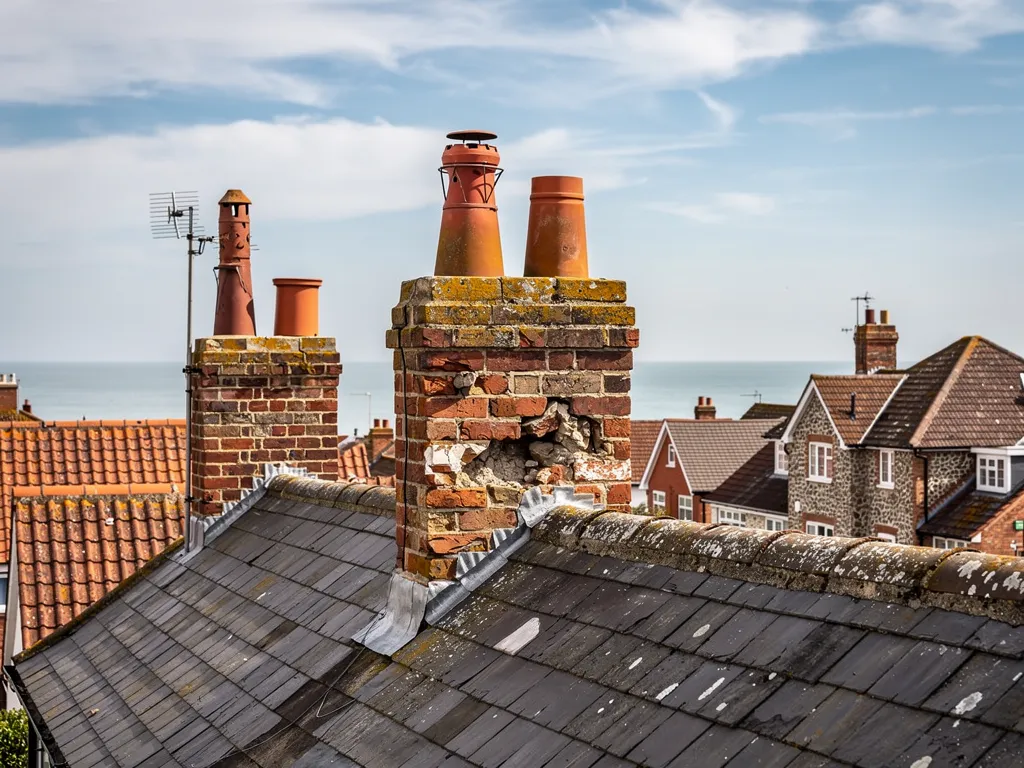
Pick up a loose piece of mortar from the base of an old chimney and it is often soft enough to crumble between your fingers. That is not neglect alone. Before cement became the builder's default, brick and stone were laid in lime, a mortar that is softer than the bricks, takes up and gives off moisture and moves slightly with the weather. The stack was designed as a whole, and the mortar was meant to be the weaker, more sacrificial part.
Of all the brickwork on a house, the stack takes the worst of the weather, wet on every face and often heated from the inside, so the choice of mortar shows up there sooner than anywhere else. Pointing laid in strong cement on top of soft old brick can look neat for a few winters, and then the bricks begin to flake, because the moisture has to leave out through the brick face, not the joint.
This guide explains what lime does, why cement can harm period stacks, how a roofer should match a mix to your bricks and what the rules say for listed buildings and conservation areas. It also covers the questions worth putting to anyone who quotes for the work.
What lime mortar is and how it behaves
Lime mortar is made from lime, sand and water. It sets slowly, partly by drying and partly by taking carbon dioxide from the air, and it stays comparatively soft and porous once it has hardened. Different kinds of lime set in different ways. Some set mainly by exposure to the air, while hydraulic limes also set through a chemical reaction with water, so they cure faster and harder. The right choice depends on how exposed the work is, and a stack is about as exposed as masonry gets.
Three qualities make lime suited to old brickwork. It is permeable, so moisture that gets into the stack can move out through the joints and evaporate. It is flexible, so small movements from heat, cold and settlement are taken up in the joints as fine cracks rather than in the bricks. And it is weaker than the brick, so if anything has to give, it is the mortar, which can be renewed, and not the brick, which cannot.
Why that matters on a chimney
A stack is a particular case. The inside warms and cools with the fire, the outside is soaked and dried by the weather, and frost works on it through the winter. Moisture needs somewhere to go. With lime, it goes out through the joints. With a hard cement mortar, the joints stay sealed and moisture is pushed into the bricks, which then take on water, freeze and shed their faces. That pattern of damage is described in our page on frost damage to chimneys.
None of this makes lime delicate. A lime-pointed stack that is well made and looked after will stand for a long time, and renewing a worn joint is a simple repair.
Why strong cement can do harm
Portland cement mortar became the standard in the twentieth century because it sets fast and hard. On new, hard-fired brick it works well. On an older stack built of softer bricks, the same strength becomes a fault. Cement mortar is harder and less permeable than the brick around it, so the brick becomes the weak point. Water that cannot leave through the joint leaves through the face of the brick, taking the surface with it as it freezes.
There is a second problem, and it shows up on stacks that have served a fire or boiler. Cement mortar can react with the sulphur compounds in flue gases, a process that swells the joints and leans the stack. Our guide to a leaning chimney stack explains that sulphate attack in more detail. Lime mortar does not react in the same way, which is one more reason it suits the job.
Hard repairs are hard to undo
Once a stack has been repointed in strong cement, it is difficult to correct without damage. The hard mortar has to be cut out by hand, joint by joint, and a power tool or careless chisel will chip the arrises, the sharp edges of the bricks. We rake out by hand where the bricks are old and fragile, take the joints back to a sound depth and repoint in a mix that matches the original.
The same applies to the bed under the pots and to the flaunching on top. The mortar haunching around the pots is often made with cement, because it must shed water and set firmly. On an old stack we choose the mix to suit the stack as a whole, taking account of how exposed the top is and how the pots are bedded.

Matching the mix to your bricks
A good lime repair begins with looking at what is there. The sand gives the mortar its colour and texture, so we match it to the original by eye on the stack and, where it helps, to a sample of the old mortar. A clean, sharp builder's sand in a mix meant to match a weathered grey-buff joint will stand out and spoil the stack's look, however sound the repair is underneath.
Strength matters just as much. The rule is that the mortar should be no harder than the brick. A soft, hand-made brick wants a soft lime. A harder, later brick can take a mix with a little more hydraulic content. Getting this wrong in either direction defeats the point, and there is no single mix that suits every stack.
Joint profile and depth
The finish matters because it affects how the stack sheds water. Joints that are flush or slightly recessed shed water cleanly. A joint struck proud, or a bead built up over the brick face, creates a ledge that collects it. We copy the original profile where it survives and avoid overlapping the bricks with pointing, a mistake sometimes called a ribbon joint.
The depth of the work needs care too. Joints are raked out far enough to give the new mortar a solid bed, and then packed in layers, because a thick single layer shrinks and cracks as it dries.
Weather and timing
Lime cures slowly and dislikes frost and rapid drying. New work is protected from hard sun, wind and frost while it sets, and a stack should not be repointed in lime during freezing weather. That sometimes means choosing the right week rather than the first available. The result lasts better for it, and you can ask your roofer how they protect fresh work.
Conservation areas, listed houses and the rules
For many older homes the choice of mortar is more than a matter of good practice. In a conservation area, the planning authority can have served a direction that takes away permitted development rights, so that works to chimneys need permission. Locally, the directions for Old Shoreham and for Kingston Buci take away Class G, which deals with chimney and flue work, and the Warwick Gardens direction in Worthing lists chimney work too, whether built, changed or removed. The councils' own pages say that a direction does not prohibit development, it simply means permission is needed for what is listed. Check the address with Adur and Worthing planning before work begins.
Listed buildings
If the house is listed, the position is firmer. Any work that harms the special interest of a listed house needs listed building consent, and carrying it out without consent is an offence. Adur and Worthing Councils list repairs using materials that do not match among the works needing consent. The South Downs National Park Authority's view is that routine maintenance and small repairs that put back exactly what was there need none, while repairs changing or entirely renewing old fabric do. Pointing a stack in a hard cement mortar that departs from the original is exactly the kind of change that draws questions. Our page on listed chimney repairs sets out the repair side in more detail.
Inside the National Park
Where a house is within the South Downs National Park, the authority is the planning authority in the parts of Worthing and Adur it has taken over, so contact it, not the district.
Not certain which rules touch your house? Ask the council's conservation team before you book the work. We can describe the repair in plain terms to help, but the decision on consent is theirs.

Lime, pots and the rest of the stack
A stack is a group of parts, and the mortar choice runs through all of them. The brickwork gets the lime pointing. Around it, the lead flashings and trays that join the stack to the roof are not mortar at all. Where lead tucks into a brick joint at the stack's face, it is wedged in and pointed over, and the pointing there should match the stack.
The flaunching and the pot beds are the places where the mortar question is most mixed. Pots and cowls must be held firmly against the wind, and many roofers use a stronger mix there. On an old stack the better approach is a mortar that is strong enough to hold the pot, shed water and still give with the stack, rather than a cement cap that cracks away at the edges. When a pot is cracked, loose or tilting, replacing it is a separate job, and the guide to chimney pot replacement covers what to expect. A cowl or cap that keeps the rain out changes how much water the mortar has to cope with, and our page on chimney cowls and pots compares the options.
Lime does not cure everything
Good lime pointing does not rescue a stack whose bricks have failed or whose base has moved. If courses are loose, bricks are crumbling through, or the stack leans, the question becomes one of rebuilding, and the mortar for the rebuild should be lime on an older stack for the reasons above. A lime repair also does little for water arriving from elsewhere, such as a failed back gutter or a lifted flashing. We find where the water gets in before deciding what the mortar has to do.

What to ask a roofer and how the price is set
A few plain questions show whether a roofer understands the job. Ask what the mortar will be, and why it suits your bricks. Ask how the old mortar will be removed, by hand or with a grinder. Ask how the work will be protected while it cures, and what the joint will look like when it is finished. A roofer who has worked on period stacks will answer without hesitation, and a vague reply is a warning.
Ask, too, for the plan to be written down. Our survey includes photographs of your own stack, taken from the roof, and the written quote that follows says what is to be done to which part. We price only the work the fault needs, and if your stack wants only its worst joints made good, that is what you are told.
What sets the cost
MyBuilder (updated 21/08/2026) gives a typical UK range of £500 to £2,000 for chimney repointing, with around £750 as a typical figure. The spread comes from the stack itself: its height, the number of faces, the state of the old mortar and how much of it is easy to get at. MyBuilder's guide also puts scaffolding for a chimney at £400 to £900. Lime repointing is slow, careful work, done in layers and protected as it cures, which affects the time on site.
Our quote is written, follows the survey and carries one total, and it names the mortar mix being used. When several quotes land, check that each covers scaffolding and VAT. More about the trade sits on our chimney repairs page. Repointing in lime is also one part of the wider job of repointing a chimney stack, which describes the sequence from start to finish.