A stack stands above the ridge, wet on all four sides and open to the wind. Nothing else on the house is so exposed, and nothing shelters it. Where the roof has the tiles to throw water off, a chimney has only its bricks and the mortar between them, and both are porous.
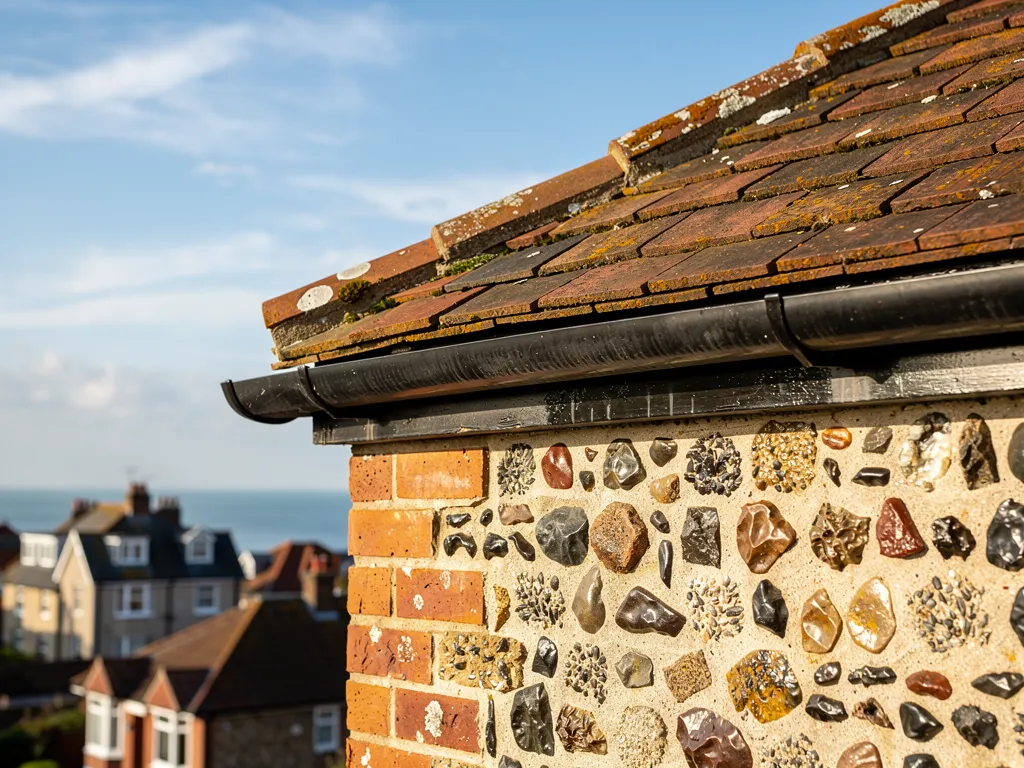
That porosity is the root of frost damage. Brick and mortar soak up rainwater like a sponge. When a cold night freezes the water inside, the ice takes up more space than the water did and pushes outward. One freeze does little. Season after season, the face of a brick flakes off or the mortar crumbles, and the next shower reaches deeper. This breakdown is called spalling when it affects the brick face, and failed pointing when it hits the joints.
Left alone, the damage works downward. Water gets into the stack, down the flue and into the breast, and shows indoors as damp on a bedroom wall. This guide sets out how the damage happens, what to look for from the garden, which repair fits which kind of damage, and how to time the work. We also cover typical costs from published UK ranges. More on the wider work is in our chimney repairs hub.
How frost breaks brick and mortar
Water is the cause, and frost is the force that finishes the job. A brick that is dry in July can be nearly saturated by February, especially on the faces that take the rain. When the temperature falls below freezing, the water in the outer layer of the brick turns to ice and expands. The surface has nowhere to go, so the weakest skin gives way, and a flake the size of a coin drops off.
Mortar goes the same way. The joints between bricks are meant to be the sacrificial part, a little softer than the brick so that any movement or weathering takes place in the mortar and the brick is left whole. When pointing is worn back by years of rain, the joints are deeply recessed, hold water and freeze, so the bricks either side lose their edges as well.
Why the stack goes first
Several things pile onto a chimney at once. It is surrounded by air, so it cools faster and warms more slowly than a wall, and the temperature around it swings further. Every face is wet when the wind drives the rain. And the top of the stack, where the flaunching and the pots sit, catches water coming straight down with no overhang to protect it. A chimney on an exposed coastal house gets a full dose of gales and driving rain from the Channel, and a stack on a sheltered house still gets frost.
Frost is not the only wear. Sun, wind, algae and slow wetting and drying all contribute, and our page on spalling chimney bricks goes into the brick face itself.
Reading the signs from the ground
You do not need a ladder to see most of the early signs. Stand back at the far side of the garden or the road, in good light, and look at the stack with binoculars or a phone camera zoomed in. Look at the colour first. An evenly faded stack is usually sound. Dark patches, or a clear difference between the sunny and shaded sides, mean it is holding water.
Then look at the texture of the bricks. Faces that have lost their skin look rougher and paler where they have flaked, and small pieces of brick or mortar may lie in the gutter or the border below. A stack whose joints stand proud of the brick, or whose joints have disappeared into dark gaps, needs attention. Mortar that has turned white and powdery, or that you can see crumbling, is on its way out.
Signs that point to a bigger problem
- A lean, or a stack that seems to bow at one corner.
- Horizontal cracks, which can mean the stack has moved.
- Pots that sit at different angles, or a cracked flaunching.
- White crystalline deposits on the brick, which are salts drawn out as moisture dries.
- Damp or staining on the chimney breast in the loft or bedroom.
Salts on their own are not an emergency, but they show that water is travelling through the stack. A leaning stack is a different matter, and our page on a leaning chimney explains what to do.
Inside the loft, look at the brickwork where the stack comes through. Damp, dark stains on the brick or timber below point to water coming down the stack, though the entry could equally be a failed lead joint at the roof. Our guide to chimney flashing shows how to tell the two apart, because they are repaired differently.

Repointing, replacing bricks or rebuilding
The damage decides the repair, and a good survey separates three cases.
Failed pointing with sound bricks is the simplest. The old mortar is raked out to a set depth, the joints are cleaned and dampened, and new mortar is pushed in and finished to match. The result is a stack that sheds water through its joints again. Our guide to repointing a chimney stack describes the work in order.
Spalled bricks need more. A brick that has lost its face can be cut out and a matching one put in, one at a time, so the stack keeps its look. This is called cutting in or tooth-and-bond work. If only a few bricks have gone, it is a modest job. If whole courses have failed, replacement is no longer a patch.
The mortar choice
Mortar should be weaker than the brick, never stronger. An old stack built in lime, repointed in hard cement, turns the stack against itself. The cement does not give, so water and frost attack the soft brick next to it. Our page on lime mortar for chimneys sets out the choice.
When a rebuild is the right call
Where the brickwork is crumbling through, where the stack leans or is cracked, or where the mortar has gone so far that bricks move in your hand, repair stops being the cheaper route. The stack is taken down to sound brickwork and rebuilt, often reusing the good bricks. MyBuilder (updated 21/08/2026) gives a typical UK range of £500 to £2,000 for repointing a chimney, with around £750 as its usual figure, and £2,000 to £10,000 or more for a stack rebuild. The spread between those two is the reason a survey matters. We say which one the stack needs and show you why. For more on figures, see our chimney repair cost guide.
The crown: flaunching, pots and the top courses
Frost damage often starts at the very top, because the crown of the stack sees the most water. The flaunching, the mortar cap that surrounds the pots, is the first line of defence. Over the years it cracks and shrinks away from the pot, and rain finds the gap. Once water gets between the pot and the bed, it soaks the top courses of brick, freezes and lifts them. Our guide to chimney flaunching shows how to tell a sound one from a failing one.
The pots are a second weak point. A clay pot holds water in its walls and splits along a line when it freezes, and a cracked pot lets water into the flue as well as shedding fragments. Our page on pots and cowls covers replacing them and keeping rain out of a flue that is not in use.
Water running down behind the stack
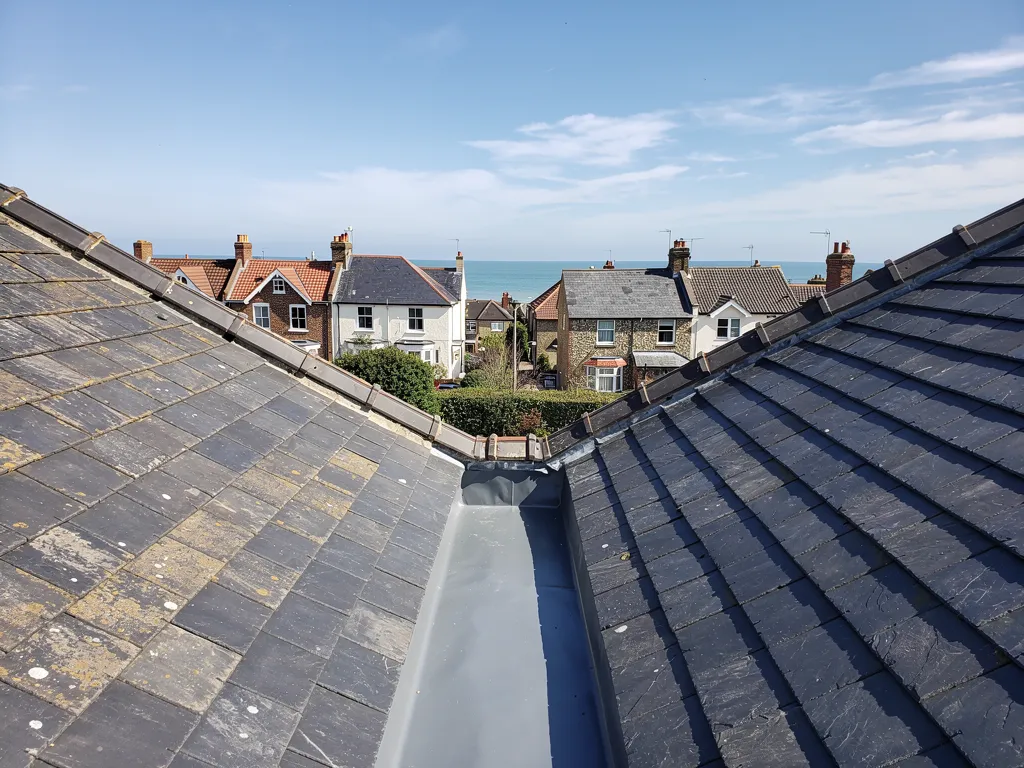
On a pitched roof, rain running down the slope meets the chimney from behind. The back gutter is the lead channel that carries water round it, and when it clogs or splits, the water pools against the brick and the brick stays wet. A stack that is wet at its base freezes at its base, and the damage is often misread as a pointing problem. Our answer on the chimney back gutter explains it, and we check it early on any stack with damp at the foot.
It is worth knowing that a repair to the brickwork alone will not hold if the water source remains. We trace where the water gets in before quoting, so that the repair closes the way in rather than treating the symptom. If there is a lead fault, a flaunching fault and a pointing fault, the written quote covers the lot as one total price, with the work ordered so that one scaffold serves all of it.

Timing the repair around the weather
Fresh mortar needs time to set before it faces a hard frost, so the calendar matters. Mortar laid in a mild, dry spell cures well. Mortar laid just before a freeze can be damaged before it has hardened, and lime mortar is the more sensitive of the two. That is why a stack that shows damage in autumn is better dealt with before the cold nights set in, not after the first freeze has done its work.
Wet weather is the other limit. Saturated bricks take new mortar badly, and rain on an open joint washes it out. On this coast a spell of fair weather can be short, so a repair is booked for the first suitable window, not left until the stack fails.
Making a stack safe in the meantime
If a stack is shedding brick and the weather rules out a proper repair, there are temporary steps. Loose pieces can be removed, an open top can be covered, and a failing section can be sheeted so water stays out. Active leaks come first, and the lasting repair follows once conditions allow.
Scaffolding is a large part of the bill and a large part of the planning. Checkatrade (last updated October 2026) gives chimney scaffolding at around £660 per week as a typical UK figure. MyBuilder (updated 21/08/2026) gives £400 to £900 for chimney scaffolding. Check whether any quote you are given includes scaffolding and VAT.
A stack looked at in September costs less to fix than the same stack looked at after a hard January, because the frost has not yet had a season to work on the open joints.
Listed buildings, conservation areas and what to send us
A chimney on a listed building, or in a conservation area with an Article 4 direction, cannot always be rebuilt or altered freely. Repointing in matching mortar is generally treated as a repair, but replacing a stack or changing it can need consent. In Old Shoreham and Kingston Buci, for example, the councils' directions take away the permitted development right over chimneys. Our guide to chimney repairs on listed buildings and in Article 4 areas sets out the detail and tells you who to ask.
Frost damage is also something an insurer may look at. Gradual deterioration is commonly excluded from home policies, while a storm that brings a stack down is treated differently, and the Financial Ombudsman Service explains how it tells the two apart. The claim stays yours, and our survey photographs the damage clearly, which gives you the evidence if you decide to ask.
What helps us before we visit
If you would like a first opinion, a few things speed it up:
- A daylight photograph of the whole stack.
- Close-ups of any area where bricks have flaked or joints have opened.
- A note of where damp shows inside the house, and when it grows.
- Whether any flue is in use, and what it serves.
We then survey the stack, trace the way in and photograph the fault, and the written quote comes with those pictures. The recommendation is the lightest repair that properly cures the cause, and a rebuild is named as one when it is the answer. Rubble leaves with us, and the roof and garden are left clear.