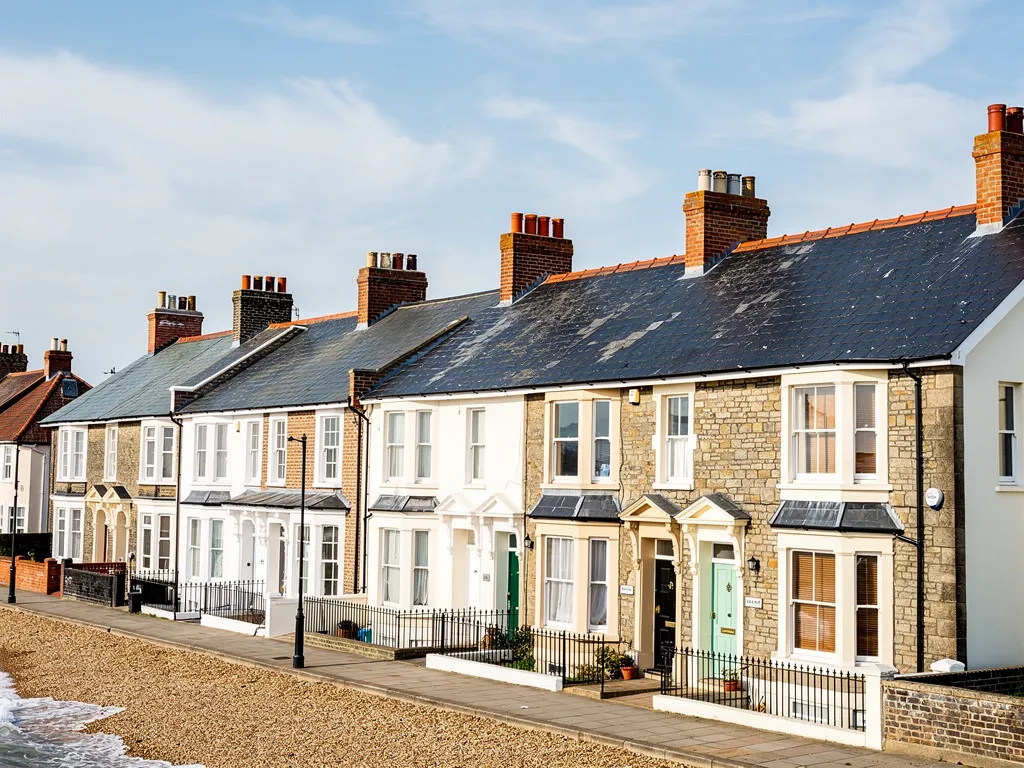
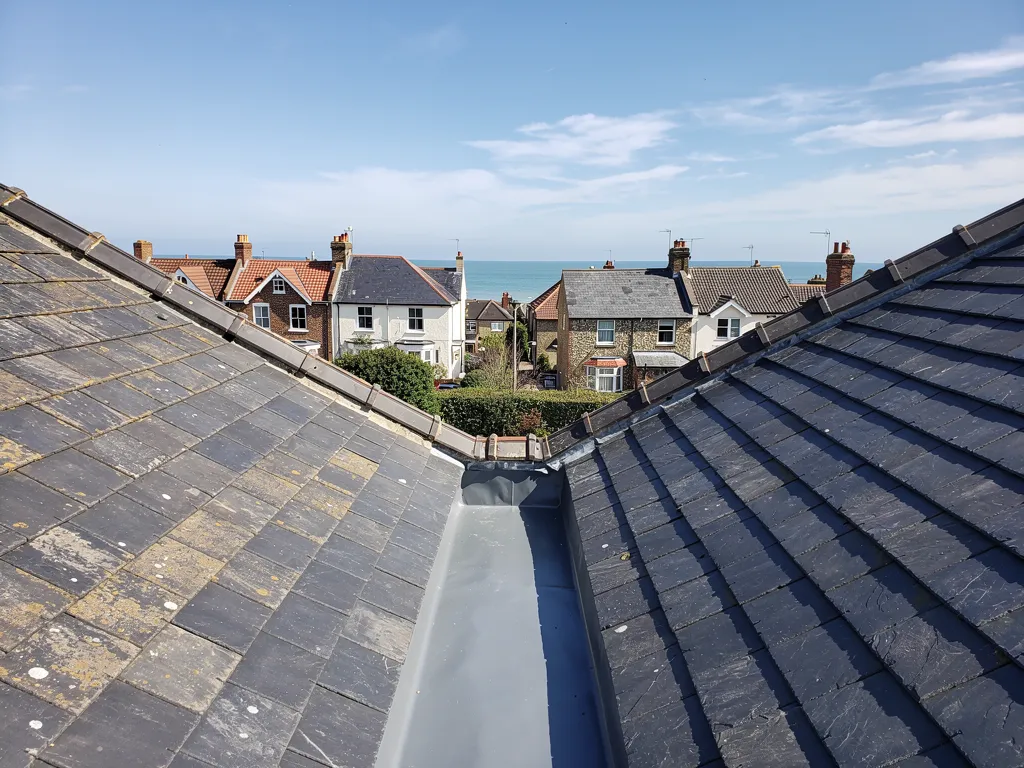
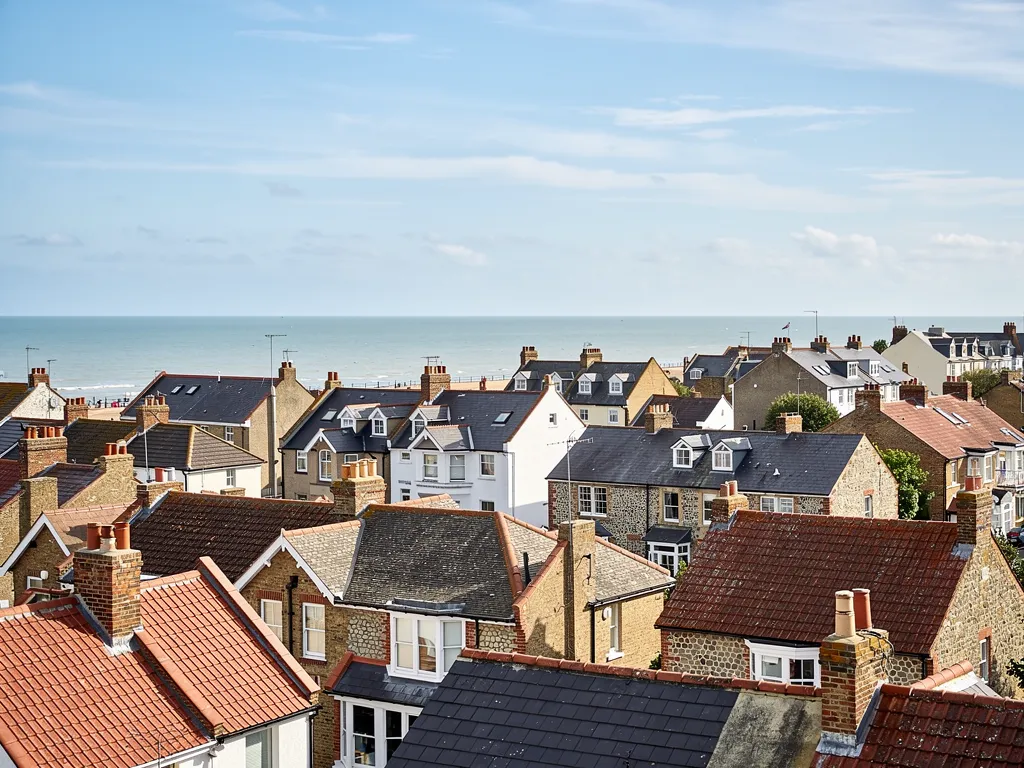
A metal roof on the Sussex coast lives in a different environment from the same roof inland. The air carries salt, gales and spray come straight off the Channel across the flat Arun plain and the seafront, and parts of a building that never meet rainwater collect whatever settles on them. Industrial units in Shoreham, Lancing, Littlehampton and along the Worthing seafront all deal with this, whatever the sheet is made of.
The questions that follow are practical ones. How near the shoreline is the building? Which surfaces are washed by rain and which are not? Is a white powdery film a fault or a sign that the metal is behaving as it should? Should the roof be washed, and how often? And what should you ask the manufacturer before you choose a finish?
This guide sets out what the published guidance says, in particular the zone system used by Vmzinc for zinc, and where it stops. Where a manufacturer's own data exists for your distance from the sea, that data is the thing to rely on. Where it does not, we say that the question has to go back to the maker.
Distance from the shoreline sets the exposure
Vmzinc, a major zinc roofing manufacturer, divides coastal locations into three zones by how far the building stands from the shoreline. The first is the sea front, up to one kilometre from the coast, which it rates as its toughest band. The second is the sea area, between one and three kilometres. The third is low maritime influence, between three and twenty kilometres.
That gives a useful frame for any metal roof, whatever the material. A building right on the seafront or at the water's edge in a harbour is likely to sit in the first band. A unit a couple of kilometres back falls in the second. A building out towards Findon or Steyning is still within the third band by distance, though its roof meets less direct sea spray.
Measuring it properly
Do not guess. Open a map, find the nearest stretch of shoreline to the building, and measure in a straight line. For a building beside a tidal river such as the Adur, ask the manufacturer how it treats estuaries, since the zone definitions refer to the coast and the answer for a harbour wall or a river mouth is theirs to give. We record the measured distance on the survey and put it in the specification, so the finish you choose is matched to the actual position of the building.
Distance is one input and not the only one. The shape of the site, nearby buildings and the way the roof faces the sea all change how much salt reaches each surface. A tall unit on open ground takes more than a low one sheltered by neighbours. The bands give a starting point for the conversation with the maker, not a promise about the life of any particular roof.
Where rain cannot reach, salt stays
On a metal roof the weather does part of the cleaning. Rain falls on the slope, carries off the salt that has settled on it and rinses the surface. The trouble starts on surfaces that are sheltered from the rain, because whatever lands there stays there.
Vmzinc says white deposits form mainly on surfaces that are not rinsed by rainwater, such as protected facades and soffits. HomeBuilding makes the same point about marine environments in general: the air in marine settings is salty enough that staining and corrosion of some metal surfaces is possible, and soffits and fascias collect salt in places the rain never washes.
The places to look
On an industrial unit those sheltered spots are easy to list:
- the underside of overhanging eaves and canopies
- soffits and the faces of fascias tucked under the gutter line
- the lower edge of cladding behind a loading-bay canopy
- sheeting under a deep overhang at a gable or verge
- the faces of parapets and returns that face away from the weather
These are the same places that are hardest to see from the ground, so a deposit can build for years before anyone looks. When we survey a coastal metal roof we check them with a camera and from access equipment, and we record what is on them. A pale film is not always harmful, but a layer that has been left to build up is harder to remove than one that has been washed away regularly, and it can hide the condition of the metal beneath.
It also helps to know which side of the building is exposed to the sea. The face that takes the direct weather is often the cleanest, because it gets rinsed, while the sheltered faces and the edges beneath the eaves gather the deposits.
Is the white film a fault?
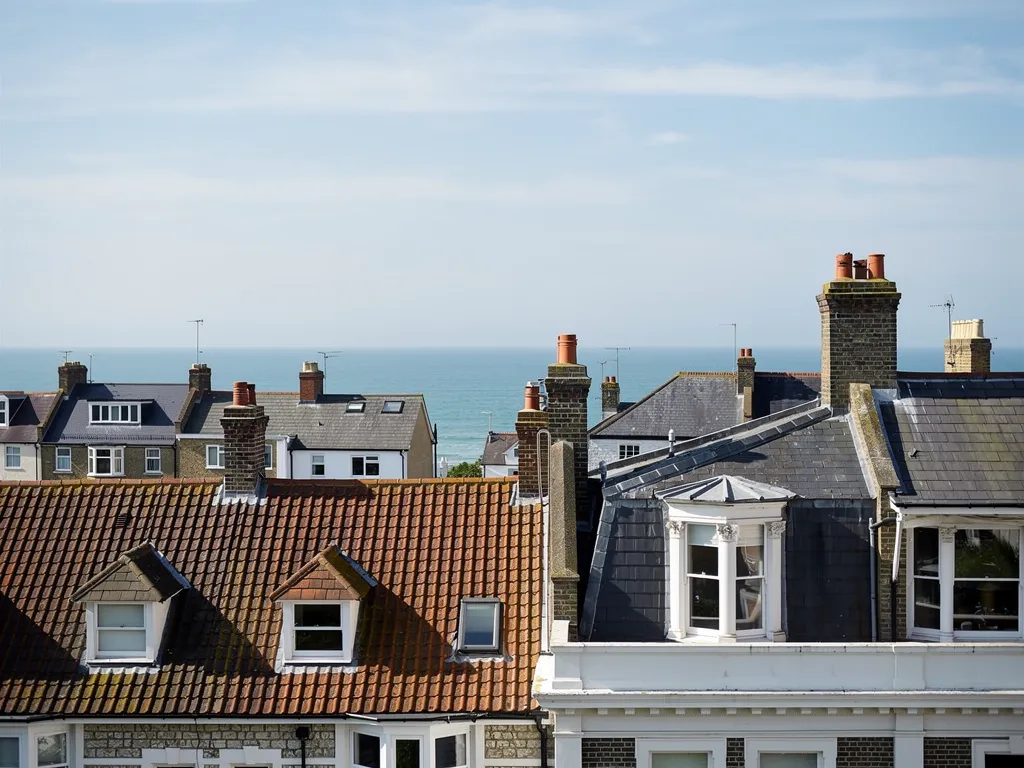
Many owners first notice the problem as a white, chalky bloom on the underside of the eaves or the lower part of the cladding, and they worry that the metal is failing. The published guidance is more measured than that. Vmzinc states that its normal warranties are valid for coastal locations and that zinc does very well there, while also saying that zinc can react with its external environment, including air with a high salt content.
Those two statements fit together. Zinc is expected to react with its surroundings, and salty air is one of them. Where rain does not reach, salt stays on the surface and shows as a white film, which is exactly what the manufacturer's washing advice is aimed at. So the film points to a surface that has not been rinsed, which is a different thing from a roof that has failed.
When to ask for a second opinion
Look closer when the deposit is accompanied by something else: a rough or pitted surface once the film is washed away, staining that tracks down from a fixing or a lap, a coating that is lifting, or water that is getting past the sheet and into the building. Those are matters for the survey and, if needed, for the manufacturer. A bloom with no other change is a maintenance item.
We would rather tell you that a roof needs a wash than quote you for a repair that it does not need. If the photographs show only deposit on sound metal, that is what the written quote will say, and the work will be a clean. If they show the metal itself has been affected, the report will say which parts and what the options are.
Washing: what the manufacturer recommends
Vmzinc's advice is simple. A rinse with clean water at least twice a year helps to keep salt deposits down. It targets exactly the surfaces that rain misses: soffits, the undersides of eaves, protected facades and the faces of cladding in sheltered recesses.
For a unit owner that turns into a maintenance task, and it is cheaper than it sounds if it is scheduled. The routine is to wash the sheltered faces and undersides with clean water, work from the top down so that rinsed salt does not run over clean metal, and let the water drain away freely through the gutters and downpipes. Avoid harsh abrasives and anything that scratches the finish, and follow the manufacturer's advice on cleaning products for the specific coating. A pressure setting that suits a masonry wall can damage a painted or pre-weathered surface.
Safe access comes first
Reaching the high parts of an industrial roof means working at height, and the sheets themselves may be fragile, particularly old cement or rooflight panels. Nobody should walk across the roof to reach an eave. Cleaning of the undersides and the edge details is done from a mobile access platform or a cherry picker, or from a ladder at the lower levels, depending on the building. Our guide to what a commercial roof costs explains how access affects any roofing figure.
If you have a maintenance contractor or a facilities team, add the roofline washes to the planned programme: one before the winter gales and one after the summer. We can set out the places to be washed with photographs, so that whoever does it knows where to look. A short log with dates and photographs lets you show the manufacturer what was done if a warranty question comes up.
Pre-weathered zinc and staining within one kilometre
Some zinc is supplied pre-weathered, with a darker or more even surface than the natural bright metal. It appeals to architects and owners who want the roof to look settled on day one. The guidance has a caution for the closest zone to the sea. Vmzinc says that for its pre-weathered products, permanent staining resulting from salt exposure is still likely within one kilometre of the sea.
That sentence matters on this coast. A building on a seafront or a harbour edge is likely to be within a kilometre of the water, which puts it in the manufacturer's first zone. If the intention is a uniform dark finish on a building at the water's edge, the finish needs to be discussed with the maker first, and you should have their answer for your address in writing before the order is placed.
How long does zinc last?
The lifespan question comes up on every zinc roof. Vmzinc puts the life of a zinc roof at more than 100 years and refers to an Environmental Product Declaration from the Building Research Establishment that states 100 years. HomeBuilding cites a contractor who gives 60 to 100 years. Those are typical figures for the metal in normal conditions, not promises for any one building, and the manufacturer's washing advice is there to keep a coastal roof in the condition those figures assume.
For a commercial building, a long life for the metal still depends on the details around it. Fixings, laps, flashings and drainage are all places where a roof can fail long before the sheet does, which is why a long-lived material does not remove the need for periodic inspection.
If a zinc or other standing-seam roof is part of a larger plan, such as overcladding an older sheet roof, the finish and zone question belongs at the start of the design.
What a coastal metal roof survey records, and what to ask the maker
A survey of a coastal metal roof records different things from one inland. We note the measured distance to the shoreline and the direction the building faces. We photograph the sheltered surfaces, the soffits and the underside of every overhang. We check the gutters and outlets, since standing water carrying salt can stain and attack the metal beneath. We look at the laps, the fixings and the cut edges, and at any place where two metals meet.
Following the survey, one written total covers whatever the roof needs: a clean and a maintenance plan, a repair, or a larger refurbishment. Where the answer is a new or refreshed covering, the overall commercial roofing service covers the options, and our page on commercial flat roof refurbishment deals with flat and low-pitched roofs, which have their own drainage questions.
Questions for the manufacturer
For any metal, ask for the maker's coastal guidance for your distance from the sea and for the warranty terms that apply at your address. Ask whether the finish needs regular washing to keep the warranty valid, whether sheltered areas are treated differently, and what the maker says about cut edges and fixings. For coated steel, aluminium or any other sheet, that written guidance is the document to rely on, and we attach it to the specification.
Where a manufacturer cannot give a clear answer for a building at your distance, the right response is to ask again, or to look at a different product. A roof that is a fair way from the shoreline will have a wider choice than one on the front. The finish itself stays under the maker's own terms, so ask for them in writing before you order.