
Question answered
How long does a conservatory roof last?
The short answer
A polycarbonate conservatory roof typically lasts around 10 to 15 years, according to HomeBuilding and the Eco Experts, who give 10 and 10 to 15 respectively. Glass and solid roofs are built differently and the guides here do not give a comparable range. Exposure, the frame, the seals and upkeep move every figure, and a manufacturer warranty is not a lifespan.
A polycarbonate conservatory roof is usually quoted at around ten to fifteen years. Frames, seals and gutters age at their own pace, so the roof as a whole needs a closer look than a single number.
The published range for polycarbonate
HomeBuilding, writing in April 2024, gives a typical lifespan of 10 years for a polycarbonate conservatory roof. The Eco Experts, updating their guide the same month, say it lasts about 10 to 15 years. Taken together, around 10 to 15 years is a fair summary of what the published guides say.
These are typical figures, not promises. A sheltered roof that is cleaned and checked can outlast the range, while one beneath overhanging branches or hit by strong sun every afternoon can fall short. The guides do not claim otherwise.
Polycarbonate is a plastic sheet, normally in a twin-wall or multi-wall form with air channels inside. Over the years it can discolour, scratch, go brittle or let moisture into the channels. The sheet ageing is only one part of the roof, and often not the first to fail.
Frames, seals and gutters age at different rates
Think of the roof as an assembly. Sheets or glass sit in glazing bars, gaskets and cappings hold them down, the whole thing rests on a frame, and water escapes through a gutter. Any one of those can wear out before the panels do, and each is renewed on its own timetable.
Gaskets and sealing strips harden in the sun and shrink, which opens gaps. That is a common reason a roof starts to drip long before the sheets themselves are worn. If this is happening, read our page on why a polycarbonate conservatory roof leaks, because a renewed seal may be all that is needed.
Frames matter too. A weakened or poorly supported frame is also a reason to think carefully before fitting something heavier, which is why the structure gets checked before any change in roof type. A roof is only as long-lived as the part that fails first.
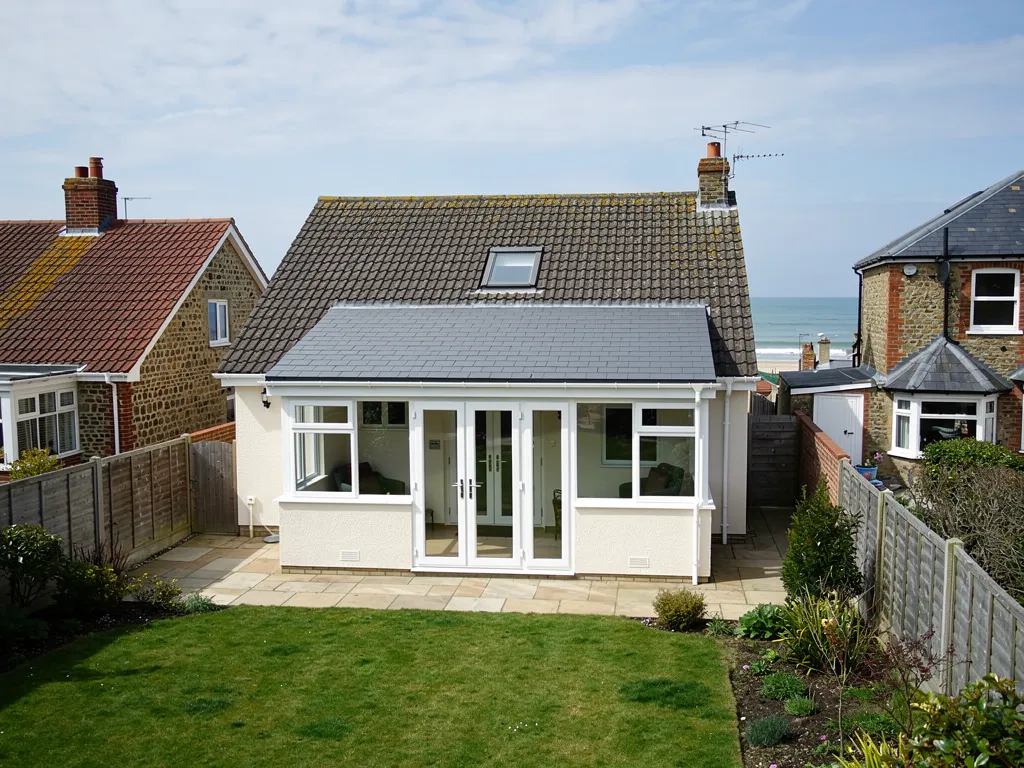
Glass, solid and flat sections
Glass and solid roofs are priced and built differently, and their life rests on the glazing units, seals and frame, so we judge each one on its condition at the survey. Ask whoever supplies it to state, separately, how long the glazing unit, the frame and the seals are expected to serve, and to put the warranty terms on paper.
Some parts can be compared. A flat section of a roof, such as a lantern base or a small flat roof joined to the house, is covered like any other flat roof. EPDM is quoted at 20 to 30 years or more by GreenSpec, and GRP at 25 to 40 years by Less. Those figures cover the covering only.
On solid roofs finished in tile or slate, the covering's own published range is a guide to the covering, not to the structure beneath it. The insulation, the timber and the junction with the house all need to be sound as well.
Signs a conservatory roof is nearing the end
Look for water first: stains on the frame or the house wall, drips at the glazing bars, or damp in the corners after rain. Condensation inside the sheet channels shows as cloudy patches or green growth in the panels.
Then look at the surface. Yellowing, crazing, cracks at the screw holes and brittle edges all show a sheet that has weathered. Gaps along the bars, loose capping and gutters that overflow suggest the seals and drainage have aged. Our page on glass or polycarbonate helps you compare what you could fit instead.
Comfort is a sign too. If the room cannot be used for much of the year because of heat or cold, the roof may be past its useful life even if it is not leaking. Age alone is not a reason to replace. A survey with photographs shows what is worn and what is not.
Extending the life and knowing when to replace
Simple upkeep helps. Clear gutters, wash the roof gently, remove moss and leaves, and look at the seals every year. Trim branches that rub or drop debris on the sheets. Avoid pressure washing, which can force water into the channels.
When the time comes, the choice is between repair and replacement. A fault in a seal, a single cracked sheet or a failed gutter is a repair. A roof that has aged across the board is a replacement, and if you are unsure what consent a change would need, our page on the 4-year rule for conservatories is a useful start. The full list of conservatory roof replacement choices is on the hub page.
Do not rely on a warranty to tell you when to act. A warranty is a promise to put right named faults on stated conditions, and the life of the roof is a separate matter. After a survey we tell you which case you are in, with photographs from your own roof, and the written quote follows.
Conservatory roof ageing: two more questions
Will a conservatory roof last longer if it is cleaned?
Cleaning helps because it removes debris that holds moisture against the sheet and the seals, and it lets you see problems early. It does not stop sunlight ageing the plastic or the gaskets hardening. Use gentle cleaning, avoid pressure washing, and check the seals each year.
Is a ten year old conservatory roof due for replacement?
Not necessarily. Ten years is the lower end of the published range for polycarbonate, so a roof that is dry, clear and sound can carry on. Look at the seals, the sheets and the gutters. If they are worn, repair or replacement becomes a survey decision.
Tell us about your roof
Describe what is happening and we will call you back to arrange a visit.
- Photographs of what we find
- A written quote with one total price
- Or call 01903 299063
10-year workmanship guarantee, in writing.