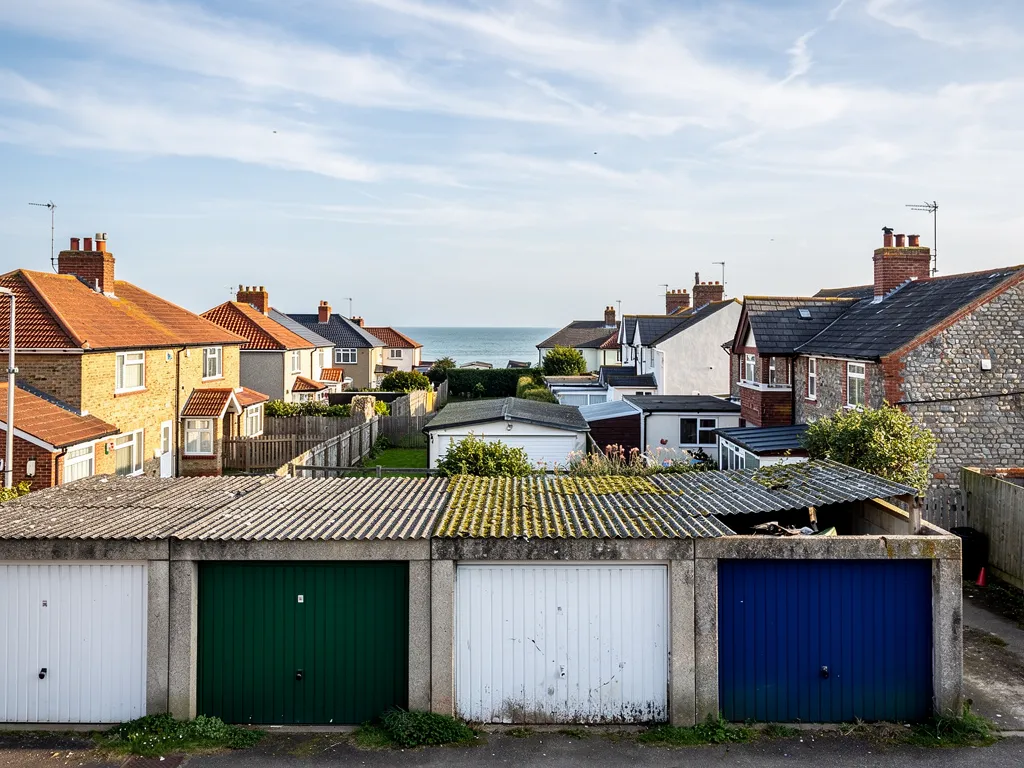
Corrugated cement sheets were widely used on garages built before 2000, and HSE advises the owner of any building from before 2000 to presume it contains asbestos. Left whole and undisturbed, an old sheet is not an emergency. The trouble starts when it has to come off, because the way it is removed decides how much dust is released, which rules apply and what the job costs.
The rules turn on one question: do the sheets come off in one piece, or do they break up? Careful removal of intact sheets sits in HSE's non-licensed category. Substantial breakage moves the work into notifiable non-licensed work, which brings a notice, medical examinations and records. Either way, the waste has its own paperwork, and the cost reflects the method as much as the size of the roof.
The sections below take the process in the order it happens: judging the condition of the sheets, removing them, dealing with breakage, handling the waste, costs, and fitting the replacement roof.
Judging the condition of the sheets first
HSE divides asbestos cement work by the condition of the material. HSE lists the removal of asbestos cement products, roof sheeting among them, as non-licensed work, so long as the material is handled with care and comes off without breaking up. It confirms that this covers weathered asbestos cement with no other serious damage. Moss, green staining and a rough, eroded surface are normal on an old garage roof. They do not, on their own, change the category.
What changes it is substantial damage: sheets that are cracked through, holed, crumbling at the edges or already in pieces. That is why the first job is a careful look, and why it comes before any price. At ground level and from inside the garage we check for cracks, patched holes, missing corners and sheets that have slipped from their fixings, and we photograph what we find.
Treat the roof as fragile
HSE's A14 guidance puts it bluntly: treat every asbestos cement roof as fragile. A sheet can look sound and still give way under a foot, and an old one can fail without warning. The ridge pieces and the laps deserve a close look as well, because cracks tend to start where a sheet is fixed or overlapped. Nobody should walk on the roof or lean a ladder against the sheeting, and a roof job that needs access across it needs proper edge protection and access equipment, set up before anyone climbs.
If you are not sure that the roof is asbestos at all, our guide on how to tell whether a garage roof is asbestos explains the clues, and why a sheet's appearance never settles the question by itself. Until you know, leave it untouched.
Careful removal as non-licensed work
Careful removal means what it says. The sheets come off whole, and nothing is snapped, drilled, scraped or smashed. HSE's A14 guidance wants big pieces brought down to ground level under control, never dropped, with no rubble chutes. It also warns that once the cement begins to break up and throw off significant dust, the job becomes notifiable non-licensed work.
In practice that shapes the whole method. Fixings are undone and not forced. Each sheet is supported while it is released, then lowered with its neighbours still in place, so no one is working under a loose sheet. Sheets are stacked flat at ground level and wrapped before anything else happens on site. The roof is cleared in an order that keeps the crew on safe access and never on the sheets.
Could the sheets stay?
A14 also prompts another question: could a different covering go over the sheets so they need not come off at all? On some garages that is a sensible route, because nothing is disturbed and no asbestos waste is created. It depends on the sheets being sound and the structure being able to carry the extra weight, and it is not a fit for a roof that is cracked or leaking at the laps. The survey tells us whether your garage is a candidate.
For a full read of the HSE position, HSE rules for asbestos cement roof sheets sets out the A14 points in turn.
When broken sheets make the work notifiable
On HSE's list, asbestos cement roof sheeting counts as notifiable non-licensed work when the material is badly damaged or broken up. Its example is dropping an asbestos cement roof. Once the work falls into that category, notice has to be given before the work starts, and HSE states there is no minimum notice period.
The duties that follow fall on the contractor, and they are significant. Those workers need a medical examination at least every 3 years, and the health records of the work have to be kept for 40 years. That is one reason a job with broken sheets costs more than a clean, careful strip. It also explains why a roofer who has seen cracked sheeting and says nothing about notification is worth a question.
If your sheets are cracked, holed or crumbling, say so when you ask for a quote. It changes the category of work, and the price.
Boards under the eaves are a separate matter
Garage eaves sometimes hide a second material. Soffits on the outside of a building are among the places HSE says asbestos turns up, and it adds that asbestos insulating board (AIB) is hard to tell apart from board that contains none. Most removal of AIB falls into the higher-risk, licensed category. So we stop and say so if a soffit board looks as though it could be AIB. It is not something to cut, drill or pull down on a hunch, and it is not part of a cement sheet strip.
Waste: wrapping, lockable skips and the consignment note
Taking the sheets off the roof is half the job. They then have to reach a site that accepts them, and HSE's guidance EM9 spells out how. Waste is wrapped twice and labelled, and cement sheet is kept in a lockable skip; HSE says that draping sheeting across an ordinary skip falls short. Nor should asbestos waste be blended into other waste to bring it under 0.1 per cent.
The paperwork matters as much as the skip. GOV.UK says asbestos waste sits outside the household exemption for hazardous waste. The contractor taking asbestos out of a home must consign it, filling in the consignment note as the producer of the waste. Anyone carrying construction or demolition waste, or acting as a broker or dealer, counts as an upper-tier carrier, whose registration renews every 3 years.
You can use that as a simple test of any quote for removing sheets. Ask who is carrying the waste, where it is going and whether you will see the consignment note. A removal that cannot answer those three questions has not planned the end of the job.
Why householders cannot just tip it
Taking sheets to the tip in a van sounds like the cheap shortcut. It is not a safe one, because loading, wrapping and carrying broken or loose asbestos cement raises exactly the risks the rules are designed to prevent. The sheets follow a set route from the roof to the disposal site, and you should expect to be given the paperwork for it.
What removal typically costs
Removal costs are published by the national guides, and they are only a guide to what your own garage will need. MyBuilder (updated 21/08/2026) puts the average removal at around £2,000, with a rate of about £50 per m² at the low end. It gives a range of £350 to £1,295 for a single garage roof and £650 to £1,800 for a double. Checkatrade gives £950 to £3,750 for asbestos removal and disposal.
| Removal | Typical UK range |
|---|---|
| Single garage roof (MyBuilder) | £350 to £1,295 |
| Double garage roof (MyBuilder) | £650 to £1,800 |
| Removal and disposal (Checkatrade) | £950 to £3,750 |
These figures buy the strip and the disposal. The new roof, and any timber repair uncovered once the sheets are off, are separate work. Our guide to how much a garage roof costs to replace gives the typical UK ranges for the new covering.
What swings the removal figure
The area of sheeting is the obvious factor. The way the sheets are fixed, the height of the garage and how easily the crew can reach it also count, as does the distance to a site that takes the waste. Count every roof surface before comparing numbers: a lean-to or carport made of the same sheets adds area, and the total grows with it. Breakage is the largest swing: sheets that must be handled as notifiable work cost more than sheets that lift off cleanly.
Because every one of those depends on your roof, the written quote comes after our survey, with photographs of your own garage, and gives one total price.
Fitting the new roof once the sheets are gone
Stripping the sheets exposes what has been holding them. We check the purlins, the cross timbers the sheets are fixed to, and the wall plates, and we look for rot or movement that the old roof hid. Any timber left soft by long damp is renewed before new fixings go in.
The replacement depends on the garage. A pitched garage can take a lightweight sheet, a tile or a slate-effect covering if the structure suits it. A flat or low-pitched garage might take felt, EPDM or GRP. Steel sheeting is another choice for many garages. Each has trade-offs in weight, noise, lifespan and cost, which we go through with you at the survey.
The new roof also has to work with the building. We explain whether the work needs Building Regulations approval where it is notifiable, and where the garage is attached or shared we raise the wall junctions and any neighbour's side before work begins.
Gutters, downpipes and leaving the site clean
Gutters and downpipes fixed to the old roof edge need a check too. HSE's own examples of asbestos cement products include rainwater goods, so cement gutters of the same age are handled with the same care as the sheets.
The job ends when the site has been cleared and the waste taken away, with the consignment paperwork passed to you. Keep the consignment note with your house papers, since a buyer's solicitor may ask for it later. If you are still weighing replacement against leaving the roof alone, send us photographs of the sheets, taken outside and inside the garage, and we will tell you what we see. Our garage roof replacement page covers the whole job.