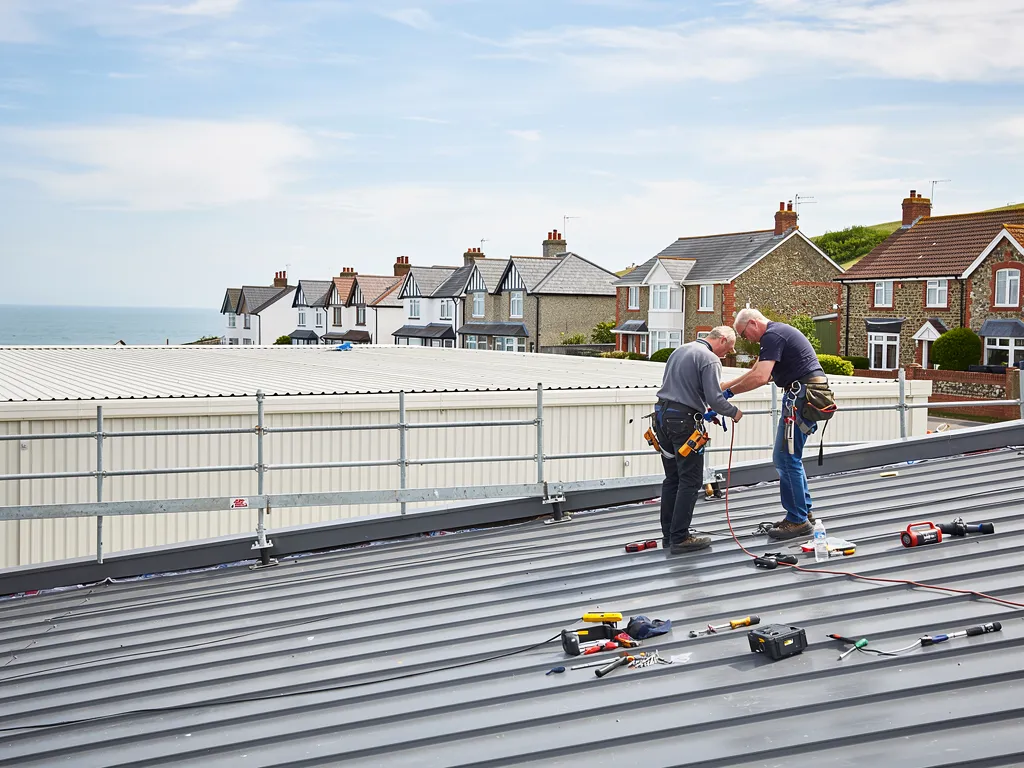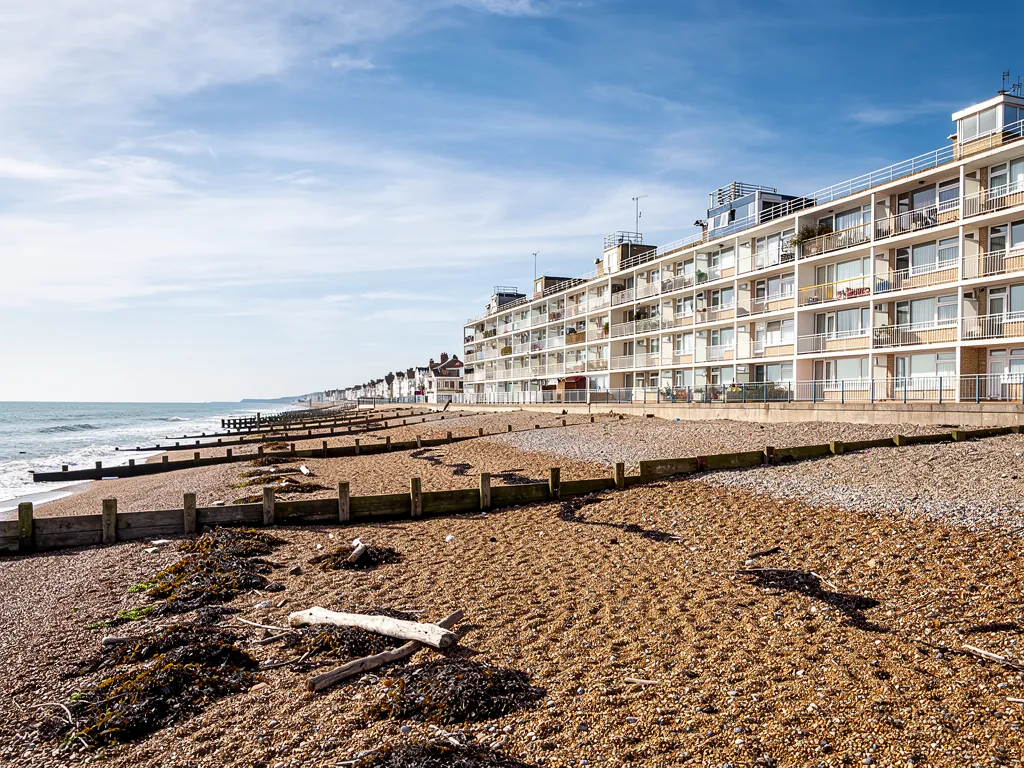
If you own a garage, shed or outbuilding with a corrugated cement roof, the guidance that matters is HSE's A14, which covers working with asbestos cement. It is written for contractors and for anyone who manages the work, and it is shorter and clearer than owners expect. This page walks through its main points in the order a roof job meets them, so you can tell whether a roofer's method matches it.
Four ideas carry most of the weight. The first is that any roof of this material must be treated as fragile, whatever it looks like from below. The second is that big sheets are brought down under control and never thrown. The third is that rubble chutes stay out of it. The fourth is that breaking the material up changes the category of the work from non-licensed to notifiable non-licensed.
Nothing here replaces the guidance itself, which you can read on the HSE website. What follows is a plain reading of it, and the questions it suggests you put to anyone who offers to take a roof like this away.
Where asbestos cement turns up on a garage
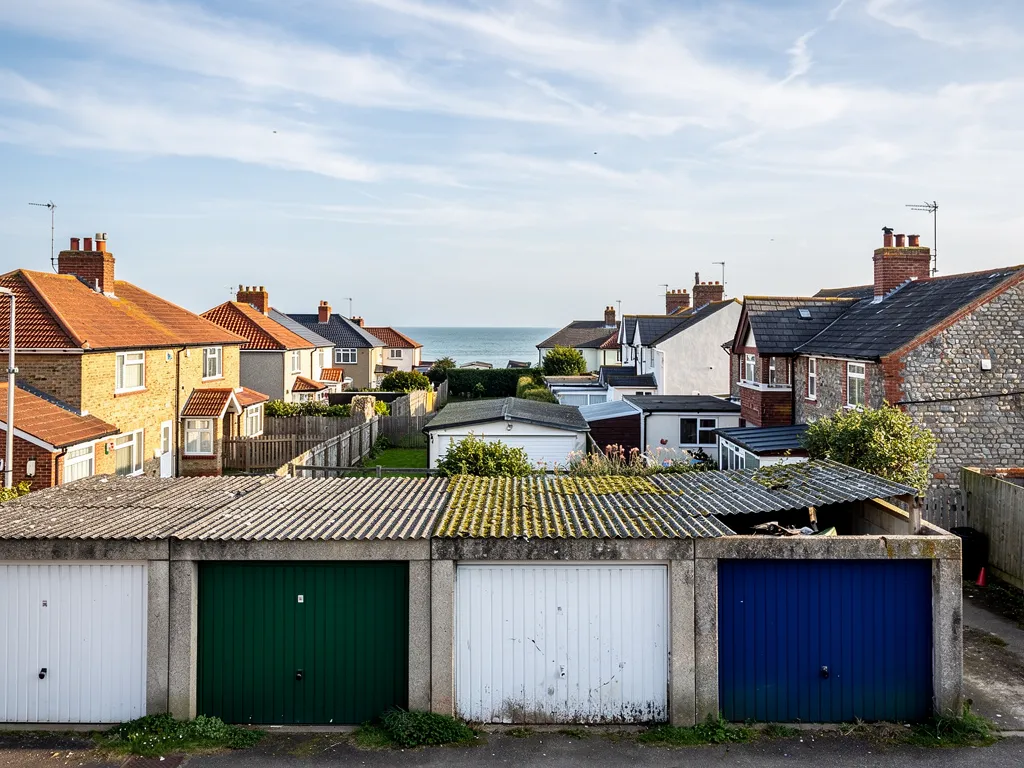
Asbestos cement is a building material made of cement with asbestos fibres set into it. It was used for corrugated roof sheets, flat sheets, gutters and downpipes, and HSE gives roof sheeting and rainwater goods as its examples. On a garage, the usual place is the roof itself, as large corrugated sheets bolted over timber purlins, often with a ridge piece along the top.
The date is the best first clue. On HSE's guidance, anything built or refurbished before 2000 is presumed to contain asbestos until shown otherwise. A garage from the 1960s or 1970s with a grey, rough-textured corrugated roof is therefore treated as suspect until a sample says otherwise. Newer cement-fibre sheets were made without asbestos, and the two can look alike. That is why appearance never settles the matter, and why a sample is the only certain test.
Other parts of the same building
Asbestos cement is not the only form to think about. HSE notes that asbestos also turns up in external soffits as asbestos insulating board (AIB), which is hard to tell from board without it. A garage with a boarded soffit under the eaves can have two materials with two different sets of rules. Cement sheets can be removed in the non-licensed category when handled carefully. HSE treats most AIB removal as higher-risk, licensed work.
So the first step on any garage of that age is to identify every suspect material before anyone starts work. Trying to separate them while the job is in progress is how a small job turns into a large one.
Why every cement roof counts as fragile
HSE's wording is short: asbestos cement roofs are always fragile. It does not say old roofs or damaged roofs. It says always, and the reasoning is practical. Cement sheets are brittle, the corrugations are thin at the crest, and the sheet may be carrying years of weathering that no one can judge from the surface. A sheet that holds one person today may not hold the next.
The first consequence is about people. No one should walk, kneel or lean on the roof. Tools, ladders and boards must not rest on the sheets. Work at height on such a roof needs its own protection against falling through, such as edge protection and a platform that spreads the load, planned before anyone climbs up. That is a safety point on top of the asbestos point, and it applies to the owner clearing leaves from a gutter as much as to a contractor. It is also why a quick glance from the garden says little about whether the roof is sound.
The second consequence is about the material. Every impact, foot and dropped tool risks cracking a sheet, and a cracked sheet is the start of the situation HSE warns about: a roof that breaks up while it is being worked on, releasing dust.
If a roof leaks, a surveyor will often look from inside the garage first, with a torch, and then from the outside using an access platform or a camera. Climbing out across the sheets is never part of the plan.
Lowering large pieces and keeping chutes out of it
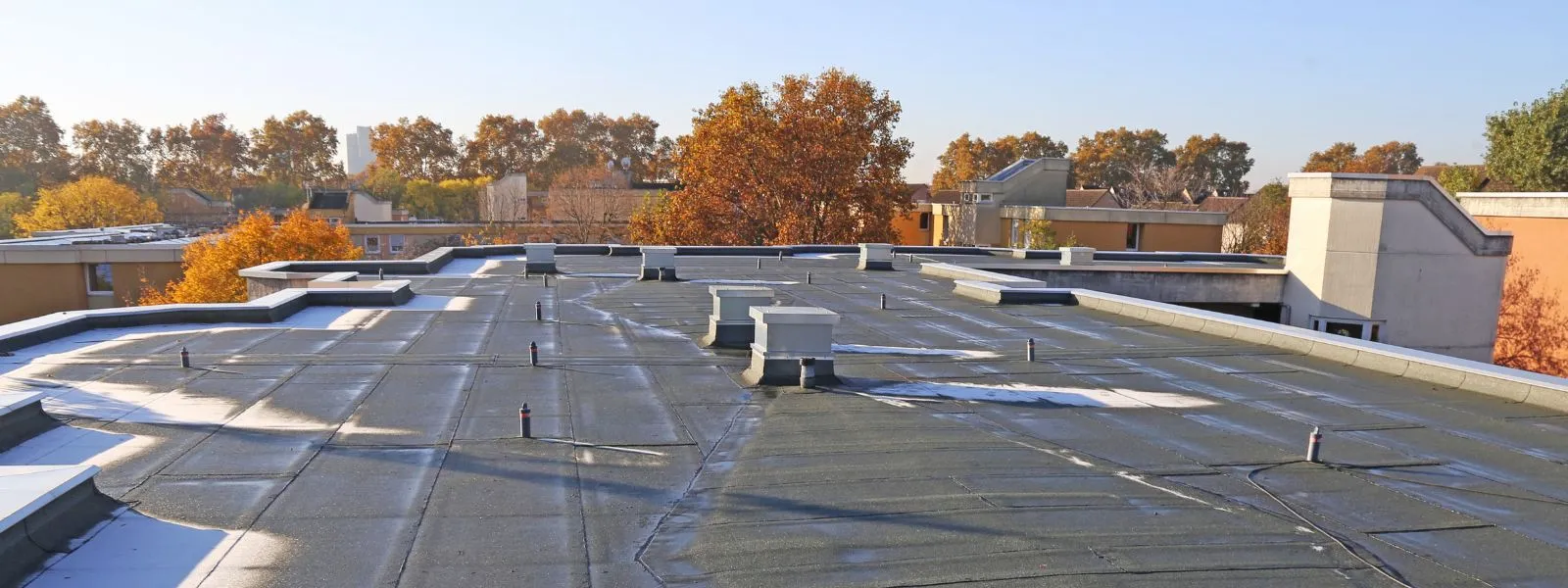
A14 gives two direct instructions for removal. The first is to bring large pieces down to ground level in a controlled way. The second is not to drop them and not to use rubble chutes. Both come from the same idea: a whole sheet is a manageable thing, and a broken one is a dust problem.
Lowering is a method before it is a rule. The crew first releases the fixings of the sheet nearest the edge, supports the sheet while it is detached, passes it down by hand or by a controlled lift to the ground, and sets it flat on a prepared surface. Each sheet follows the one before. Nobody works beneath a sheet that has not yet been secured, and nothing is thrown or slid.
A rubble chute defeats the whole approach. A sheet travelling down a chute scrapes the sides, lands hard and breaks, and it also releases whatever dust the fall creates at the bottom. A drop from the roof edge has the same effect. Dropping is in fact the example HSE uses in its notifiable work guidance, where dropping an asbestos cement roof is given as an instance of substantial damage.
What the owner can look out for
You do not need to supervise a roof strip, but a few signs are easy to spot from the garden. Sheets should come down whole, not in pieces. Nothing should be dropped into a skip or stacked loose. The ground below should be clear and covered. And if someone proposes smashing the roof out, or cutting it with a power saw, the method is already outside what the guidance describes.
For the full removal sequence on a garage, our guide to removing an asbestos cement garage roof covers each stage and the usual costs.
The line between non-licensed and notifiable work
HSE sorts asbestos work into three bands, and a cement roof can sit in two of them. Careful removal of asbestos cement products, provided the material is handled without breaking up, is non-licensed work. HSE adds that weathered cement without other serious damage belongs here too. So the grey, mossy garage roof on a long-standing garage can usually be taken off in this category.
Substantial damage changes it. Serious breakage changes this: HSE says that where the cement crumbles and sheds significant dust, the job becomes notifiable non-licensed work. In that category, notice must be given before work begins, and HSE sets no minimum lead time for that notice. The workers involved need medical checks at least every 3 years, and the health records for the job must be kept for 40 years.
The third band, licensed work, is reserved for higher-risk materials such as most AIB removal. It does not apply to carefully removed cement sheets. Our page on whether you need a licence to remove an asbestos roof goes through the question, and the answer depends on the material and on its condition.
Condition decides the category. A sheet that comes off whole is one thing, and a sheet that crumbles in the hand is another.
For owners the practical point is to be accurate about the state of the roof. Cracks, holes and crumbling edges should be mentioned to every contractor who prices the job, because they move the work into the second band and change both the method and the quote.
Overlaying the sheets instead of removing them
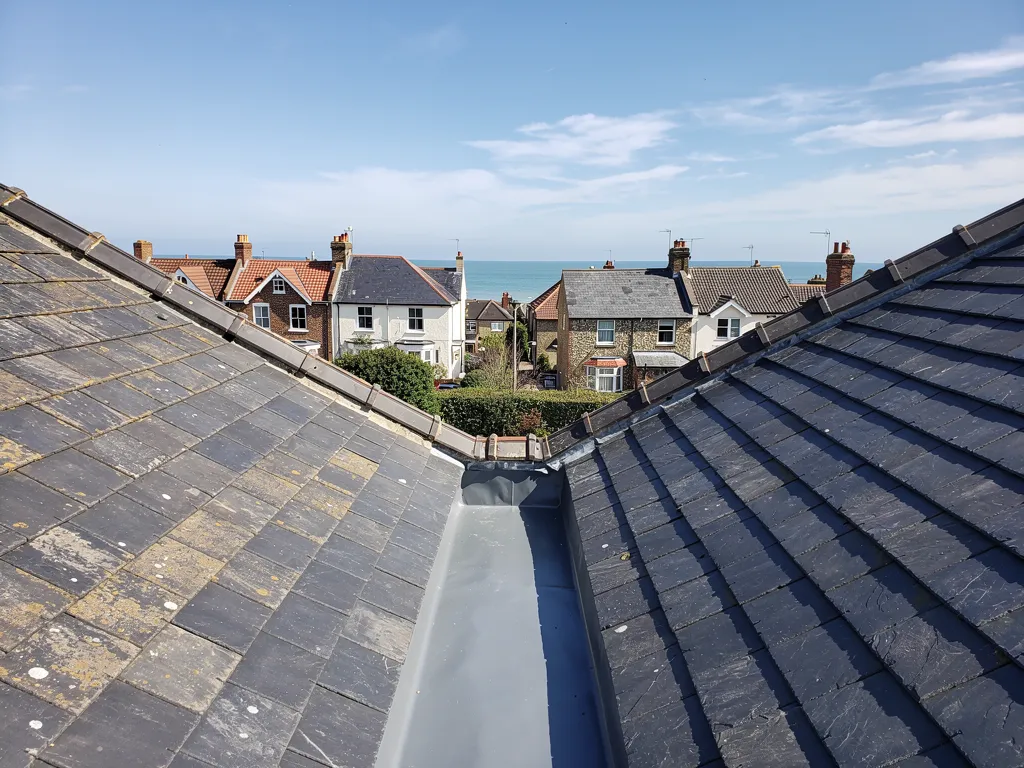
One of the questions A14 puts to anyone planning this work is whether a new covering could simply go over the old sheets. The thinking is straightforward. If the sheets are left in place and covered, nothing is disturbed, no asbestos waste is created and the risk of breakage is lower.
It is not always possible. The structure under the sheets has to take the extra load, the sheets need to be in reasonable condition, and the new covering has to be fixed without drilling or breaking the old one in a way that releases fibres. A roof that is cracked, leaking at its laps or sagging between purlins is not a candidate. Neither is one where the owner wants to change the shape of the building.
When it works, it can suit a garage where the existing roof is sound and the aim is a better weather surface. We explain the method and its limits at the survey.
Choosing what goes on instead
Whether the sheets are overlaid or removed, the next question is the new covering. A flat garage has different options from a pitched one, and the roof structure sets the limits. Re-felting a flat garage roof is a common route. For the wider choice of coverings, the best materials for a garage roof compares felt, EPDM, GRP and steel sheets.
Each covering has an expected life and a cost that depends on the job. Either way, we write the quote once the survey is done.
Waste, paperwork and questions to ask a contractor
The rules do not stop when the sheets reach the ground. HSE's EM9 guidance wants waste wrapped twice and labelled, cement sheet kept in a lockable skip, and no mixing with other waste. Covering an ordinary skip with sheeting is, in HSE's words, not good enough.
For a home, GOV.UK adds a document trail. Asbestos waste is left out of the household exemption for hazardous waste, so whoever takes it out of a home has to consign it and make out the consignment note in the waste producer's role. A carrier of construction or demolition waste is an upper-tier carrier, registered for 3 years at a time.
That gives you a short, practical checklist to use with any roofer. Keep the paperwork with the house records afterwards, because it shows what was removed and where it went, and a future buyer's solicitor may ask for it.
- How will the sheets be released and lowered, and will anything be dropped or sent down a chute?
- What happens if a sheet breaks, and is the work then notifiable?
- How will the sheets be wrapped and where will they be kept on site?
- Who carries the waste, where does it go, and will you receive the consignment note?
- What will the new roof be, and does the quote include it?
We answer those at the survey, in writing, with the photographs. The quote is written, and the waste goes with us when the new roof is finished, with the consignment paperwork for the asbestos explained before work starts. If you would like to talk it through first, call us on 01903 299063. Our garage roof replacement page covers the wider job.