
Question answered
Do you need a licence to remove an asbestos roof?
The short answer
Usually no, for cement roof sheeting. HSE places careful removal of asbestos cement, roof sheets included, in the non-licensed group so long as nothing is broken up on the way down. Substantial damage moves the job into notifiable non-licensed work, and asbestos insulating board is stricter again, since most removal of it is reserved for a licence holder.
For a typical garage roof of cement sheets, the answer is usually no, but only if the sheets come off whole. Insulating board and damaged sheets follow different rules, and the waste has its own paperwork.
Three categories, and where a garage roof sits
HSE sorts asbestos work into licensed work, notifiable non-licensed work and non-licensed work. The sorting follows the material and its condition, not the size of the job. A garage roof is small, but that does not move it between the categories.
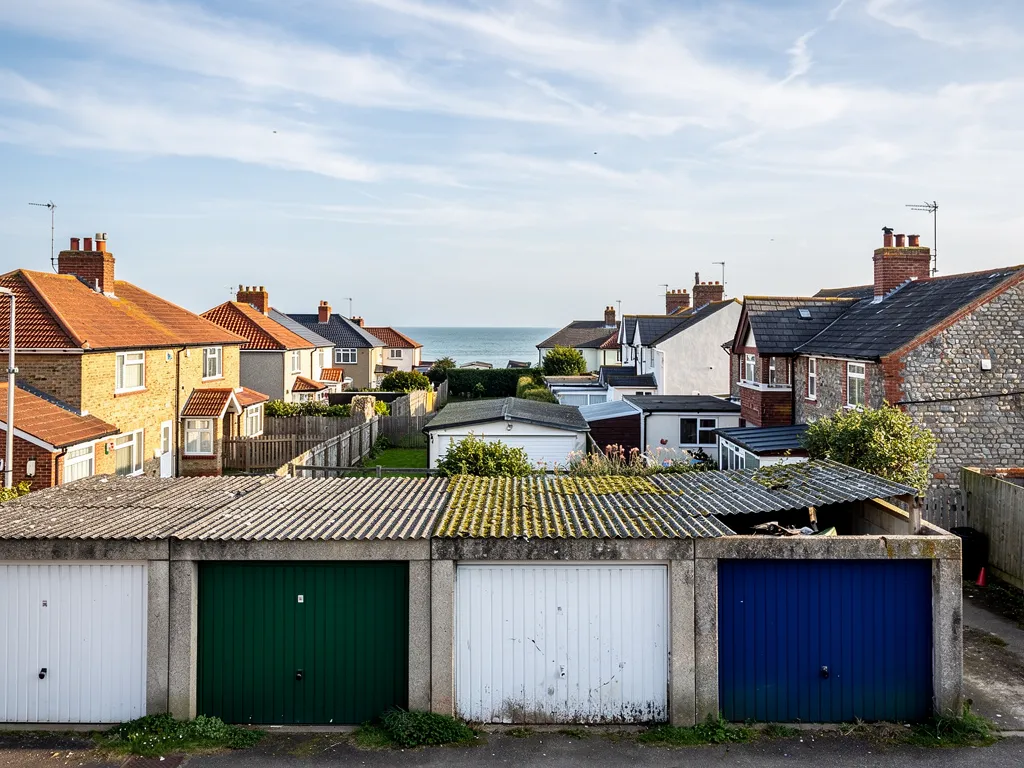
Asbestos cement, the grey sheeting on many older garage roofs, falls in the non-licensed group. HSE's list covers roof sheeting and rainwater goods made of it, on condition that they are lifted and lowered carefully and not broken. It also says weathered cement counts, as long as it is not badly damaged in other ways.
So a garage roof of whole, weathered sheets can be taken off without a licence. That describes the category of work and says nothing about how well any particular contractor does it. You still want to ask how the sheets will come down, which is what the rest of this page covers. Our page on how to tell if a garage roof is asbestos helps you establish what you have first, and the garage roof replacement page shows how we approach the job.
When damage changes the answer
The condition that matters is that nothing breaks up. If sheets crack badly, crumble or are dropped, the work is no longer plain non-licensed work. HSE's illustration of notifiable work is bringing an asbestos cement roof down in pieces, and its roofing guidance adds that once the sheets begin to shed noticeable dust, the job counts as notifiable non-licensed work.
That is still not licensed work, though it brings extra duties: notice to the regulator before work starts, health checks for the workers every three years or sooner, and records of the job held for 40 years. Our explainer on notifiable non-licensed work goes through them.
It is one reason sheets left to weather for decades are best assessed before anyone climbs on them. A brittle sheet is harder to lift whole, and you cannot judge brittleness from the ground. Large pieces should be lowered by hand, never dropped and never fed into a rubble chute, and nobody should put weight on the sheets themselves, so the access equipment is part of the plan from the start. A roofer who finds sheets breaking mid-job should stop and reassess, not carry on regardless.
Asbestos insulating board is a different matter
Asbestos insulating board, AIB, turns up in soffits, panels and linings and not on the roof sheets themselves. HSE names external soffits among the places asbestos is found, and treats most AIB removal as a job for a firm that holds the specialist licence.
This matters on a roof job, because soffits and fascias are part of the same visit. A roofer who tells you the whole project is non-licensed because the sheets are cement may be overlooking the boards under the eaves. AIB is also hard to tell from harmless board by eye.
If your garage has soffit or lining boards and dates from before 2000, ask the person surveying the roof how they will deal with them. The answer should be specific: either the boards are sampled and found clear, or they are left alone for someone with the right licence. Nobody should cut, drill or pull them as part of the roof work. Our page on testing a garage roof for asbestos covers sampling.
What careful removal looks like in practice
Because whole cement sheets need no licence, the quality of the method is what you are really checking. HSE's guidance points to several things you can ask about.
The sheets should be unbolted and lowered rather than snapped or thrown. Dust is kept down, the sheets are wrapped twice and labelled as asbestos waste, and they travel in a lockable skip; draping them over an ordinary skip is not acceptable. Asbestos waste must never be mixed in with other rubbish.
A contractor who takes asbestos out of your home also has to consign the waste, completing the consignment note as the waste producer. A firm that carries building waste for others sits in the upper tier of waste carrier registration, so ask who is taking it away and request a copy of the paperwork. The pages on the HSE rules for asbestos cement and asbestos waste disposal cover this in more depth.
Nothing here is an invitation to take sheets down yourself. Without the right access equipment, a fragile roof, a flawed method and a wrongly wrapped load are all easy to get wrong, and the consequences fall on you as the householder.
Removing a cement garage roof: two more questions
Does a garage roof of whole asbestos sheets still need a specialist with a licence?
Not under HSE's rules, because careful removal of whole asbestos cement sheeting is non-licensed work. What you need is a contractor who handles the sheets whole, wraps and labels the waste and consigns it properly. Ask how they will do each of those before you agree anything, and ask for the paperwork afterwards.
Is there a way to avoid removal altogether?
Sometimes. HSE's guidance asks whether the sheets can be covered with a non-asbestos material instead. It depends on the structure carrying the extra weight and the sheets being safe to work from. Where it is possible it also cuts the amount of waste, though the survey has to confirm the structure can take it.
Tell us about your roof
Describe what is happening and we will call you back to arrange a visit.
- Photographs of what we find
- A written quote with one total price
- Or call 01903 299063
10-year workmanship guarantee, in writing.