
Question answered
Testing a garage roof for asbestos
The short answer
A garage roof is tested by having a trained person take a small sample, which a laboratory analyses and reports on in writing. It is worth doing when you cannot date the roof or want to prove sheets are not asbestos. For anything dating from before 2000, HSE's default is to presume asbestos, so a test mostly swaps that presumption for evidence.
A laboratory result is the only way to settle what a roof is made of. Here is when sampling earns its cost, how it is done safely, and what the answer lets you decide.
When a sample is worth taking
HSE's default for a building from before 2000 is to presume asbestos is there. If your garage is clearly older than that and the sheets are grey cement, you can plan around the assumption without a test. The money goes on the safe removal or overcladding instead.
A sample earns its fee in less clear cases. You may not know when the roof was last replaced. The sheets might have been fitted by a previous owner with no paperwork. Or you may suspect the sheets are a modern non-asbestos cement, in which case a clear result can lower the cost of the whole job, because non-asbestos sheets do not need asbestos waste handling.
A result also helps when you are selling. Buyers' surveyors ask about asbestos on older garages, and a laboratory report is better than a shrug. Our page on how long a garage roof lasts helps you judge whether the sheets are close to worn out anyway.
How a sample is taken without making a hazard
The aim is a piece the size of a coin, not a hole in the roof. A trained person works from a safe position, never kneeling on the sheets, because HSE stresses that roofs of this type are fragile throughout. They choose a spot where the material is already loose or at an edge, wet it to keep fibres down, take the piece, and put it in a sealed bag, often double-bagged and labelled with where it came from.
The place the sample came from is then sealed or covered, so that the cut edge does not shed fibres. Dust is kept to a minimum throughout, and the work is done without power tools.
This is not a job for a householder with a screwdriver. A badly taken sample can create the very problem you want to avoid, and a poorly labelled one can give a result for the wrong material. If a sheet is cracked and a small piece has already fallen away, do not pick it up. Mention it to whoever attends, and see how to tell if a garage roof is asbestos for what to avoid touching.
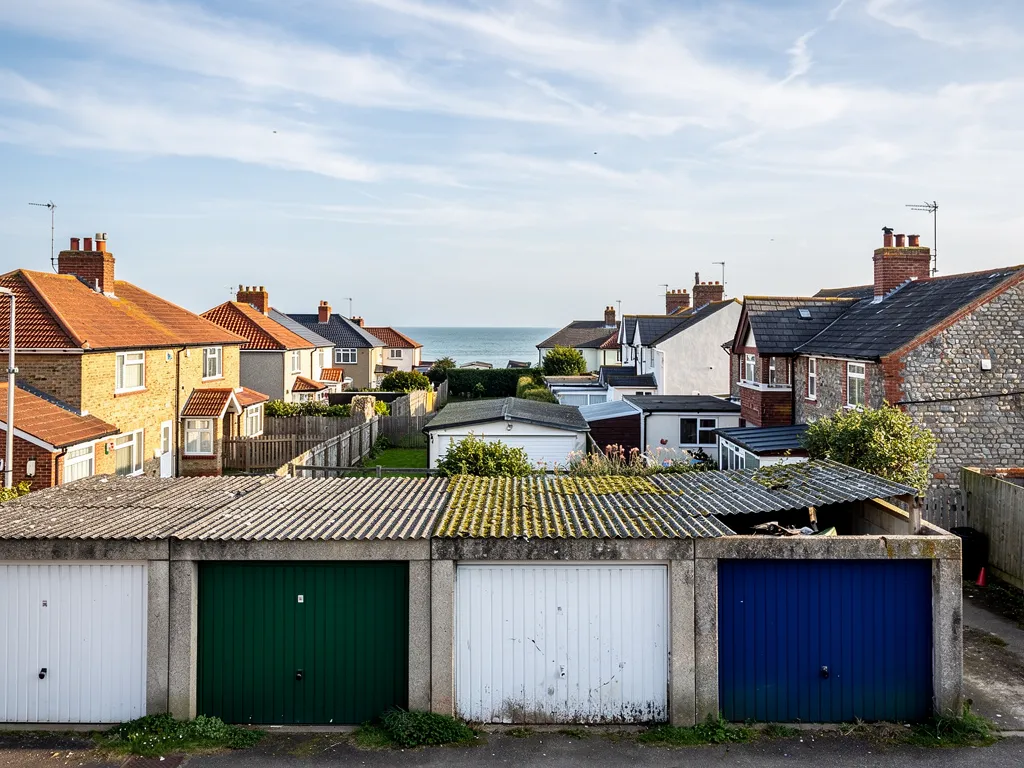
What the laboratory does and what you receive
The sample goes to an analytical laboratory, where an analyst examines it under a microscope and identifies whether asbestos fibres are present and, if so, which type. You receive a written report listing each sample by its reference and describing the finding.
Keep the report with the house documents. It answers questions from surveyors, insurers and any contractor who quotes for the roof. It also shows whoever removes the sheets how to treat the waste. HSE says asbestos waste must be double-wrapped and labelled, and that a lockable skip is needed for asbestos cement sheet, so an early answer spares you a shock on the day.
Take more than one sample if the roof has different materials, such as sheets on the main span and a different board on a lean-to or porch. HSE warns that insulating board looks much like harmless board, so soffit boards need their own sample, not an assumption from the sheets. Our page on notifiable asbestos work explains what changes if material is damaged during the visit.
What sets the cost of testing
The price depends on how many samples are taken, who attends, how far they travel and the laboratory's fee for each one. A single sample from a single-garage roof is a small job; a garage with sheets, soffits and a lean-to is more. The written quote for any work we do follows our survey and gives one total price.
Compare that with what the result can save or confirm. MyBuilder's asbestos removal guide (updated 21 August 2026) gives typical UK ranges of £350 to £1,295 to remove a single garage roof and £650 to £1,800 for a double. A test that shows the sheets are not asbestos could take the disposal part of that bill out of the job.
Equally, a positive result is useful, because it lets you choose between leaving, covering and removing the sheets with real evidence to go on. A felt roof over a timber deck is a different case; see garage felt roofs. For a roof that is already letting water in, a leaking garage roof explains how to protect the contents meanwhile.
While you wait for the result
Until the report says otherwise, behave as though the roof is asbestos cement. Do not walk on it, lean a ladder against the sheets, drill brackets into them, hang anything from them or clear moss. Keep the garage tidy underneath, and avoid storing items in a way that means someone has to push on the roof to get them out.
If the roof is leaking, move belongings and put a tray under the drip, but do not patch the sheets with sealant or screws. Anything that disturbs the surface is best left to the person who takes the sample or the contractor who will do the work.
Once the report arrives, you can plan. If sheets are clear, you are choosing a new covering. If they are asbestos cement, you are choosing between overcladding, careful removal and leaving them for now, with a clear idea of cost. Our licence question for asbestos roofs follows naturally from that choice, and the garage roof replacement page shows how we survey first.
Asbestos sampling on a garage: two more questions
Can I send a sample off to a laboratory myself?
It is not advisable. Taking the piece is the risky step, because it can crack a fragile sheet or release fibres, and a poorly labelled sample gives a result you cannot rely on. A trained person takes it safely and records exactly where it came from.
Does a clear result mean the whole roof is safe to cut?
Only for the materials that were sampled. A garage may combine sheets, soffits, a lean-to and old linings, and each can be different. A clear result on the main sheets says nothing about a soffit board, so check that every material you plan to disturb was covered by the report.
Tell us about your roof
Describe what is happening and we will call you back to arrange a visit.
- Photographs of what we find
- A written quote with one total price
- Or call 01903 299063
10-year workmanship guarantee, in writing.