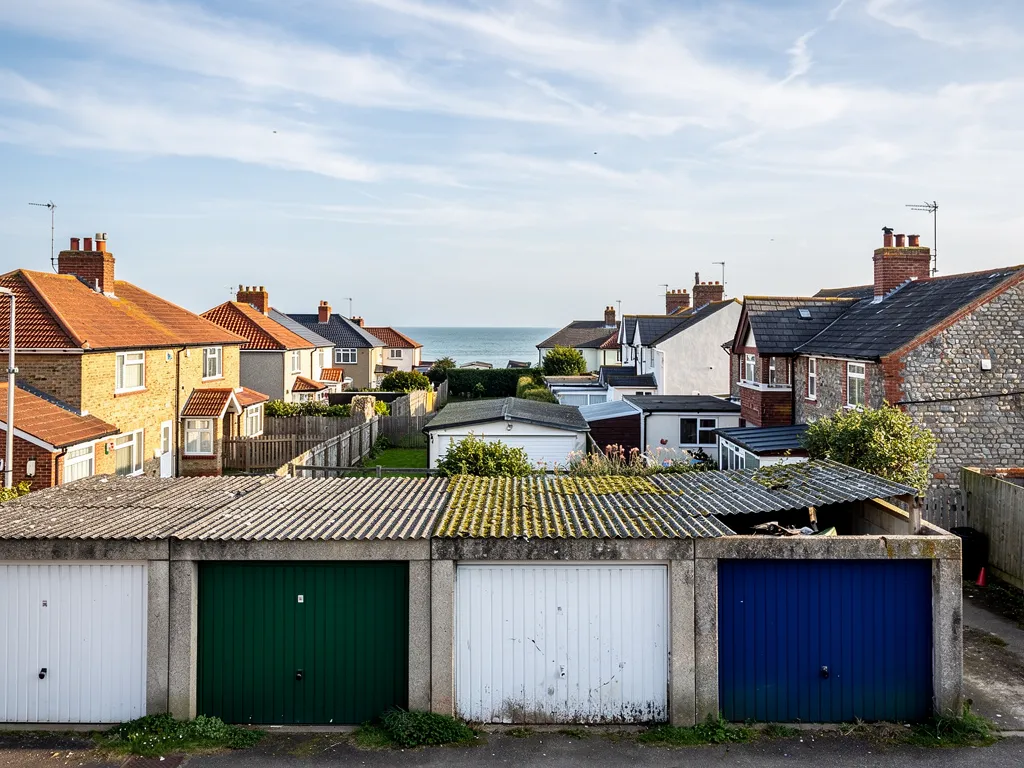
A felt roof on a garage is about the simplest waterproof layer there is: rolls of bitumen-based sheet laid on a timber deck, laid with a slight slope so water runs to one edge. It does its job for years. Then the surface starts to crack, blister and lift, and a damp patch on the garage wall or a drip over the car tells you the end is near. The question worth asking is whether a fresh covering is all the roof needs.
Often it is. If the deck underneath is sound and the roof still drains, stripping the old felt and laying a new system is the smallest job that cures the leak. If the boards have gone soft, if water sits in a pond that never clears, or if the garage turns out to be roofed with something other than felt, a new layer is money spent on the wrong repair.
This guide explains how to tell which case you have, what happens on the day, where the edges and wall joints are won or lost, and what re-felting typically costs. It also says when we would steer you to a different covering. The first look is always at the shape of the roof under the felt, not just the felt on top.
When a new layer of felt is the right answer
Re-felting suits a flat or near-flat garage roof where the covering is the part that has failed. The signs are a surface that has crazed or split, felt lifting at the laps, the overlaps between neighbouring sheets, bubbles that have burst, and bare patches where the mineral finish has worn away. Those faults sit in the top layers. The timber below them can still be perfectly good.
Age matters, but only as a guide. In its flat roof cost guide (last updated March 2026), Less gives torch-on felt a life of 10 to 20 years: a good job reaches the top of that range and a poor one may not see 10. CORC, a roofing advice site, says well-maintained torch-on can last 30 years or more. The two disagree, which is useful in itself: workmanship, drainage and upkeep move the figure more than the date on the calendar.
Signs that point to a re-cover
One leak at a corner with sound boards all round it, a ceiling that is dry apart from a single stain, and a felt surface with several defects but no soft spots all lean towards re-felting. A patch can cure one split. When the felt has failed in several places, patching turns into a string of small visits, and renewing the whole covering works out cheaper over time.
Signs that point elsewhere
Corrugated sheets, a pitched roof or any covering that is not felt calls for a different answer. Garages built or refurbished before 2000 may have asbestos in the roof, and HSE advises assuming it is present unless a test shows it is not. Our guide to testing a garage roof for asbestos comes before any plan to cover or strip a corrugated roof.
Reading the boards and the fall before a roll is laid
Whatever goes on top depends on what lies beneath it. Before quoting, we lift a corner of the old felt, or look at the underside of the deck from inside the garage, and check the timber. Boards that are dark, soft under a screwdriver or sagging between the joists have been taking in water for a long time. New felt laid over them blisters again as the damp rises, and the fixings have nothing sound to bite into.
The fall comes next. A flat garage roof is rarely flat in the strict sense; it is meant to slope towards the gutter. IKO, citing the 2018 edition of BS 6229 (since revised), recommends a finished fall of at least 1:80 on a flat roof, and designing to 1:40 so that sag and building tolerance cannot eat into it. Older garages were often built with less. After rain, look for pools still standing a day or two later. Standing water ages felt faster, and it shows where the deck has dipped.
Cures for a weak deck and a flat spot
Isolated soft boards are cut out and replaced with timber of the same thickness. A roof that has settled can sometimes be brought back to a fall with tapered firring strips, wedge-shaped timbers laid on top of the joists, though that means opening the roof further than a simple re-cover would. If the structure has moved, with a sagging joist or a wall plate that has dropped, re-felting is the wrong first step and the survey will say so.
We photograph what we find, from underneath and from above, and the pictures travel with your quote, so you can see the boards we saw.

What happens on the day, stage by stage
On a single garage the stripping, repairs and re-covering are normally a short job, and the weather decides the timing, because felt is never laid on a wet deck. The work runs in this order.
- The old felt is cut off and bagged, and the deck is swept and left to dry.
- Bad boards are replaced, and the surface is checked for proud nail heads and sharp edges.
- An underlay or vapour layer goes down first, where the chosen system uses one.
- The new layers are laid from the low edge upwards, lapped so that every joint sheds water instead of catching it.
- The edges, drip and wall junction are finished, and the gutter is checked.
How the layers are fixed down
Torch-on felt is melted onto the deck or the layer below with a gas torch. That gives a continuous seal, but it means a naked flame beside timber, so the roofer has to keep checking for smouldering once the work is done. Cold-applied and self-adhesive systems avoid the flame and suit a garage with a timber fascia or a fence close by. Mechanically fixed felt is nailed or screwed through the laps instead. Each method is workable on the right roof.
What matters is how the laps and edges are sealed, and whether a cap sheet gives the top layer its mineral surface to shield the bitumen from sun. Ask any roofer which system they propose and why it suits your garage.
Waste goes with us. The old felt, boards and offcuts are taken away, and the drive is left swept.
Edges, upstands and the junction with the house wall
Most felt roofs fail at the edges, not in the middle. A broad field of felt is easy to lay; the trouble starts where it stops. At the front edge, a drip, a metal or plastic lip along the edge, throws water off the roof and into the gutter. If it is missing or too short, water curls back under the felt and rots the fascia board and the end of the deck. At the sides, the felt is turned up and covered so that driven rain cannot get in beneath it.
Where the garage meets the house there is an abutment, the line where a roof finishes against a wall. The felt climbs the wall as an upstand, and a flashing seals the top of it: lead, metal or a felt cover tucked into the brickwork. Lead let into a mortar joint and worked down over the upstand lasts longest. Mastic smeared along the join is a stop-gap that fails first. If the junction is a repeat offender, our page on lead roofing shows how a proper flashing is made.
Gutters, outlets and things that poke through
Rain leaving the roof has to go somewhere, so the gutter matters as much as the felt. A blocked or sagging garage gutter pushes water back over the lip of the felt, and the damp then shows inside the garage wall. We clear it and re-set it to run towards the outlet, and where it is old and cracked we note that in the survey. Our guide to garage guttering covers the choices.
Any pipe, vent or small rooflight that passes through the roof gets its own upstand or collar, sealed into the new layers rather than left to the old sealant. These small penetrations are common places for a new roof to leak within a few winters if they are skipped.
Typical costs for a felt garage roof
Garage roofs are small, so the totals are modest, but the spread is wide because the sizes and the repairs under the felt differ so much. The figures below are published national guide prices for typical UK jobs.
| Item | Published range | Source |
|---|---|---|
| Single flat garage roof | £700 to £1,000 | MyBuilder, updated 21/08/2026 |
| Double flat garage roof | £900 to £1,400 | MyBuilder, updated 21/08/2026 |
| Felt, per m² | around £75 | MyBuilder, updated 21/08/2026 |
| Garage re-felt | £1,000 to £2,000, average £1,500 | Checkatrade, October 2026 |
Checkatrade's garage figure does not say whether VAT is included, so ask of every quote you hold whether VAT and any scaffold sit inside the total.
What moves the price
Size sets the base. After that come the number of layers in the system, how many boards need replacing, whether the roof has to be re-sloped, how easy it is to carry materials to the roof, and how many edges, upstands and penetrations need dressing. A garage tucked behind the house with no side access costs more to work on than one on the front drive, because every roll and board has to be carried through the house or over a fence. Weather windows count as well, since felt needs a dry deck and a job may wait for a settled spell.
After the survey comes the written quote, one total figure, with the photographs alongside. If a patch will hold, we will tell you so instead of selling a re-cover.
When another covering is the better choice
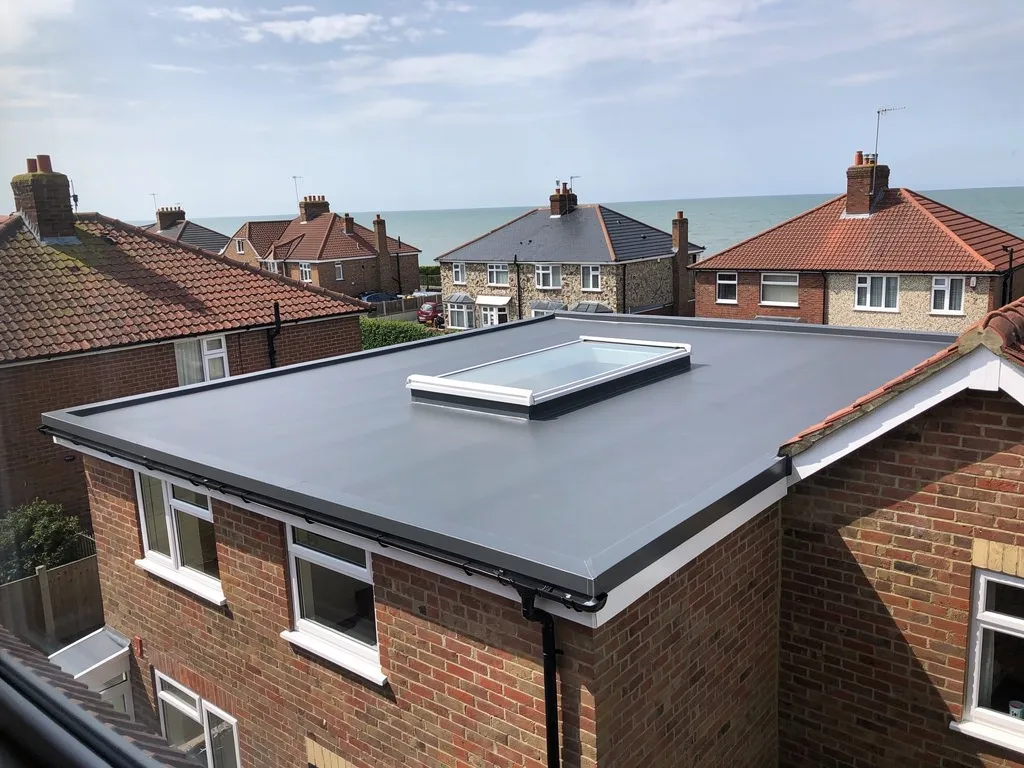
Felt is not always the right answer, even on a flat garage roof. Think about alternatives when the roof is large, awkward in shape or has several rooflights, because every lap and upstand is a place for water to test the work. A single-sheet rubber membrane, EPDM, is laid in one piece across most garage roofs and has fewer joints to fail. Our guide to EPDM garage roofs goes through it.
For EPDM, GreenSpec expects 20 to 30 years of service, while Less quotes 30 to 50. GRP, a glass-fibre reinforced plastic laid wet and set in place, is quoted by Less at 25 to 40 years. How long any covering lasts turns on weather exposure, the standard of the work and upkeep, so treat these as ranges, not promises. The comparison of materials, including steel sheets, is in our guide to the best material for a garage roof.
If the roof is not flat at all
A garage with an old corrugated roof may need overcladding or a new pitched structure, not felt. The pros and cons of covering old sheets rather than removing them are set out in our page on overcladding asbestos cement sheets. And if you are weighing a slope for better drainage, see converting a flat garage roof to pitched.
Whichever covering is chosen, the quote names it and the wall upstands it relies on, and the wider options are on our garage roof replacement page. To start, send photographs of the roof from above if you can reach it safely, the wall junction, and the garage ceiling, and we will tell you which route fits.