
Question answered
Garage roof guttering
The short answer
Garage guttering collects what the roof sheds and carries it to a drain or soakaway. Sheet roofs shed water along a long edge, so the gutter needs enough capacity, a gentle fall to the outlet and firm brackets. Old asbestos cement gutters are grouped by HSE with roof sheeting and need the same care. Guide prices for replacement guttering are per metre, and a survey shows which parts have failed.
Whatever covers the garage, the gutter beside it decides where the rainwater ends up. Sheet, felt and tiled roofs all depend on it.
How a sheet roof sends water to the gutter
A corrugated sheet roof is a row of channels. Rain runs down each trough and drops off the lower edge in a line of streams, which land in the gutter along the garage's full width. Wind pushes some of that water sideways, so the gutter has to be wide enough, and set close enough to the sheet edge, to catch it.
Flat roofs work differently. The membrane or felt drains to one side or end, often over a drip edge or trim, and the gutter takes the whole load from that edge. On a larger garage that is a lot of water in a downpour, so a small domestic half-round on weak brackets can be overwhelmed.
Where the sheet edge hangs too far over the gutter or stops short of it, water either misses and runs down the wall or splashes over the back. Setting that position is part of fitting the roof, not an afterthought. Our guide to condensation in garage roofs covers another frequent source of drips in these buildings.
Falls, brackets and outlets that keep it flowing
A gutter needs a fall so that water travels to the outlet instead of sitting. Manufacturers typically recommend a gentle slope, roughly 1:600 to 1:350 depending on the system. Brett Martin's guidance gives 1 mm of fall for every 600 mm and says brackets should sit no more than 900 mm apart. The instructions for your own product apply.
Many garage gutters fail through age and neglect rather than design. Brackets that have rusted or worked loose let the run sag, so water pools in the middle and spills. Joints dry out and weep. Leaves from a nearby tree, moss washed off the roof and a bird's nest can block the outlet.
A sagging gutter tends to show as a dark stripe on the wall below, green growth at the joints or a drip in one spot. Garages often have a single downpipe at one end, and if that blocks, the whole run backs up. We check gutter, outlet and downpipe together, because clearing one while ignoring the rest rarely cures it.
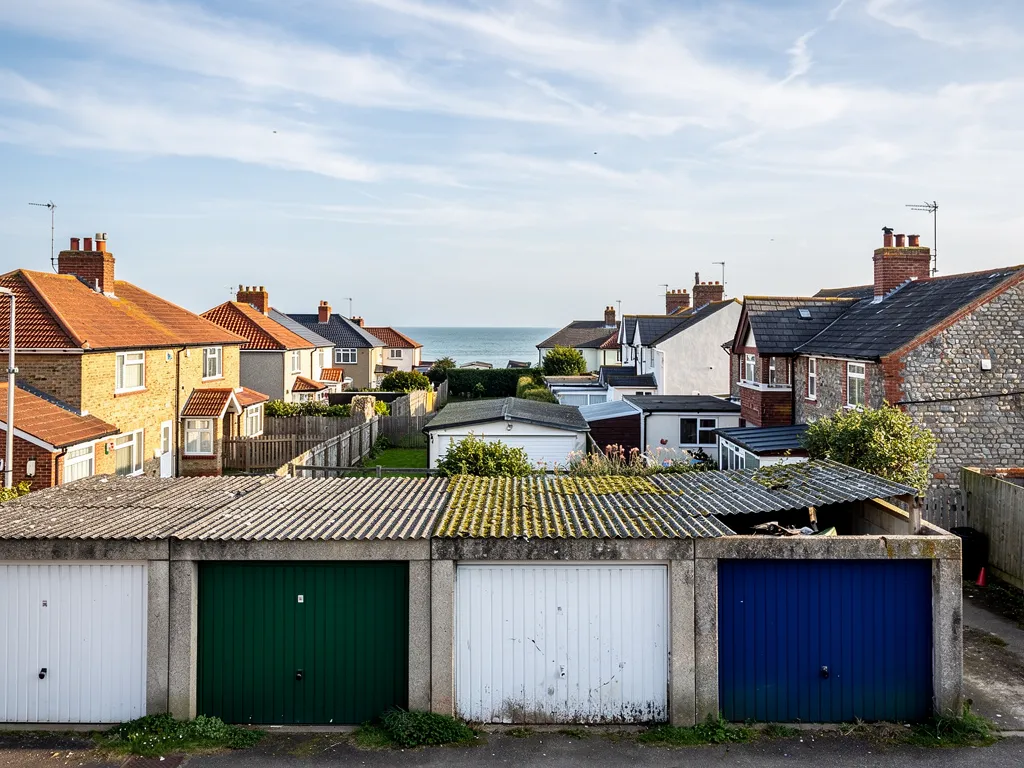
Asbestos cement gutters and downpipes
Many garages put up before 2000 have cement gutters and pipes beside cement sheets. HSE groups roof sheeting and rainwater goods made of asbestos cement together, and tells owners to presume asbestos in buildings of that age. A grey, heavy, rough-textured gutter on such a garage should be treated as suspect.
That changes what you can do with it. Do not scrape, drill, cut or pressure wash old cement gutters, and do not knock out a blocked section with a hammer. Lifting leaves out by hand, with care, is one thing; work that breaks the material is another.
Replacement is more than a swap if the gutters are cement. They have to come off whole, be wrapped and leave as hazardous waste, and the household exemption does not cover asbestos waste. Our pages on HSE asbestos cement rules and removing asbestos sheets yourself explain the detail, and the garage roof replacement overview puts it in context.
Repair, re-fix or replace
Small faults can be mended. A refitted bracket, a new joint seal or a cleared outlet often restores a gutter in decent condition. Where the run has cracked, the brackets have rotted into the fascia or the gutter is too small for the roof, replacement is the better fix.
Modern plastic systems are light and easy to fit, and aluminium or steel alternatives suit exposed spots. The right size depends on the roof area draining to it, so a larger garage or a long single fall may need a deep-flow profile and a second downpipe.
The fascia behind it matters too. A gutter screwed to rotten board will not stay up, so renewing the fascia may come first. On a coastal site, gales give brackets and joints an extra test. Typical UK guides put guttering replacement at £30 to £70 per metre (MyBuilder, updated 21 August 2026), and the final figure depends on length, access and what is found. The written quote follows the survey. Money matters after storm damage are covered on our garage roof insurance page.
Where the water goes, and sheets that leak at the eaves
Draining a garage roof to the wrong place causes trouble. A downpipe that empties onto the path, into a neighbour's space or against the garage wall sends water where it should not be. Connection to a drain or soakaway has its own rules, and your council or the drainage owner can advise.
Sometimes the drip at the eaves is the sheet and not the gutter. A cracked sheet end or worn fixing lets water through just above the gutter line. People reach for a brush-on sealer, which may help briefly on a sound roof; our guide to sealing an asbestos roof explains why that needs care on cement sheets.
Surveying a garage guttering fault means looking at all of it: sheet edges, eaves filler, fascia, brackets, outlet, downpipe and ground. We photograph each part and send you the findings before we quote. Ground-level pictures of the gutter line, with the garage's size, tell us what is likely to be involved.
Gutter questions for garage owners
Why does my garage gutter overflow only in heavy rain?
A gutter that copes with showers and spills in a downpour is usually too small, sagging between brackets, blocked at the outlet or short of downpipes. A large flat or sheet roof can deliver more water than a basic domestic gutter can carry, so the survey checks capacity as well as debris.
Can I add a gutter to a garage that has none?
Usually, if there is a fascia or sound edge to fix to and somewhere sensible for the water to go. On sheet roofs the gutter has to sit where it catches the drip line. If the roof edge is cement, fixing into it needs a plan first, so ask before drilling.
Tell us about your roof
Describe what is happening and we will call you back to arrange a visit.
- Photographs of what we find
- A written quote with one total price
- Or call 01903 299063
10-year workmanship guarantee, in writing.