
Question answered
How to tell if a garage roof is asbestos
The short answer
Start with the date. HSE's guidance is to presume asbestos is present in any garage dating from before 2000. Grey corrugated or flat cement sheets on an older garage fit that picture, but looks alone prove nothing either way. Do not break, drill, scrape or walk on the roof to check; have a trained person take a sample.
You cannot be sure from the ground, and a roof that looks harmless may not be. The date of the garage is the first clue, and sampling by a trained person is how it is settled.
Begin with the age of the garage
The most useful single fact is when the garage was built or last worked on. HSE's line is that anything built or refurbished before 2000 should be presumed to contain asbestos. That is a rule for planning, not a test result, but it is the safe way to treat any older roof until a sample says otherwise.
Dates can be hazy on a garage. Many were added to a house years after it was built, replaced a smaller shed, or were re-roofed by an owner who has since moved on. A sectional concrete garage may carry roof sheets that were fitted long after the walls. If you cannot show that the roof covering went on after 2000, treat it as suspect.
Ask whoever sold you the house for any paperwork, and check surveys, building control papers and old invoices for the roof. A document that names the sheet material is better evidence than a guess from the lawn. Our page on garage roof replacement shows how we survey these roofs before quoting.
What asbestos cement sheets look like
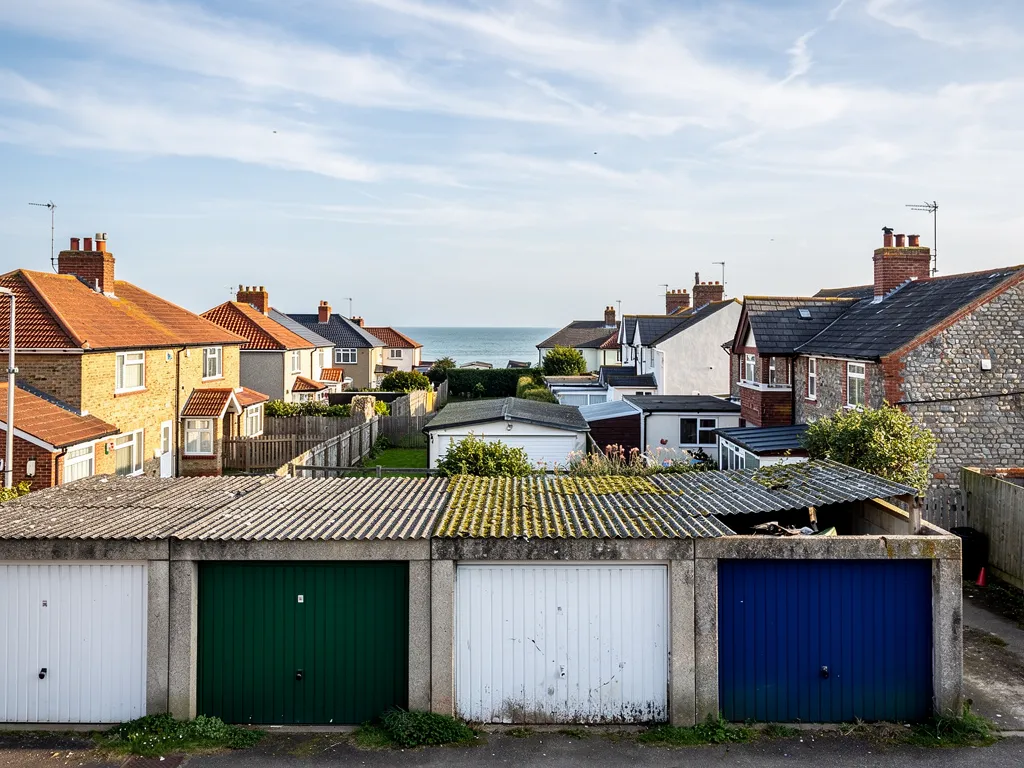
Asbestos cement is a mix of cement and asbestos fibres pressed into sheets. On garages it usually appears as large corrugated sheets, or flat panels, in a dull grey. Age often shows as streaks, moss, lichen and a rough, weathered surface, and the edges and ends may look slightly fibrous where the sheet has eroded. Bolts or hook fixings run through the high points of the corrugations.
Roofs of this kind are fragile, HSE stresses, so a sheet that looks solid can still give way under a person. Never test it by standing on it.
None of those features is proof. Modern fibre-cement sheets without asbestos look much the same, as do some profiled metal and plastic sheets with a grey finish. A weathered surface tells you the sheet is old, which is useful, but it cannot tell you what the sheet is made of. Only analysis of a sample answers that, and testing a garage roof for asbestos explains how it works.
Soffits, boards and other parts of the roofline
The roof sheets are not the only place to look. Among the locations HSE names are external soffits, and asbestos insulating board, shortened to AIB, went into soffits, linings and panels on older buildings. AIB is a different material from asbestos cement and the rules around it are stricter, with most removal reserved for a specialist who holds the appropriate licence.
The difficulty is that AIB looks like ordinary board. HSE points out that telling it from non-asbestos equivalents by eye is hard, so the eye is a poor guide to soffit panels, garage ceilings and the infill under a gable.
If your garage has flat boards under the eaves or around the door head, and it dates from before 2000, treat them with the same caution as the sheets. Leave them alone, do not drill or cut them, and mention them to whoever surveys the roof. The longer asbestos cement roof removal page covers the removal side.
Why you must never break a sheet to check
Asbestos cement is low risk while it stays whole. The danger comes when it is broken, drilled, scraped, sanded or blasted with a pressure washer, because that puts fibres into the air. A cracked corner, or a drill hole made to see what is inside, turns a harmless guess into a hazard and a mess you then have to deal with.
For the same reason, do not lift a sheet to peek underneath, snap off a piece for the bin, or take a screwdriver to the edge. Moss and algae should be left, not scrubbed.
Keep people and pets away from any cracked or broken pieces on the ground, and do not sweep or vacuum fragments with household tools. If a sheet has fallen or shattered, leave it where it is and get advice before anything is moved. Our page on the fragile asbestos roof goes into the fall risk, which is as serious as the fibre risk.
What happens once you know, or still cannot tell
If the garage predates 2000 and the roof is sheeting, the working assumption stays until a sample shows otherwise. A trained person takes a small piece with the sheet kept as intact as possible, seals it, and sends it to a laboratory. The result is a written report, which you can keep for the next owner.
If the answer is asbestos cement, you have choices. You can keep an eye on it, cover it over, or take it off. Careful removal of whole sheets does not need a licence under HSE's guidance, but the way it is done matters; do you need a licence to remove an asbestos roof sets that out. If the sheets are already damaged, the position changes again.
We survey first, show photographs of the roof, and then send a written quote giving a single total.
Two more questions about spotting asbestos
Can I tell from the shape of the corrugations whether a sheet is asbestos?
No. Asbestos cement and non-asbestos fibre-cement sheets share profiles, and metal and plastic sheets copy them too. The profile, colour and weathering are clues about age at best. A laboratory result on a sample is the only reliable answer, and a built-before-2000 garage is treated as suspect until then.
Is a garage roof with moss and cracks more likely to be a problem?
Weathering makes asbestos cement more brittle, so cracks matter for safety, but moss is not a sign of fibre content. A mossy roof is simply an old one. Leave it alone, keep off it, and have it assessed rather than cleaning it, since scrubbing or washing can release fibres.
Tell us about your roof
Describe what is happening and we will call you back to arrange a visit.
- Photographs of what we find
- A written quote with one total price
- Or call 01903 299063
10-year workmanship guarantee, in writing.