
Question answered
Is an asbestos garage roof safe to walk on?
The short answer
No, an asbestos cement garage roof is not safe to walk on. HSE guidance describes these roofs as fragile every time, however sound and weathered the sheets look. A fall through the sheets is the first danger, and breaking them frees fibres, which is the second. Stay off the roof, keep ladders off the sheets, and have the garage assessed before any work.
No. Corrugated asbestos cement sheets can look solid and still give way underfoot without any warning. Here is why they are so risky, and what to do about a roof you suspect is one.
Fragile means it can break under a person's weight
In roofing, fragile has a specific meaning: a surface that may not carry a person. HSE's guidance on asbestos cement treats the whole category as fragile. It does not matter how thick the sheets seem or how long they have sat there.
Age makes the position worse. Sheets that have taken decades of weather turn brittle, and moss and lichen grow across them and cover cracks. A corrugated sheet may bear weight on the crest of a ridge in the profile and fail between fixings, or crack at a lap where two sheets overlap. There is seldom a sign before it goes.
For a homeowner the practical rule is simple. Do not step onto the roof to clear leaves, mend a leak or fit a dish. Do not rest a ladder against the sheets or lean across them from a ladder. Anyone who has to go up needs proper edge protection and a method planned for fragile surfaces, and a plank laid across the top is not one.
Two dangers: the fall and the fibres
A fall through a garage roof is the more immediate risk, because the drop onto a concrete floor hurts as much as it would from any other roof. The second danger is slower. Breaking asbestos cement can release fibres, and HSE says that when the material begins to crumble and throw up significant dust, the job counts as notifiable non-licensed work.
That is a change of category, not a reason to panic about a roof that is merely old. Weathered sheets in good order, left alone, shed very little. The risk climbs when sheets are cracked, drilled, scrubbed or dropped. Pressure washing and wire brushing, tempting on a mossy roof, are the very treatments to avoid.
If a sheet has cracked, a branch has struck it or somebody has stepped through, stop and keep others away. Cover the area only if you can do it without touching the material, and ask for advice before clearing up. Our page on removing asbestos roof sheets yourself covers what the guidance asks of anyone handling them.
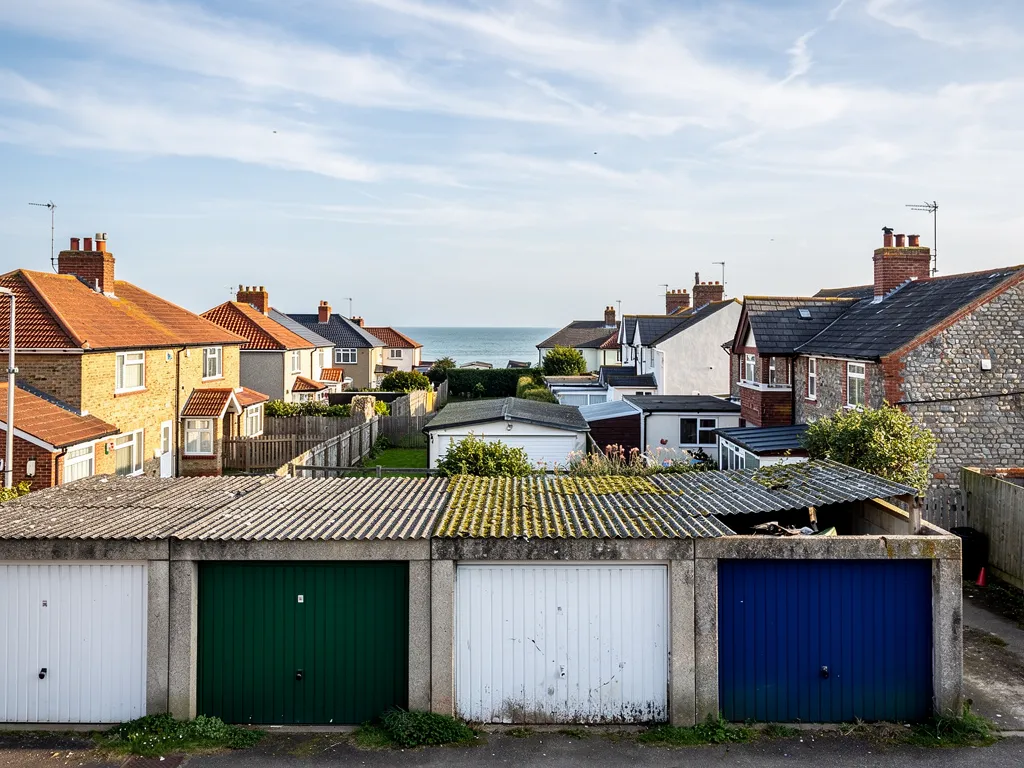
How to tell if your garage roof may be asbestos cement
You cannot be certain by eye. HSE says to presume asbestos in anything put up or refurbished before 2000. Big grey corrugated sheets on a garage of that age are a typical example, though modern fibre cement and some plastics look alike.
Clues include the age of the garage, the sheet profile, a rough weathered face covered in moss and the look of the edges at the eaves. None of them proves anything. A sample test by a suitable laboratory gives an answer, but taking the sample needs its own plan, because snapping off a piece is the very thing you should not do casually.
Do not collect a piece yourself and do not scrape the surface. If you want to know, ask for an assessment first, and treat the roof as asbestos cement until told otherwise. The page on checking whether a garage roof is asbestos explains the options in more detail.
Rooflights, moss and other ways people fall through
Fragile roofs are made more dangerous by what hides in them. Plastic rooflights in a garage roof are usually weaker than the sheets around them, and they may be painted over, greened with algae or lost under moss. A person heading for a gutter or a ridge can easily put a foot on one without knowing.
Wet weather makes the surface slippery, and coastal air grows moss and algae fast on shaded slopes. Wind adds a risk of its own: a person on a sheeted roof in a gust can be thrown off balance onto a patch that gives way.
None of this is a reason to ignore a leak. It is a reason to look from the ground, from inside the garage and from a stable platform, and to book a survey that never involves standing on the sheets. We record what we find in pictures and plain words, then put the quote together once the plan is agreed.
Drips are often condensation rather than a hole, so we check that too. The wider garage roof replacement page shows the options.
What happens next: overlay, seal or remove
There are three broad routes for an asbestos cement garage roof: leave it and monitor it, cover it, or take it off. HSE's roofing guidance poses the question of laying a non-asbestos sheet over the top rather than removing, which avoids disturbing the old material. Overcladding suits some roofs where the structure is sound and the sheets are in fair condition, and the page on overcladding asbestos sheets covers it.
Where the sheets must come off, careful lifting of weathered, undamaged sheeting sits in the non-licensed class. It still needs a plan: lowering whole sheets, wrapping and labelling them, and sending them off as hazardous waste under a consignment note. See asbestos waste disposal.
Before choosing, check the permission side: planning permission for a garage roof sets out the usual points. A few photographs of the garage from the ground are enough for us to say what the survey should cover.
Fragile roof questions
Can I stand on the roof if I use a board across the sheets?
A board spreads the load but does not make an asbestos cement roof safe to walk on. HSE calls these roofs fragile without exception, and shifting the board, or stepping on and off it, risks cracking a sheet. If someone must go up, the access needs a planned method for fragile surfaces.
Is it a problem if my garage roof sheets are covered in moss?
Moss is mostly a cosmetic and drainage matter, but it hides cracks and makes the surface slippery. Do not scrub or pressure wash it off, because that can damage the sheets and release fibres. Leave the surface alone and ask for a survey that works around it.
Tell us about your roof
Describe what is happening and we will call you back to arrange a visit.
- Photographs of what we find
- A written quote with one total price
- Or call 01903 299063
10-year workmanship guarantee, in writing.