
Question answered
How long does a garage roof last?
The short answer
A garage roof typically lasts from around 10 to 20 years for torch-on felt, 20 to 30 years or more for EPDM, 25 to 40 years for GRP, and 30 to 60 years for concrete tiles. These are published typical ranges, not promises. Workmanship, drainage, shade, foot traffic and maintenance decide where a particular roof lands in its range.
It depends almost entirely on the covering and on how well it was laid. Typical ranges run from about ten years for a poor felt job to several decades for tiles and some membranes.
Typical lives by covering
Published lifespans are ranges, and sources sometimes disagree. The table gives the typical UK figures for the coverings garages most often have.
| Covering | Typical life | Source |
|---|---|---|
| Torch-on felt | 10 to 20 years | Less, March 2026 |
| EPDM rubber | 20 to 30 years or more | GreenSpec |
| GRP fibreglass | 25 to 40 years | Less, March 2026 |
| Concrete tiles | 30 to 60 years | MyBuilder and Marley |
| Clay tiles | 40 to 60 years | MyBuilder |
Flat roofs in general run to between 15 and 30 years, MyBuilder says. Treat all of these as planning figures: careful laying over a dry deck can beat the low end of a range, and a rushed job can fall short of the high end. The garage roof replacement page shows how we approach each. Warranties come from the maker and differ from lifespan, and a guarantee period only tells you what the supplier will stand behind. EPDM is rubber and GRP is glass-reinforced plastic; our pages on EPDM on a garage roof and garage felt roofs look at each.
What shortens a garage roof's life
The same material can last twice as long on one garage as on another. Several things drive the gap.
Water that stays put does the most harm. Good practice is to design a flat roof with a 1:40 fall, which leaves a finished slope of at least 1:80 (IKO, citing the 2018 edition of BS 6229, since revised). A roof laid too flat, or one that has sagged, keeps puddles for days, and each puddle keeps working on the covering.
Edges and joints come next. Felt laps, EPDM seams, the upstand against the house wall and the trims around the perimeter are where wind and rain look for a way in. Coastal weather tests them harder than a sheltered inland site would, so the fixing of edge trims and flashings matters.
Overhanging trees drop leaves and shade the surface, which holds moisture and grows moss. Foot traffic damages felt and thin membranes, and stored items dragged across the roof do the same. A gutter that has silted up pushes overflow back beneath the edge. Clearing the gutter and keeping the surface clean are the lowest-cost ways to add years.
Pitched garages and older sheet roofs
Pitched garage roofs follow the lives of the tile or slate they carry. Concrete tiles carry a Marley estimate of roughly 60 years (not a guarantee), against a MyBuilder replacement point of 30 to 50. Clay tiles are put at 40 to 60 years. Under the covering, battens and underlay age too, and underlay can fail before the tiles. See the pitched garage roof for what to check.
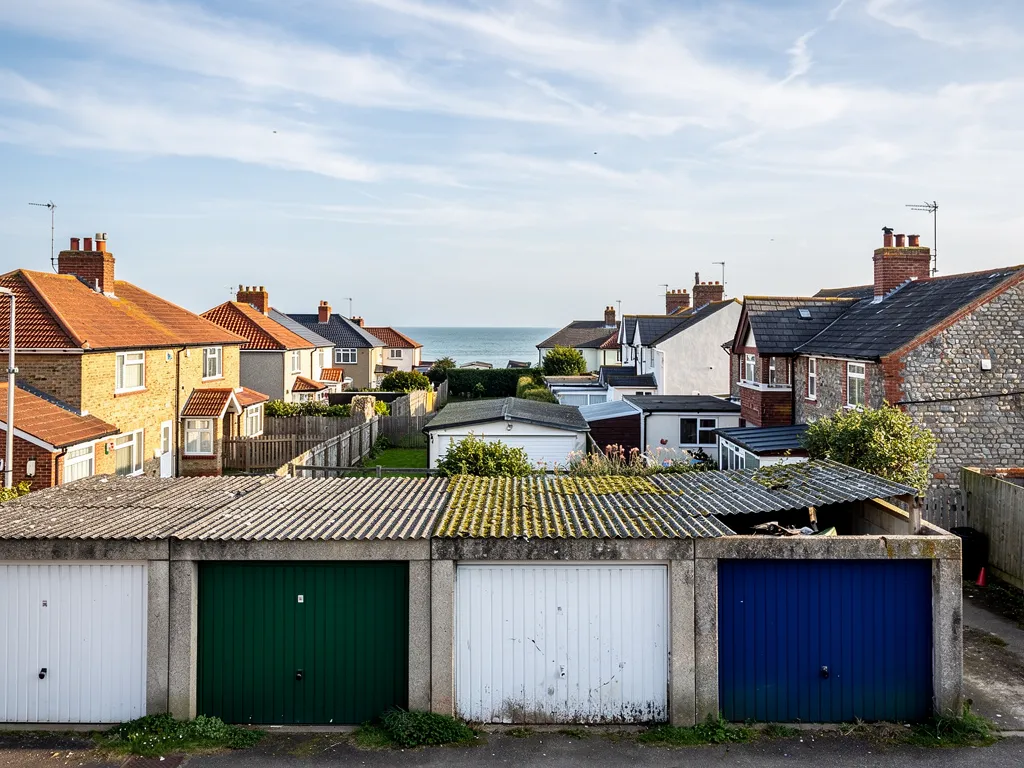
Older garages often have cement sheets, and these are a different case. A sheet can stay in place for a very long time, but it turns brittle with age, and HSE describes roofs of this kind as fragile throughout. For a garage dating from before 2000, HSE's default is to presume asbestos. Age on its own is no reason to take sheets off, and removal is a decision for after you know the material. Testing a garage roof for asbestos explains how to find out, and overcladding asbestos sheets covers covering rather than removing.
Signs a roof is nearing the end
Several signs say a covering has little life left. On felt, look for splits along the laps, blisters that crack, bare patches where the surface has worn off, and ridges where it has cracked over upstands. On a membrane, look for lifting seams, pinholes and edges that have pulled away.
Inside the garage, watch for stains on the ceiling or the top of the walls that return after dry spells, and for a damp smell. Photograph any stain each time you notice it, so you can see whether it is growing. A dated set of photographs also helps if you later compare quotes or sell the garage, and it shows a surveyor how the fault has changed over the seasons. Soft or spongy boards under the covering mean the deck has been wet for some time, which turns a covering swap into deck repair as well.
One leak does not mean the roof is finished. A single failed joint can be repaired, and a leaking garage roof explains how to decide between repair and replacement. A roof with several repairs, a covering well into its expected life and a doubtful deck is a different case.
Our survey starts by tracing the leak, and you get photographs of your roof and a recommendation for the least work that does the job. A repair is the answer whenever a repair properly solves it.
Garage roof lifespan: two more questions
Does a manufacturer's guarantee tell me how long my garage roof will last?
No. A guarantee states what the supplier will stand behind for a set period, usually when the product is installed to its instructions. Lifespan is the likely working life, and it depends on the fall, drainage, edge details and maintenance. A roof can outlast its guarantee or fail inside it.
Can an old felt garage roof be coaxed through a few more winters?
Sometimes. Clearing debris, keeping gutters running and repairing splits early help, and a coating or patch can buy a few seasons on a sound roof. Once the felt is cracking widely or the deck is soft, extra layers rarely pay and replacement is the better value.
Tell us about your roof
Describe what is happening and we will call you back to arrange a visit.
- Photographs of what we find
- A written quote with one total price
- Or call 01903 299063
10-year workmanship guarantee, in writing.