
Question answered
Is a garage roof covered by home insurance?
The short answer
A garage roof may be covered by home insurance if the garage sits within the buildings cover or counts as an outbuilding, but the policy wording decides. Insurers separate storm damage from wear and tear, and the Financial Ombudsman Service notes that exclusions often take in gradual damage. Read the schedule, keep photographs, and hold off on permanent work until the insurer has been told.
It can be, but your policy wording and the reason the roof failed decide it. A storm that rips sheets off is judged very differently from a covering that has aged out.
Is the garage inside your buildings cover?
Home policies treat garages in different ways. Some fold attached and detached garages and other outbuildings into the buildings sum insured. Others list them separately, set lower limits or exclude certain constructions. A lock-up in a block you do not own may be insured by the freeholder instead of by you.
Look at the schedule and the definitions in the policy booklet, where terms such as outbuilding, garage and domestic building are explained. Check for conditions about state of repair, roof materials, or business use. If you cannot work out the answer, ask the insurer or broker and write down what you were told.
The roof is part of the building, so if the garage is covered, the roof falls under the same terms. That does not make every roof problem claimable. The next sections explain how insurers split sudden damage from decline. For freehold and leasehold questions in blocks, see shared garage roofs.
Storm damage versus wear and tear
When the Financial Ombudsman Service weighs a storm complaint, it works through a short checklist. It wants to establish that a storm really occurred on the day, that the harm looks like the usual work of a storm, and that the weather, rather than something else, did the main damage. Strong winds with rain, hail or snow are its picture of a storm, and the insurer carries the job of proving that any exclusion applies.
Which? reported in November 2025 that insurers often lean on their trade body's storm definition, and cited a leak through a badly kept roof as typical wear and tear. It also quoted regulator figures: just 32 per cent of the storm claims lodged in 2024 ended in a payout.
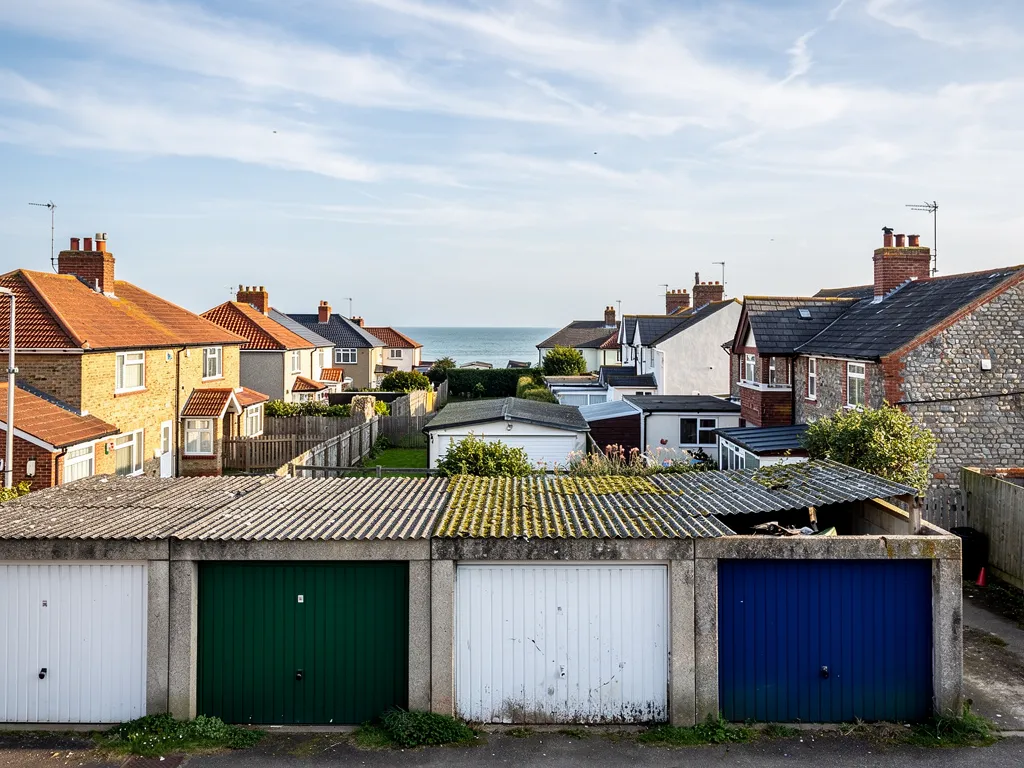
For a garage, that makes a sheet torn off in a gale a different story from sheets that cracked with age and finally let go. An old asbestos cement or felt roof that fails in a blow can be argued either way, and evidence of its earlier condition counts.
Gradual damage, leaks and condensation
The Ombudsman also observes that exclusions frequently reach damage built up gradually. Persistent leaks from worn felt, slow rot in a deck, rusting fixings and condensation all fall into that bracket for many policies. Insurers also expect an owner to keep a building in reasonable order, so a roof neglected for years may be harder to claim for.
Condensation is a common source of confusion. Drips from an uninsulated sheet roof are building physics, not weather damage; our page on condensation dripping from a garage roof explains the difference. A blocked gutter that overflows and soaks a wall is a maintenance problem too, as covered in garage roof guttering.
Useful evidence shows the roof's state before the incident and what altered afterwards. Photographs from before and after, receipts for past repairs and dates of the weather all help. At survey we describe what we find in plain words and pictures. Whether the insurer treats it as storm damage is the insurer's decision, and nobody can guarantee the outcome.
What to do straight after a storm hits the garage
Make the area safe first. If sheets have lifted or fallen, keep people and pets clear, and do not climb onto a damaged roof. Broken asbestos cement needs particular care: do not sweep up fragments or move pieces, and read why asbestos garage roofs are fragile.
Photograph everything before it is touched, from the ground and from inside the garage. Note the date, the weather and what is affected. Then contact your insurer. Advice put out for Storm Eunice in 2022 told householders to ring the insurer promptly. Temporary emergency repairs to limit further harm were encouraged, with a call to the insurer beforehand.
A temporary cover, such as a tarpaulin or sheeting secured safely, is a reasonable way to keep water out, and the receipt is worth keeping. Permanent work can wait for the insurer's instructions. Where water is coming in, we stop that first, and we can set out the repair in writing. Conversion questions are on our garage conversion roof page.
If the claim is refused, and choosing the repair
Start by complaining to the insurer in writing and asking for its reasons. The route is insurer first. Should eight weeks pass with no final answer, or the answer disappoints, the Financial Ombudsman Service will look at it, free of charge, provided you bring the case within six months of that final response. See also the garage roof replacement overview.
If the claim is accepted, you still choose the repair. An insurer may offer a cash settlement or a repair, and the best long-term fix may not be the least expensive one. Compare coverings in garage roof materials, and ask how long each lasts.
Where sealing is suggested as a stopgap, our page on sealing an asbestos roof explains the limits. Ask any contractor for a written quote that says what is included, if VAT and any scaffold are included in the price, and what happens if something unexpected turns up. Photographs of the damage and the garage help us judge what a survey should cover.
Insurance questions about garages
Will my insurer pay for a new garage roof after a gale?
That depends on the policy and the facts. The insurer will ask whether a storm occurred, if the damage looks like a storm's work, and if the roof was in sound condition beforehand. Nobody can guarantee a result. Make the roof safe, photograph the damage and speak to the insurer before permanent work.
Does it matter that the garage roof is asbestos cement?
It can. Policy terms on building materials and condition vary, and asbestos cement raises waste and handling costs that some policies treat differently. Tell the insurer what you know about the roof, and do not disturb broken sheets while you wait for their reply.
Tell us about your roof
Describe what is happening and we will call you back to arrange a visit.
- Photographs of what we find
- A written quote with one total price
- Or call 01903 299063
10-year workmanship guarantee, in writing.