
Question answered
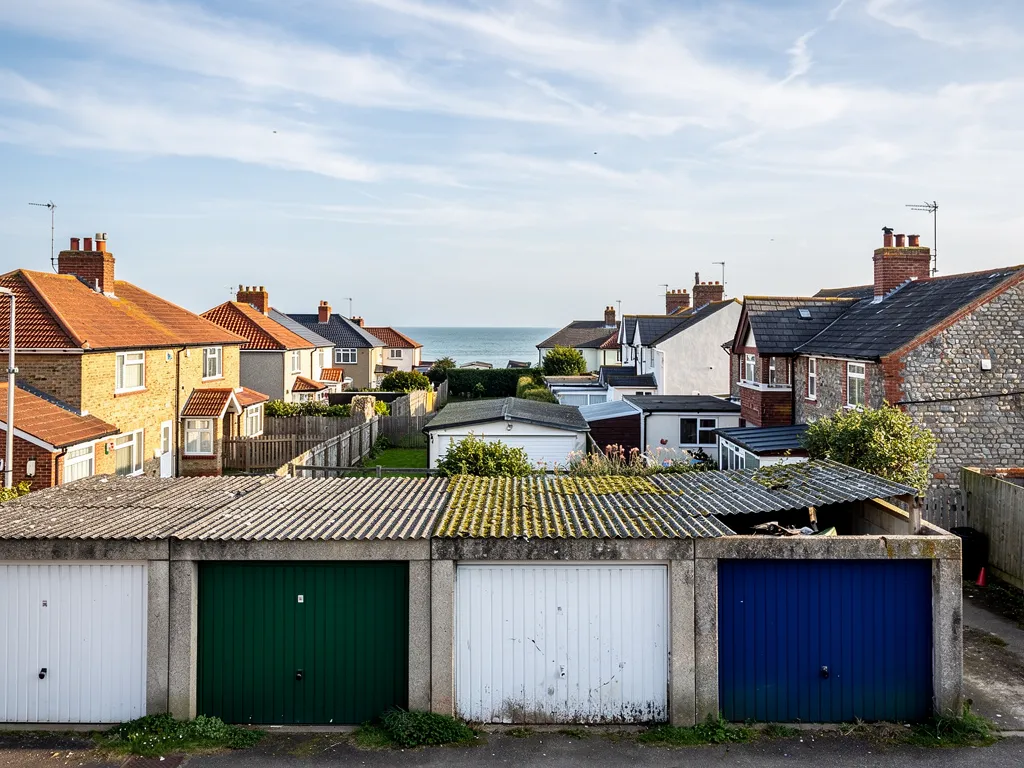
Shared garage roofs in a block
The short answer
A block of lock-up garages usually has one roof running over several doors, so a leak in your bay may start in your neighbour's, and work on one section affects the rest. If the roof is asbestos cement, HSE says such roofs are always fragile and sheets must be handled whole. Agree who owns and pays for the roof, survey the full run, and arrange the work in one go.
Lock-up garages built in a row often sit under one continuous roof. That makes a repair or replacement a shared decision, and one that is easy to get wrong without a plan.
Why a row of garages behaves as one roof
Garages built in blocks behind terraces and flats were usually put up as a single structure: a row of brick or concrete bays with dividing walls, topped with one long run of sheeting or a flat deck. The roof does not stop at the wall between you and the next owner. The same purlins, the same lapped sheets and often the same gutter run straight across.
This changes how a fault should be read. Water that drips in your bay may be entering three bays along and tracking sideways on a support beam or a sheet overlap. Treating only your own length can leave the cause untouched, and a patch beside a neighbour's untouched sheets leaves a step in the roof where wind can lift an edge.
It also changes what a fair repair looks like. A survey that walks the whole row, from below as well as outside where access allows, shows where the fault starts and whether a replacement of the full length is the more sensible job than a string of separate fixes.
Asbestos cement sheets across a block
Long garage rows are just where asbestos cement sheeting was used. HSE tells owners to presume asbestos in any structure dating from before 2000, and it labels every roof of this material as fragile. A big run of sheets is no place to stroll across to inspect it, to pressure wash it or to hop between bays.
The same advice allows a careful, whole-sheet removal of weathered but sound sheeting without a licence. Once sheets have cracked or collapsed, the job moves into the notifiable category. In a shared block that distinction matters, because the sheets form one structure used by several people, and a broken sheet in one bay can scatter debris over its neighbours.
Our page on whether an asbestos garage roof is safe to walk on goes through the fragility point in more detail, and the garage roof replacement overview shows where each step fits.
A long row also makes a good argument for one survey of the whole roof, so that cracks, lapped joints, missing fixings and sagging supports are recorded together and nobody argues later about which bay a fault belongs to.
Who owns the roof, and who pays
Ownership is the first question, and the answer sits in paperwork rather than on the roof. Some garages are freehold, each owner holding a bay and a share of the structure. Others are leased from a landlord, a management company or a housing provider, and the lease says who repairs the roof and how costs are shared. In a block that belongs to a flat development, the garages may be part of the building's common structure.
Check the title deeds or the lease before anyone orders work. If the roof is the landlord's responsibility, an owner who repairs it independently may find the cost cannot be recovered. If it is shared, the document should show the split, and a written agreement between the owners avoids later arguments over who owes what.
We cannot advise on your legal position, and the deeds or a solicitor will settle it. What we can do is survey the roof, explain the fault in plain words, and put one total price in writing, either for the section you are responsible for or for the whole run.
Talking to neighbours and working at the shared wall
Even where each owner controls only their own bay, the work will affect the others. Scaffolding or a working platform may stand on a shared forecourt, sheets may be lowered across a neighbour's door, and the roof edge or gutter may be common to the row. A short note through each door, with dates and what to expect, goes a long way.
Work that touches a wall shared with a neighbour can bring a legal duty to give notice. GOV.UK's party wall guidance says notifiable building work needs written notice, and that you cannot assume silence means agreement. It is worth reading the guide before any work involving the dividing walls between bays, and taking advice if there is doubt.
Where the row has a management company, tell them first. They may already have plans, a survey or a contractor, and joining a block-wide job is often simpler than running a separate one beside it. For timings on a single roof, see how long a garage roof replacement takes.
Planning one job across the whole run
A single well-planned job usually makes more sense than separate ones. One scaffold or set of platforms, one waste arrangement, one matching covering and one set of edge details reduce the points where the new roof can fail. If asbestos sheets are involved, one plan for handling, wrapping and removing waste is safer than several contractors working in turn.
Planning permission is worth a check if the block will be altered in shape or height, rather than re-covered like for like; see planning permission for a new garage roof. If the garages are concrete sectional units, the concrete sectional garage page explains how those roofs are built.
A good first move is a handful of ground-level photos of the roof, a count of the bays and any lease papers you hold. From those we can say what a full survey of the run should look for, and whether it is a job for one owner or the whole block.
Questions about garage blocks
Can I replace only the section of roof over my own garage?
Sometimes, if the sheets or deck can be separated cleanly at a dividing wall and the neighbours agree. The joins, the gutter and the ridge or edge detail need care, and with asbestos cement sheets, cutting or breaking them is exactly what you want to avoid. The survey will say whether a section is practical.
Who should I tell before work on a shared lock-up roof?
Tell the landlord or management company if there is one, and each neighbouring owner whose bay or access the work touches. Check your lease for any consent needed. Where a dividing wall is involved, read GOV.UK's party wall guidance. Giving everyone dates and the plan in writing avoids most of the disputes.
Tell us about your roof
Describe what is happening and we will call you back to arrange a visit.
- Photographs of what we find
- A written quote with one total price
- Or call 01903 299063
10-year workmanship guarantee, in writing.