
Question answered
How long does a garage roof replacement take?
The short answer
A garage roof replacement is usually a short job next to a house re-roof, but no single figure fits every garage. A single flat garage goes quicker than a double or a pitched one, and a corrugated sheet roof depends on whether the sheets contain asbestos. Rotten decking, awkward access, a dry forecast and waste arrangements all add time, and the survey settles which of them apply to yours.
A garage roof is a smaller job than a house roof, but the timescale still shifts with the material chosen, how sound the deck underneath is and the weather. Here is what moves it.
What decides the length of the job
Four things matter more than the rest: how big the roof is, what is going on it, what lies under the old layer once it is lifted, and the weather. A single garage with a plain flat roof leaves a roofer little to work around. A double garage, a pitched roof with a ridge and verges, or a roof that butts against the house brings more to cut, fix and dress.
The deck is the big unknown. On a flat roof it is the boarding that carries the waterproofing, and a leak that has run for a season often leaves some of it soft. Swapping a few boards is quick. Renewing most of the deck, or the joists under it, turns a short job into a longer one. We look for this at the survey, from underneath as well as above, so the plan matches the roof rather than a guess.
Access counts too. A garage at the end of a narrow drive, or in a courtyard behind other houses, slows every delivery and every trip with old material.
Flat garage roofs: felt, EPDM and GRP
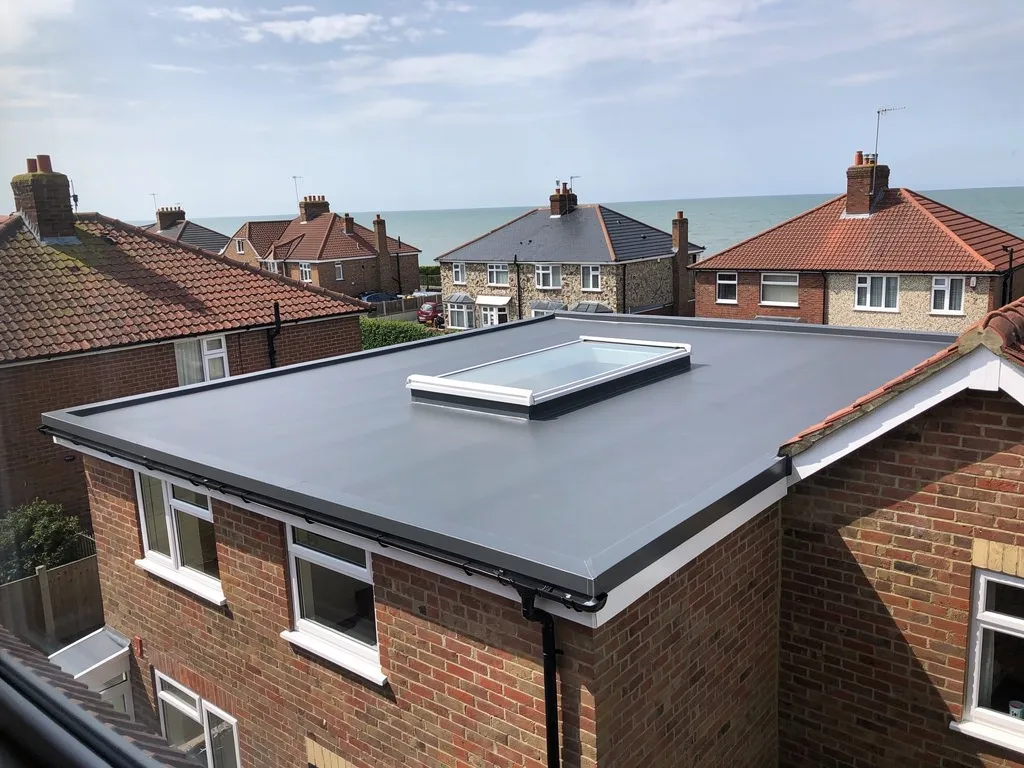
Flat garage roofs are covered in a few ways, and each has its own rhythm. Felt goes down in layers, with the roofer working edge by edge. EPDM, a single rubber membrane, is rolled over the deck in one piece, glued and then trimmed and sealed at the edges. GRP, glass-reinforced plastic, is a fibreglass laminate coated in resin on site, and it needs time to set before it takes rain.
None of these is a long job on a single garage with a sound deck. What stretches it is the edge detail: new trims, upstands against the house wall, and the drip edge over the gutter. Those are the places water finds first, so they are never hurried.
Resin and adhesive depend on dry conditions as well. A damp deck or a wet morning means the work waits, which beats sealing moisture in. If you are weighing coverings, our pages on the EPDM garage roof and the wider garage roof replacement service show how each is laid.
Pitched and corrugated roofs take a different path
A pitched garage roof means rafters or trusses, battens, underlay and tiles or slates, so there are more stages, and each leans on the last. Ridge and verge work, done with mechanical fixing, adds careful time at the end. Stripping the old covering and making the building weathertight before the weather turns is the first aim.
Corrugated sheets go on faster than tiles, because big pieces cover a lot of roof at once. The labour sits in the supporting purlins, the fixings, the sealing of laps and the ridge or flashing at the top. The corrugated garage roof page covers the sheet types.
If the old sheets are fibre cement, the order of work changes, because they come off differently from metal or plastic. The next section explains that. Where the roof belongs to a block, there may be arrangements to make with neighbours first, and our page on shared garage roofs covers them.
Asbestos cement sheets add steps before any new roof
Many older garage roofs, especially big corrugated ones, are asbestos cement. HSE's advice is to assume asbestos is likely in a building from before 2000, so a suspect roof gets identified before anyone touches it. That can mean a sample test, which adds a step before a start date is fixed.
The Health and Safety Executive classes careful removal of weathered, undamaged sheeting as non-licensed work, yet it still wants a plan: sheets lifted off whole and lowered, wrapped, labelled and carried away as hazardous waste under a consignment note. Sheets that have already broken up move the job into the notifiable category. None of it is quick to arrange, and none of it should be rushed to save a day.
Planning that order is part of the survey. Our page on walking on an asbestos garage roof covers why nobody should step on the sheets, and the quote will say how removal and waste are handled.
Weather, sequence and what the quote should say
On this coast the forecast sets the start. A strip-off leaves a garage open to the sky, so a careful roofer strips only what can be made weathertight by the end of the working day and covers the rest. A blustery morning off the Channel can stop sheets and membranes being handled safely, and a sudden shower stops felt or resin work.
That is why we avoid promising a finish date before the survey. What we give is a written plan after it: the order of work, who clears the old material, whether scaffold or a platform is needed, and anything that may stretch the job, such as a rotten deck or an extra layer of old covering underneath.
Settle planning questions early, especially if you want to change the roof's shape. The page on planning permission for a garage roof covers the usual points. Photographs and the garage's size get the conversation started quickly.
Timing details for garage roofs
Can the old garage roof stay on while the new one is laid?
Sometimes a new covering can go over a sound existing one, which saves the strip-out. It turns on the condition of the deck, the weight the structure can take and the type of covering. HSE's asbestos cement guidance even raises covering the old sheets with something else. Whether it suits your garage is a survey decision.
Do I need to empty the garage before work starts?
Clearing it is sensible. Debris and dust can fall into the space, and the roofers need room to work from inside as well as outside. Move vehicles, paperwork and anything that dislikes dust, and cover what has to stay. If the roof is asbestos cement, ask what protection the plan includes before anything comes off.
Tell us about your roof
Describe what is happening and we will call you back to arrange a visit.
- Photographs of what we find
- A written quote with one total price
- Or call 01903 299063
10-year workmanship guarantee, in writing.