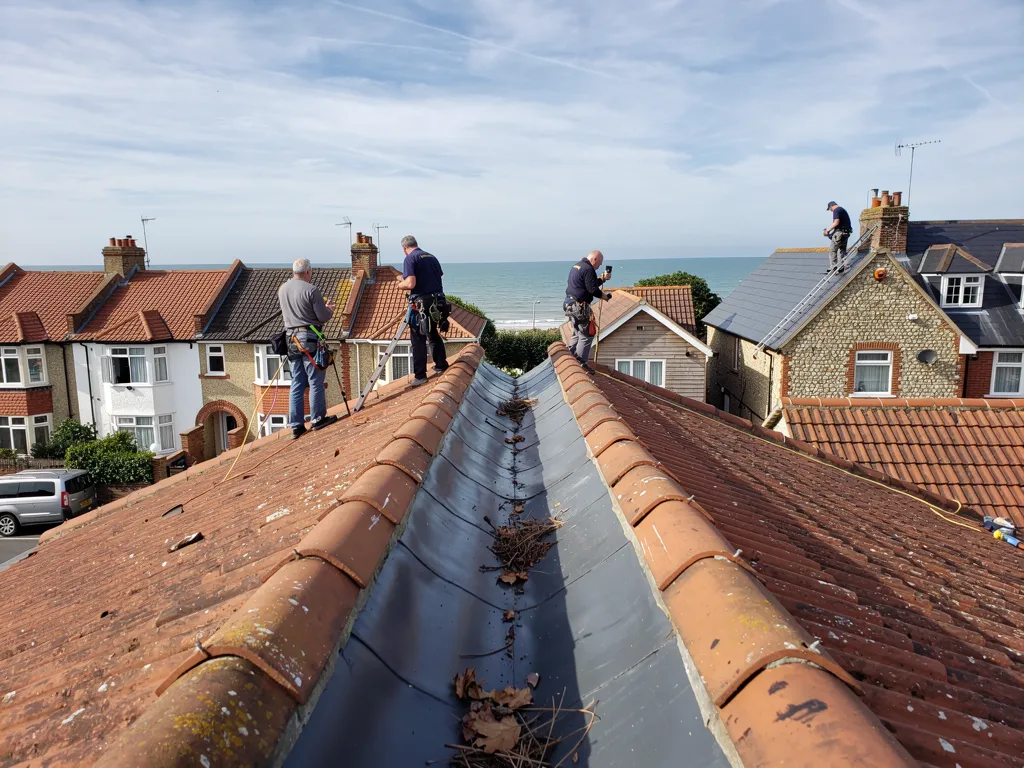
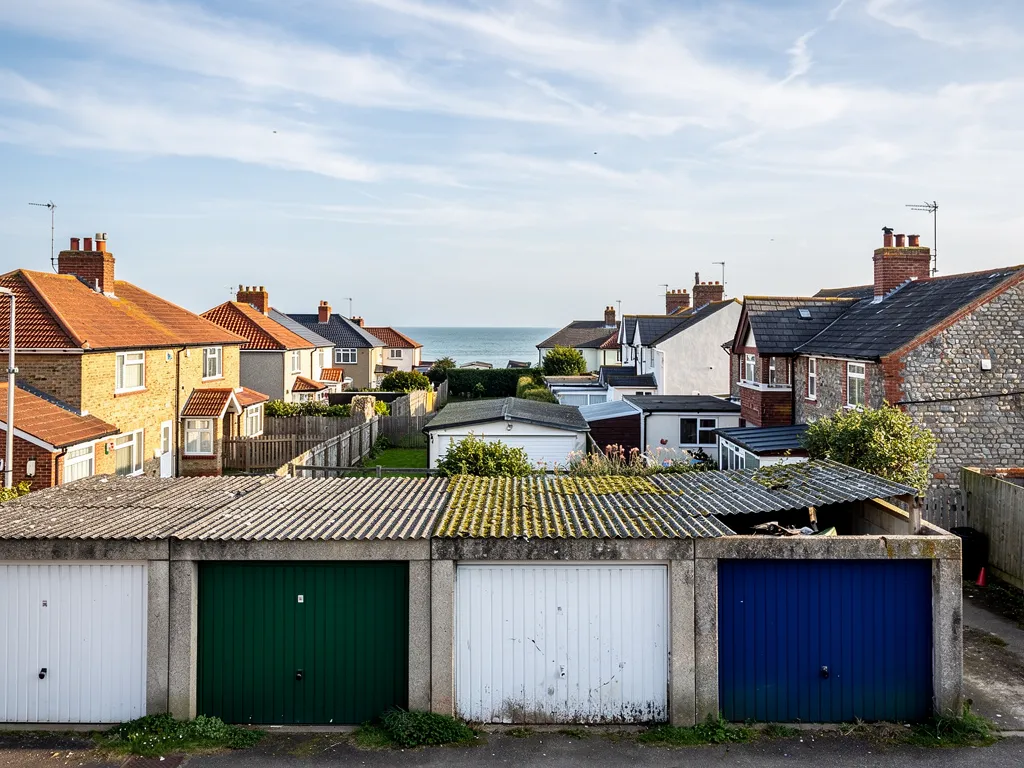
A corrugated sheet roof is among the commonest coverings on a detached or sectional garage, and from the driveway the different kinds look alike. The wavy profile gives each sheet stiffness, so a thin material can span the gap between timber supports without a solid deck underneath. Behind that shared shape sit very different materials: coated steel, bitumen-soaked fibre, modern fibre cement and, on garages of a certain age, asbestos cement. They age in different ways, they leak in different places and, above all, they are handled differently when the time comes to take them off.
Getting the material right comes first, because it decides the method, where the waste goes and which jobs happen in which order. This guide goes through each type, then the frame beneath, the laps and fixings that keep water out in a gale, and the choice between patching one sheet and re-covering everything. Where the sheets could be asbestos cement, the later sections send you to the fuller guides on removal, and the garage roof replacement hub gathers the rest.
Four kinds of sheet under one wavy profile
Look at the underside from inside the garage before you judge by the top. Coated steel sheets are thin metal with a painted or plastic-type finish, and the cut edges and fixing holes show bare metal. They flex if pushed and ring when tapped. Bitumen sheets are dark, light and slightly springy, with a fibrous edge. Fibre cement sheets are grey, stiff and brittle, with a matt surface that grows moss and lichen readily. Asbestos cement sheets look almost identical to fibre cement ones, and that is the whole difficulty.
Appearance cannot separate those last two. HSE treats any building from before 2000 as likely to contain asbestos, and a corrugated garage roof from that period falls squarely under it. Do not guess from the look of a sheet, and do not scratch or break a corner off to see inside. The survey deals with the question, and until it is answered the roof is treated as if it were asbestos cement.
Why the material comes before the quote
A steel roof can be unscrewed, lowered and taken to a scrap merchant. A bitumen or modern fibre cement roof goes out as ordinary construction waste. A roof that might be asbestos cement is treated as asbestos until a test says otherwise, with its own handling, wrapping and disposal, and a different set of costs. That is why we ask what the sheets are, or why we arrange for them to be checked, before we put a price on the replacement.
If you cannot tell, do not scrape, drill or break a sheet to find out. Take photographs from the ground and from inside, and let the survey deal with it.
Where coated steel sheets give way
Steel sheeting is light, quick to lay and long-lived when the coating is intact. Its weak points are the places where that coating is broken. Cut edges, nail or screw holes and scratches from a ladder expose the metal, and rust starts there before spreading under the paint. On a garage that stays damp, the lowest edge of each sheet, and the overlaps, show the first corrosion.
The fixings fail before the sheets do. Steel moves a little with heat and cold, and over the years that movement works the screw holes wider. Once a fixing sits loose, water follows it down the shank into the timber below, and the sheet starts to lift in wind. A rattle during a gale is often the first sign.
Condensation is the other regular complaint. Bare steel is cold, so warm air from a car or a tumble dryer turns to droplets on the underside and drips as if the roof were leaking. A thin anti-drip layer on the underside of some sheets soaks it up, but it can fall away once it has been wet and dried many times. Our guide to insulating a garage roof deals with that side of things.
Repair or replace
A few loose fixings and a patch of surface rust can be treated, the screws replaced with new ones that carry a sealing washer, and the lap resealed. Rust that has eaten through the sheet, or a coating that has failed across the whole roof, is the point at which patching stops being sensible. We tell you which side of that line your roof sits on and show the evidence in photographs.
Fibre cement and bitumen sheets today
Modern fibre cement sheets are made without asbestos and are still sold for garages, sheds and outbuildings. They are stiff, do not rust and do not need painting, but they are brittle. A dropped tool or a foot placed between the supports can crack a sheet, and a crack lets water through along its whole length. Nobody should walk on corrugated sheeting that is not boarded or properly supported, so we spread our weight on boards and do not stand on the sheets themselves.
Bitumen sheets are cheaper and lighter still. They soften on a hot day and can sag between the purlins, the timbers laid across the slope that the sheets are screwed to, which leaves low spots that hold water. Over time the surface colour fades and the sheet becomes brittle at the edges. They suit a shed more than a garage that you want to keep dry for decades, although a well-fixed bitumen roof does give years of service.
Translucent panels
Many garages have one or two clear or translucent corrugated panels to let light in. These are usually plastic, and they fail sooner than the sheets around them, yellowing, clouding and cracking. Because they sit in the same profile, they are an easy swap while the remaining sheets are in good order. Clear panels also bring a different kind of wear, because sunlight breaks plastic down faster than it affects cement or coated metal. If you want the light without the leak, mention it at survey and we can talk through the options.
None of these types asks for much beyond sound fixings, correct laps and a frame in good order. When any of those is wrong, the sheets get the blame for what the frame or the fixings have done.
Older asbestos cement sheets: what changes
Asbestos cement sheets are strong while they stay whole, and that is why so many lasted. The danger comes when the material is broken, drilled or scrubbed, because fibres are released. HSE describes every asbestos cement roof as fragile, so nobody should stand or lean on one.
In HSE's terms, lifting the sheets off whole and with care counts as non-licensed work, even where weather has worn the surface. Once they crumble and throw up significant dust, the job moves into the notifiable category and the regulator must be told before it starts. Either way, the method matters more than the speed, and a hammer and a skip are not it.
HSE's own guidance raises the question every owner should put first: could the old sheets be covered with a different material, not removed? Sometimes they could, and the survey tells you whether yours is one of them, based on how brittle the sheets are and whether the frame can carry a second layer. Sometimes the sheets are too far gone, or the structure cannot carry a second layer, and removal is the only answer.
What you pay for
MyBuilder (updated 21/08/2026) gives a typical UK range of £350 to £1,295 to remove a single garage roof of asbestos cement and £650 to £1,800 for a double. Those figures cover the removal and not the new roof. Our guide to concrete sectional garage roofs looks at the common case in detail, where the sheets sit on a prefabricated frame.
Your own roof gets photographed at survey, and those pictures arrive with one written total.
The frame under the sheets
Corrugated sheets are only as good as what holds them. On most garages they rest on purlins, the horizontal timbers that run across the slope, which in turn sit on the walls or on rafters. The sheets are fixed through the crest of the wave, or sometimes the valley, into those purlins. If a purlin has rotted, twisted or moved, the fixing has nothing to bite on, and the roof loosens however good the sheet is.
We check the frame from inside the garage with a torch, looking for dark stains, soft timber, sagging between supports and daylight where there should be none. We also look at the wall plate, a timber bedded on top of the wall to spread the roof's load. On a flat or low-pitched garage roof, water that has ponded for years often soaks the timber long before it shows on the ceiling.
Fall and pitch
Corrugated sheets need enough slope to throw water off, and a shallow roof makes the laps more likely to let rain creep back up under the sheet. The profile and manufacturer decide the minimum, so we check the data sheet for the sheet in use. A garage that has been re-roofed in the past at a lower slope than the sheet allows will often leak at its end laps, and the answer is a change of roof design, not more sealant.
Where the sheets sit on a flat deck, falls matter as much. On a flat deck, IKO (citing the 2018 edition of BS 6229, since revised) designs for 1:40 so that 1:80 survives as the finished minimum, but that figure belongs to flat roofs. For sheets, follow the maker's pitch.
When the frame is damaged, we show you the timber in photographs and price the repair as part of one total. Replacing a purlin or two while the sheets are off is a modest job. Finding rot after the new sheets are down is a much bigger one, which is why we look at the underside first.

Laps, fixings and the choice between one sheet and a full re-cover
Water gets past corrugated sheeting at its joints. Side laps, where one sheet overlaps the next along its length, need enough overlap and the correct wave to sit under the wind, and end laps, where sheets overlap up and down the slope, need more overlap again as the pitch gets flatter. Fixings go through the crests with sealing washers, and ridge and edge pieces are fixed in addition to being sealed. Sealant on its own is not a fixing and does not hold in a gale.
That matters on an exposed garage. A detached garage on a Worthing estate, a Shoreham industrial edge or an open Downs field takes sea weather with little shelter, and a loose edge sheet acts as a sail. We fix the perimeter more heavily than the middle, in the way manufacturers set out, and we check the ridge and verge details for the sheet in use.
When one sheet is enough
A single cracked or slipped sheet can be swapped if the neighbouring sheets are in good order and the new one matches the profile. The catch is access, because you cannot walk across an old sheeted roof to reach it. Where the sheets are asbestos cement, even one sheet counts as a job with rules, because the same handling and waste duties apply however small the piece.
When to re-cover
If sheets are failing in several places, if the fixings are spent across the roof, or if the frame needs work, a full re-cover costs less over the years than a run of patches. It also gives the chance to add insulation and put the right lap and fall in place. Our guide to garage roof Building Regulations covers what consent may apply. Whichever sheet you choose, ask how the laps will be sealed and which fixings will go through the crown of the profile, because those two details decide how the roof copes with sea wind.