There is no single best material for a garage roof, because garages differ more than people expect. Some are flat, some are pitched. Some are attached to the house, some stand alone at the end of a drive. Some have a sound timber deck, and others carry old cement sheets that must come off first. The right covering is the one that suits the shape, the structure and the weather the roof has to face.
Four options cover most of what is fitted on a garage today: bitumen felt, EPDM rubber, GRP and profiled steel sheets. Pitched garages can also take tiles or slates, but on a small outbuilding those are less common. We look at each of the four in turn, using published lifespans and typical UK prices, then at what the Sussex coast adds to the decision.
The figures come from national guides, not from Watertight, and a lifespan is a range that depends on exposure, workmanship and upkeep. Your own quote is written after a survey of the garage.
What a garage roof has to do
A garage roof has a plainer job than a house roof, which is part of why the choice of material is so open. It must keep water out, carry its own weight and the occasional leaf and snow load, and survive being ignored. Nobody inspects a garage roof the way they look at the main house, and repairs are put off until a drip lands on the car.
Three things narrow the choice. The first is the shape. A flat or near-flat roof needs a continuous waterproof layer with no joints that can pond water, so it points to felt, EPDM or GRP. A pitched roof lets gravity clear the water and can take sheets, tiles or slates, but each has a minimum pitch and the maker's data sheet states it.
The second is the structure. The deck or the rafters have to carry the new covering and take its fixings. A lightweight sheet suits a timber frame that was built for cement sheets, while a heavy tile needs stronger timbers. Where the old roof is asbestos cement, the structure also has to cope with the removal, which our guide to HSE rules for asbestos cement roof sheets covers.
The third is how long you want to keep the garage as it is. A covering with a long published life makes sense if you plan to stay. If the garage is going to be converted or demolished in a few years, a shorter-lived and less costly option may be the better use of money.
Flat or pitched, the main fork
If the existing roof is flat, replacing it with another flat roof is usually the simplest route. Changing a flat roof to a pitched one is a larger job, because it changes the structure, and it can raise planning and Building Regulations questions that we explain in a survey.
Bitumen felt
Felt is the long-standing covering on flat garages, and the one owners tend to picture. Bitumen felt is laid in two or three layers, with the laps and edges sealed, either by torch or by adhesive. The top layer is often a mineral-surfaced cap sheet that protects the bitumen from sunlight.
MyBuilder (updated 21/08/2026) gives felt at about £75 per m² for a garage roof. That is the middle of the typical UK range for the options in this guide, and felt is widely fitted for that reason. Less (updated March 2026) gives torch-on felt 10 to 20 years, with the top of that range open only to a well-laid roof and a poor job failing within 10. CORC is more generous, giving 30 years or more for torch-on felt kept in good order. The sources disagree because the result depends so heavily on how the roof is laid and looked after.
Felt suits a garage that is square, simple and reasonably sheltered. Its weak points are the seams and the details: where the felt turns up a wall, around a rooflight or at a drip edge. Workmanship matters more than the label on the roll.
When felt is the sensible choice
On a garage with a sound deck and a plain outline, felt gives a proven result at a modest typical price. Our guide to re-felting a garage roof goes through the layers, the edge details and the common failures.
A felt roof is also easy to repair in patches, which helps on an older garage where you are not sure how long you will keep it. The trade-off is that patches multiply as the roof ages. At some point re-covering costs less than another round of repairs, and we say when we think a garage has reached that point.
EPDM rubber
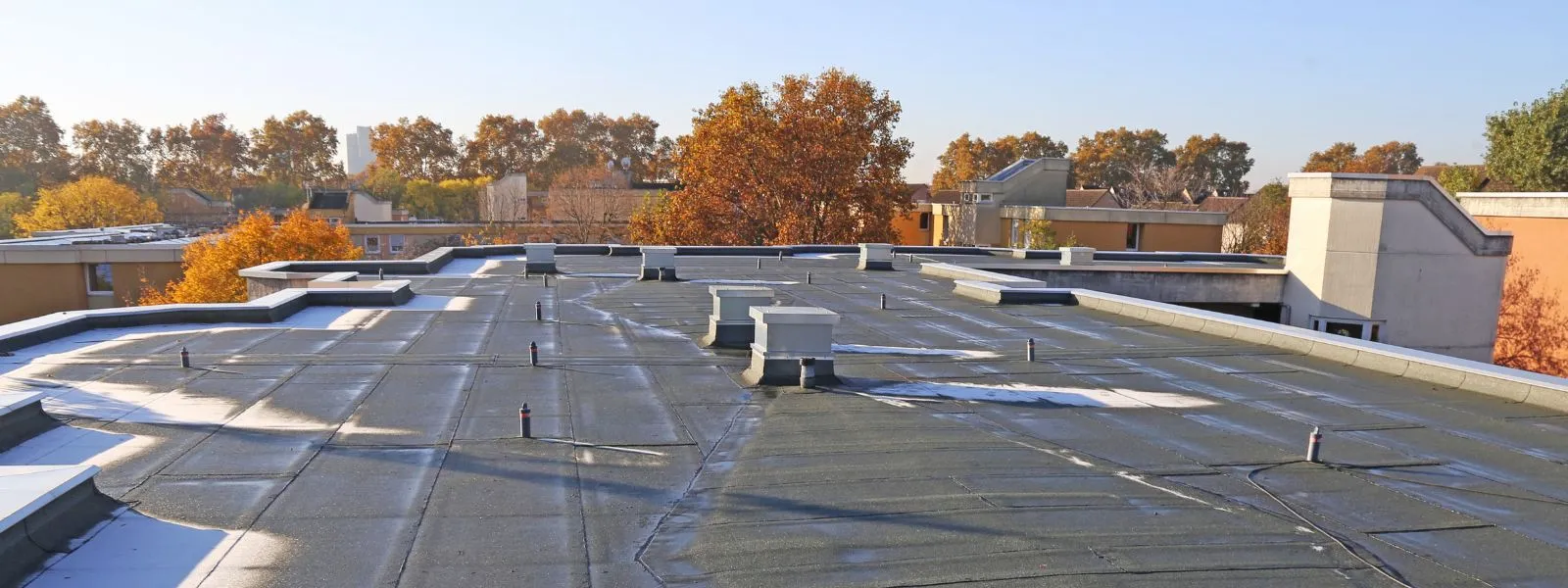
EPDM is a rubber-based membrane that arrives as a sheet or roll, sized so a small garage roof takes a single length. On a garage, the covering is stuck down to the deck with adhesive, trimmed at the edges and finished with preformed corners. With one sheet over the main area there are no lap joints across the middle of the roof, and that is where many other coverings begin to leak.
MyBuilder (updated 21/08/2026) gives EPDM at £70 to £100 per m² for a garage roof, a typical UK range that overlaps with felt. On lifespan, GreenSpec expects EPDM to serve for 20 to 30 years. Less gives 30 to 50 years, and CORC says EPDM can last 50 years or more. A safe summary is 20 to 30 years or more, remembering that every figure is a range and none is a promise.
The membrane is flexible, which helps on a garage where the roof moves a little with the seasons. It also copes with odd shapes and with upstands where the roof meets a wall.
What to check on an EPDM garage roof
The quality of an EPDM roof depends on the adhesive fixing and the detailing. The deck must be dry, clean and flat. The edge trims must be fixed properly, because the edges are where wind gets under a membrane. The seams around corners and penetrations should be factory-formed or properly sealed.
A common question is whether a rubber membrane is worth the cost on a small outbuilding. We will tell you at the survey whether the deck you have suits it.
GRP fibreglass
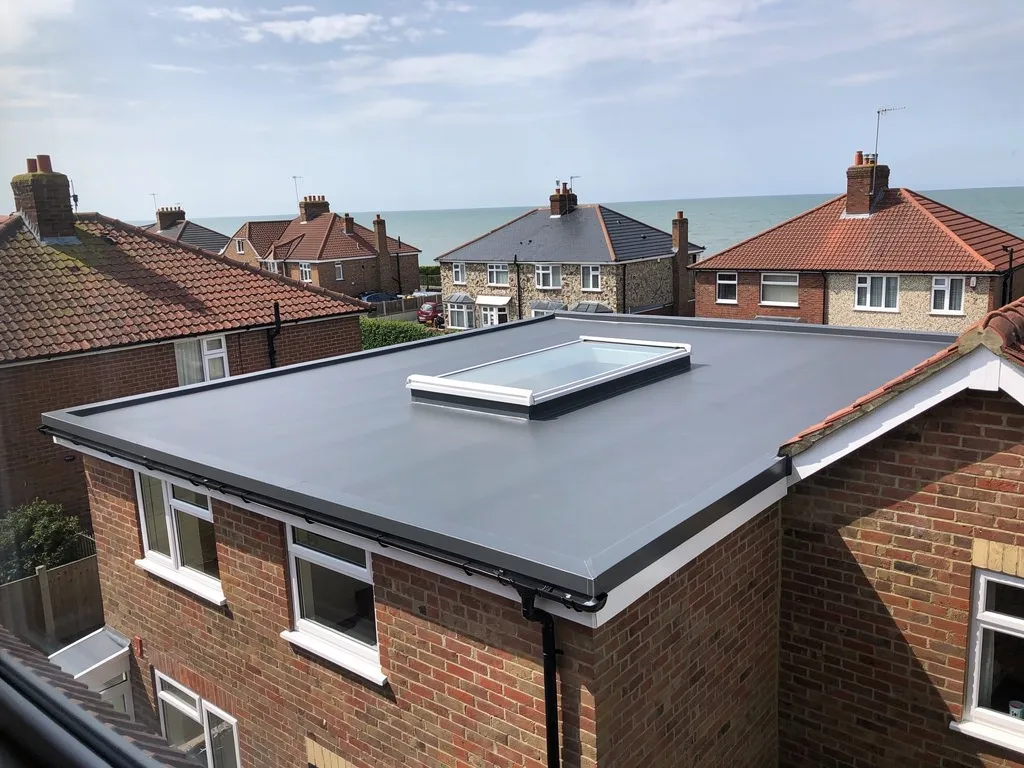
GRP stands for glass-reinforced plastic, which in roofing means a resin laid over glass-fibre matting that sets into a single hard skin. Unlike felt and EPDM, it is laid wet, in place, and keyed to a timber deck. The result has no laps or joins across the roof, and edge trims, a topcoat for colour and weather resistance, and a drip edge complete it.
MyBuilder (updated 21/08/2026) gives GRP at about £125 per m² for a garage, the highest of the three flat options in its guide. Less gives 25 to 40 years for lifespan, and CORC says GRP can last 25 years or more. The extra upfront cost buys a rigid surface with no joins that suits a roof which people sometimes walk on, and a shape with several awkward corners.
GRP needs a stable deck. Because the skin is rigid, movement in the boards underneath can crack it over time, so the deck is fixed securely and the boards are sound before the resin goes on. It also needs dry weather to cure properly, which affects when the work can be done on the Sussex coast, where a settled spell is not guaranteed.
Weighing GRP against the alternatives
The things in GRP's favour are the lack of joints and the long published life. The things against are the higher typical price and the need for dry conditions and a sound deck. On a garage with a simple shape and sound boards, felt or EPDM can do the job for less. On a garage with an awkward outline, or one that gets foot traffic, GRP is often worth the difference.
Whichever you choose, ask whether the quote covers the edge trims and the drip edge. Also ask how the covering will be dressed up the garage wall, because that junction is where many garage roofs let water in first.
Steel sheets and other pitched options
Pitched garages have a wider choice. Profiled steel sheets, usually with a coating, are light, quick to fit and common on outbuildings. Concrete tiles and slates suit a garage that matches a house with a tiled roof. Fibre-cement and other non-asbestos sheets are another replacement for old cement roofs.
The price and life of steel and other sheet coverings turn on the coating, the sheet maker and the shape of the job, so your written quote fixes the figure after the survey. How they behave is easier to describe. Steel sheeting is light, which helps where the old structure is slender, but it is noisy in rain unless it is insulated or lined, and condensation forms on the underside in a cold, unheated garage. Sheet makers publish a minimum pitch and fixing pattern, and both must be followed.
Tiles are heavier. Marley expects concrete tiles to last around 60 years without promising it, while MyBuilder puts replacement at 30 to 50 years, so 30 to 60 years is a fair summary. Natural slate has the longest published life of the pitched coverings, with MyBuilder and Checkatrade both describing a well-installed roof as lasting a century or more, though it needs a suitable pitch and a stronger frame.
Replacing asbestos cement sheets
When the old roof is corrugated asbestos cement, the new covering interacts with the removal. A lightweight sheet is often the natural replacement, but overlaying can sometimes avoid removal altogether, which our guide to overcladding asbestos sheets explains. Where sheets are cracked or broken up, the work moves into a different HSE category, which we explain at the survey.
Choosing for an exposed coastal garage
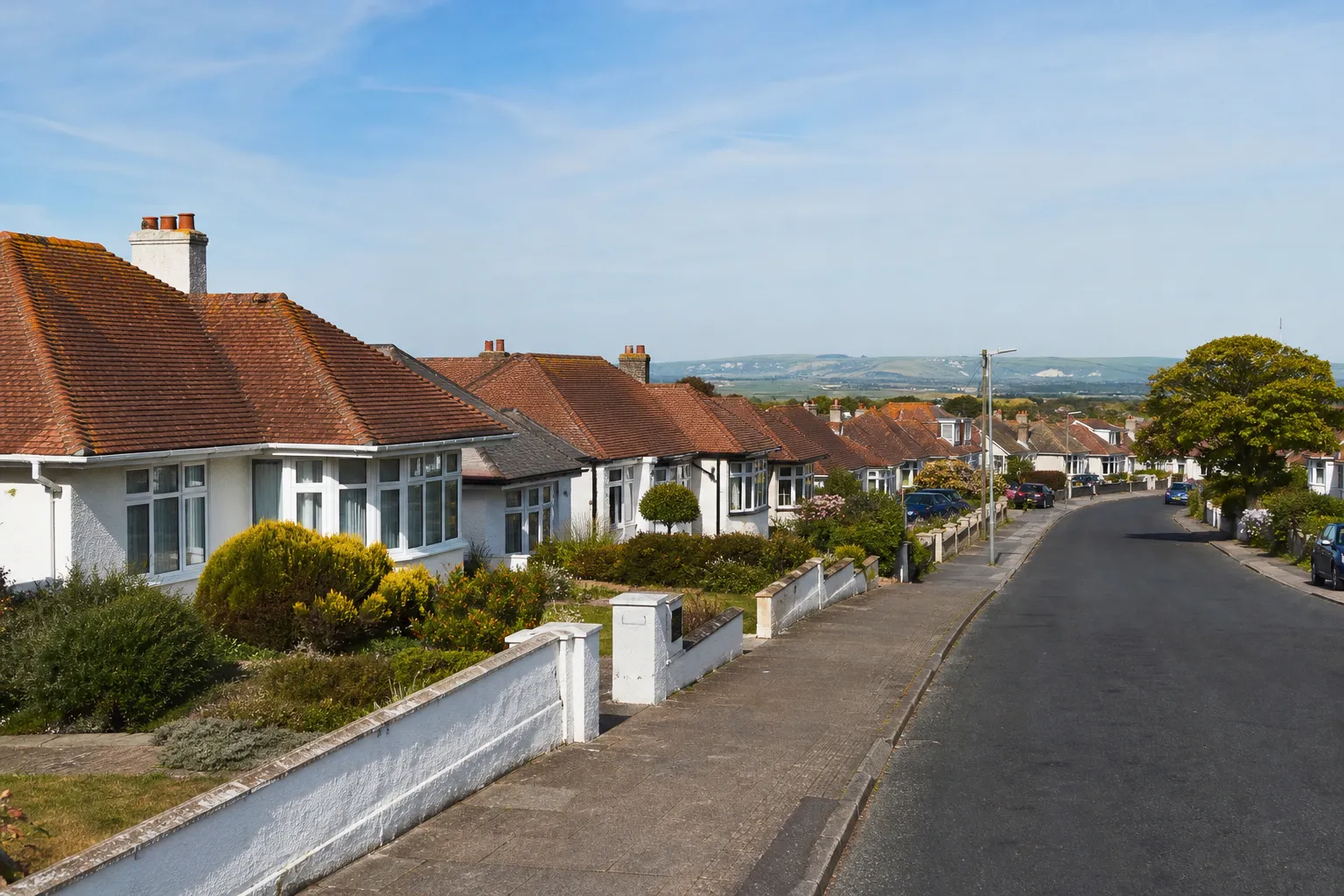
A garage near the Worthing seafront or on an open estate faces gales, driving rain and salt-laden air with little to break them. That does not rule out any of the four coverings, but it shifts the weight of the decision towards fixings, edges and detailing.
Wind works on a roof as suction as well as pressure. Marley says a roof pitched below 30 degrees can see severe suction over its windward slope. A lightweight roof on a garage is exactly the kind of roof that suction can lift at the edges. So the edge trims on a flat roof, and the verges, ridge and sheet fixings on a pitched one, are where we spend our attention.
Salt air is the other coastal factor, and it bears mostly on coatings, trims and fixings. The sheet or tile maker is the right source for what suits a seaside site, so we ask for its guidance on coastal use before the covering is chosen, and we follow it on the fixings.
| Covering | Typical UK price | Published life |
|---|---|---|
| Felt | About £75 per m² | 10 to 20 years (Less) |
| EPDM | £70 to £100 per m² | 20 to 30 years or more |
| GRP | About £125 per m² | 25 to 40 years (Less) |
Prices are MyBuilder (updated 21/08/2026), and lifespans are ranges from the guides, never promises. Send us photographs of the garage and its roof, and we will recommend the covering that fits, show you why with photographs, and send a quote written as one total. Our garage roof replacement page covers the wider job.