
Question answered
How long does a tiled roof last?
The short answer
A tiled roof typically lasts between 30 and 60 years, sometimes longer. MyBuilder puts concrete at 30 to 50 years and clay at 40 to 60, while Marley reports a Building Research Establishment finding of at least 60 years for clay tiles. These are typical ranges, not promises. Exposure, fixings, underlay and upkeep decide where a particular roof lands.
Published figures for tiles run from about 30 years to 60 and beyond, and the spread is wide for a reason. The tile is one component of the roof, and sea weather works on all of them.
Clay and concrete: the ranges people quote
No single number covers every tiled roof, because sources measure different things. MyBuilder says clay tiles usually need replacing after 40 to 60 years and concrete after 30 to 50. Marley, a tile maker, expects its concrete tiles to serve for around 60 years, and states that this is no warranty of how long a given roof will last.
Put those together and a fair reading for concrete is often 30 to 60 years, with clay matching it or going further. Natural slate sits higher still, and our pitched roofing hub shows how the coverings compare. The wide gaps come from site conditions. A sheltered roof with clear gutters and sound fixings will outlive the identical tile on an exposed ridge that nobody has looked at for twenty years, and nothing printed on a tile can tell you which of those two roofs you have. Only an inspection can, and a good one looks at the timbers and the fixings as well as the surface.
What the 60-year figure says, and where it stops
Marley's article, created on 28 September 2016, says the Building Research Establishment arrived at a minimum life expectancy of 60 years for clay roof tiles. That is a handy benchmark for a modern tile, well made and well fixed, in ordinary conditions. It describes the material. It does not describe your finished roof, and it is no commitment to the owner.
Nor does it stretch backwards. The Building Conservation Directory warns that the 60 years cannot be applied to old peg-tile roofs, since they are a different animal: hand-made tiles, older timbers, lime mortar and generations of patching. If your roof is old, use the benchmark as a starting point and let what the survey finds settle the question. Tiles that look weathered can be perfectly sound, and tiles that look tidy can be failing at the nail holes underneath.
A maker's warranty is a third thing. It sets out what the maker will cover, and that is a narrower promise than a lifespan.
The tile usually outlasts what holds it
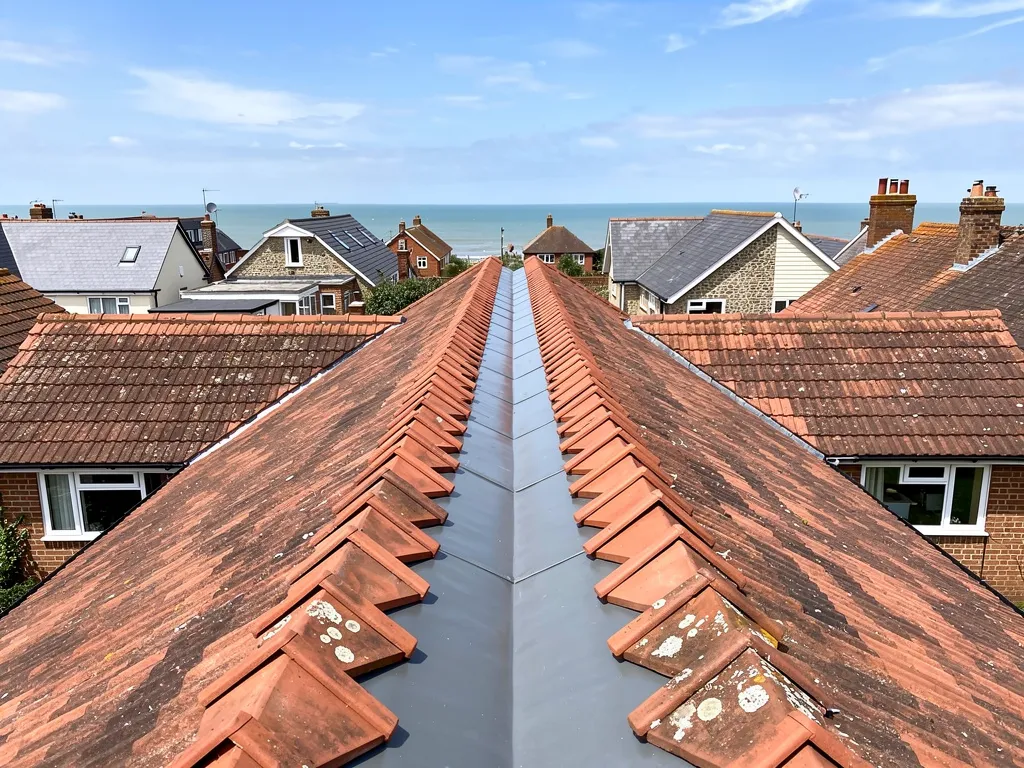
On plenty of roofs the tile is fine and the parts around it have given up. Underlay perishes, particularly at the eaves. Battens rot where water has found them. Old nails fatigue and let tiles creep, a pattern we explain in what causes slipped roof tiles. Ridge and hip tiles bedded on mortar alone loosen with time, and lead flashings split along their folds.
The standard has moved on here. Marley explains that since the 2014 revision of BS 5534 ridge and hip tiles have had mechanical fixings as well, with the mortar no longer trusted to do the whole job. Roofs finished before then often have mortar doing a job it was never good at. Putting that right is a repair, not a replacement, so a tired ridge does not by itself mean a new roof is due.
What shortens a roof's life near the sea
The tile is rarely the first casualty on the coast. Gales work on the fixings, and Marley points out that where the pitch is under 30 degrees, wind pulls hard on the windward side as suction. Across the years that rocks tiles on their nails. Driving rain tests each lap, lead joint and mortar bed, while salty air leaves deposits where rain cannot wash them, as under soffits and fascias, which is HomeBuilding's point about marine settings.
Moss and algae hold water on shaded slopes, and frost then bites on a wet porous tile. Clearing gutters and lifting moss by hand both help. MyBuilder notes that a pressure washer may damage delicate tiles, so think twice before accepting one as the cure for moss. A survey tells you which of these forces is at work on your roof, and which to leave alone.
Repair, patch or re-cover: reading the signs
A few cracked or slipped tiles make a repair job, and a single broken tile can be swapped, as replacing one cracked roof tile sets out. The signs of a roof nearing its end look different: tiles flaking in layers or crumbling at the edges, battens gone soft, daylight showing at the eaves, a ridge that keeps working loose and a slope that has started to dip.
When repairs arrive every winter, ask what the next few years of call-outs will add up to against a re-cover. A flat roof, for comparison, lasts 15 to 30 years according to MyBuilder, and pitched and flat roofs compared weighs one against the other. We photograph the trouble spots on your own roof and write the quote after the survey, so the evidence is yours to look at before you decide. Where a repair will buy plenty of years, that is the job we price, not a re-cover.
Tile life and warranties
Is a tile maker's warranty the same as the roof's lifespan?
No. A warranty covers what the maker will put right under set conditions, usually for a stated period. A roof's real life depends on fixings, underlay, battens, exposure and upkeep as well as the tile, so the two figures can sit far apart.
Do clay tiles last longer than concrete ones?
Published ranges suggest clay often goes further, with MyBuilder giving 40 to 60 years against 30 to 50 for concrete, though Marley expects concrete to reach around 60. Treat each figure as a guide. Condition, fixing and exposure count for more than the label.
Tell us about your roof
Describe what is happening and we will call you back to arrange a visit.
- Photographs of what we find
- A written quote with one total price
- Or call 01903 299063
10-year workmanship guarantee, in writing.