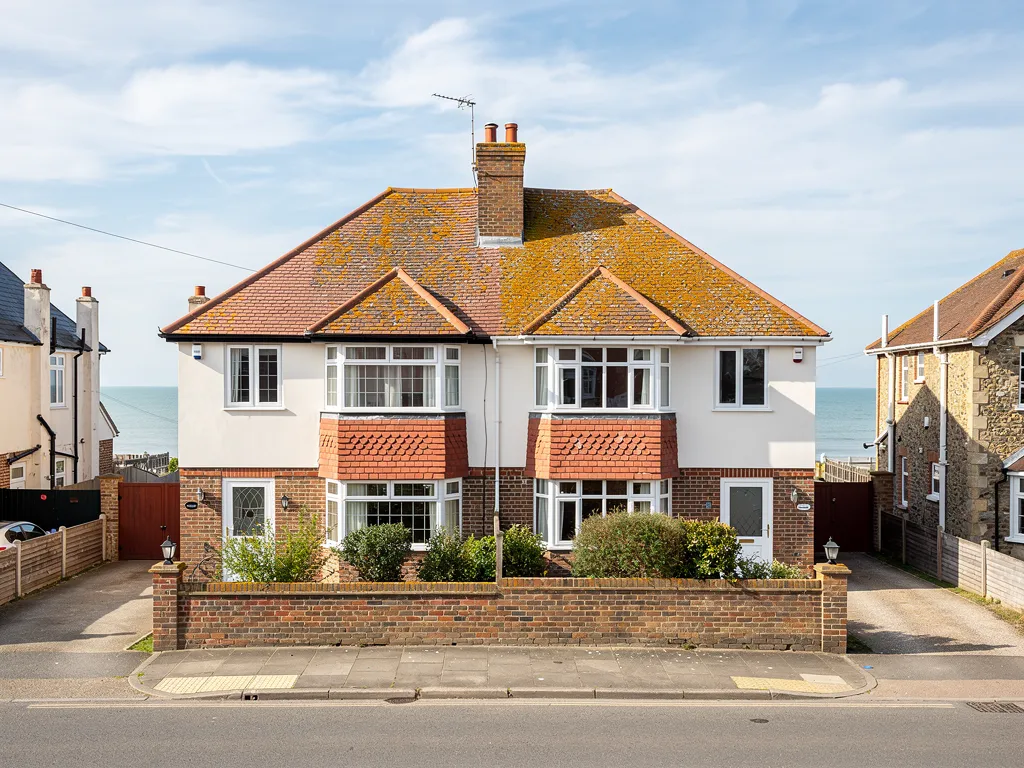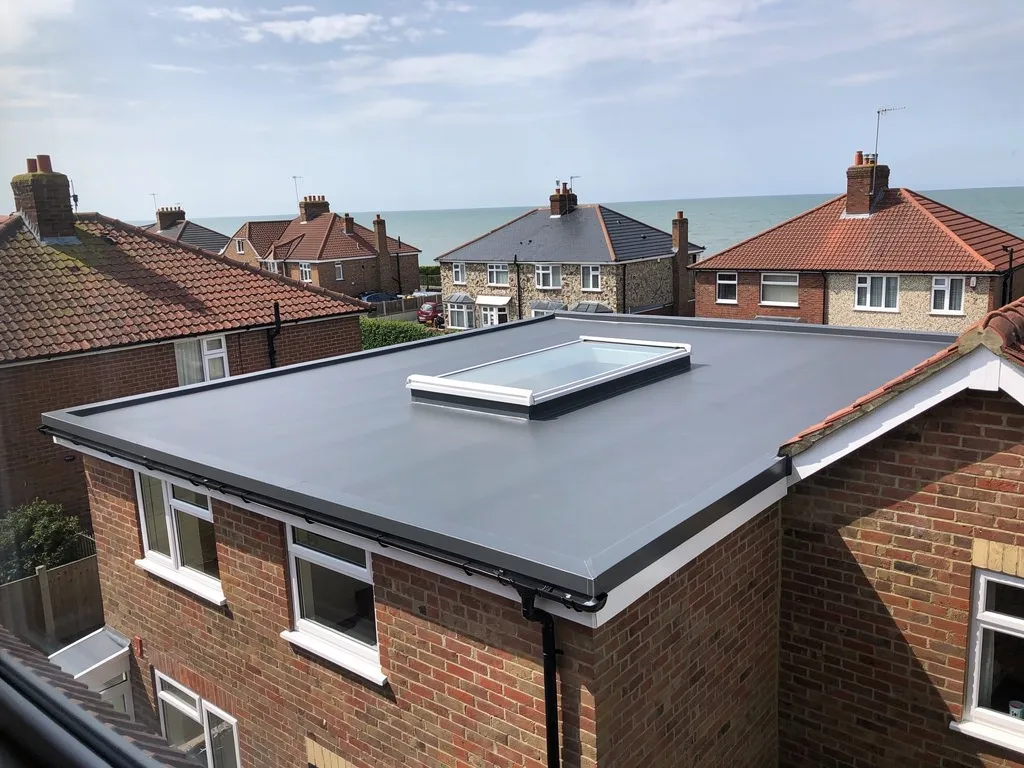
Roofs rarely fail on a calm day. They give way in the first proper gale of the autumn, when a tile that has been loose since spring finally lifts, or a gutter that has been silting up since the leaves came down overflows behind the fascia. On the Sussex coast the wind comes straight off the Channel, rain arrives sideways, and salt in the air does the covering and the metalwork no favours. A short check in October costs little beside a ceiling replaced in January.
This guide is a working list. It starts with what you can do safely from the pavement, the garden and the loft, then moves through the parts of a tiled roof that give trouble first: the tiles themselves, then the ridge with its hips, the valley channels, the flashings and the gutters. It ends with advice on storm damage and insurers, because that is the other thing worth settling before the weather arrives.
It is aimed at tiled roofs, clay or concrete. It does not try to settle whether a roof can be replaced in winter, which our roof replacement pages deal with. The point here is to avoid needing emergency work in the first place, and the wider range of pitched roofing services is there if the check turns something up.
The check you can make without a ladder
Stay off the roof itself. Tiles are slippery, a cracked one can break under a boot, and falls from roofs are the main reason this job is best left to people with proper access equipment. Nearly all of an autumn check can be done from the pavement, the garden and the loft hatch.
Choose a bright, dry day and walk right round the house with binoculars. Run your eye along each slope for tiles sitting out of line, for gaps where one has gone, and for tiles with a pale, broken edge. Look along the crest for tiles that have shifted, or for mortar that is crumbling or has dropped into the gutter. Check the chimney stack for leaning, cracked pointing or a loose pot.
Reading the debris
What lands on the ground is a clue. Chips of mortar, fragments of tile or clumps of moss in the gutter mean something is breaking up overhead. A stripe of moss growing down a slope can mark a valley that holds water. A dark stain below a brickwork joint can mean a flashing is letting go.
Inside, take a torch into the loft and look up at the underside of the roof. Daylight where there should be none, damp patches on the timber or insulation, and droplets on the underlay all deserve a note. Phone photographs make any later conversation with a roofer far easier.
If you see something you cannot explain, stop there. We would rather inspect it with proper access than have you guess from a stepladder.
Slipped and cracked tiles
A slipped tile is the commonest autumn finding. Each tile hangs from a batten, one of the timber laths across the rafters, by a lug on its back, and is held with nails or clips. When a nail corrodes, a clip fails or a batten softens, the tile loosens and creeps downhill. Once one has moved, its neighbours lose some protection, and in the next gale the gap widens.
The repair is simple if done early: lift the row above, set the tile back, fix it properly and find out what let it go. If the fault is a rotten batten or a row of tired nails, replacing a single tile will not hold, and we tell you that plainly. Our guide on slipped roof tiles shows how to tell the difference. A cracked tile is another matter. It may shed water for a while and then let go in a frost, so we replace it and do not smear it with sealant.
Clips and the wind
The modern answer to a restless tile is a mechanical fixing. Marley warns of strong suction on a windward slope below 30°, and Wienerberger expects every tile of the single-lap kind to have a mechanical fixing at the least, within a scheme drawn up for the particular site, its position and its exposure. Our guide to roof tile clips explains how clips are used and where.
A house close to Shoreham airport may need further advice from the tile maker, because Marley notes that aircraft can create wind loads on nearby roofs beyond what the standard calculation assumes. Whether your address is affected is something we check at the survey.
Clay peg tiles on older village houses follow different rules, and their repair is covered in clay peg-tile roofs.

Ridges, hips and verges before the gales
The ridge crowns the roof, the hips are the sloping edges running down from it at outward corners, and the verge is the sloping rim above a gable wall. These are the exposed edges, and the wind finds them first.
Plenty of older ridges rely on a mortar bed alone. Since the 2014 revision of BS 5534, ridge and hip tiles are not held by mortar alone; each one carries a mechanical fixing as well. The reason is that mortar's grip in tension cannot be trusted to resist suction over years of weathering. If your ridge is still bedded in mortar, and the mortar is cracked or falling out, it is a candidate for re-bedding with a mechanical fixing or for a dry ridge system, where the tiles are clipped to a batten and the joints are covered by a vented strip.
What to look for
A shifted ridge tile shows as a stepped line against the sky. Cracks along the mortar, or a pale seam where mortar has parted from the tile, mean water is entering at the joint. At the verge, check that the tiles are still anchored to the wall, since a lifted verge lets wind under a whole slope.
Putting this right is modest in cost beside the damage if it fails. MyBuilder (updated 21/08/2026) gives typical UK figures of £300 to £600 for fresh bedding or replacement ridge tiles, and £200 to £400 to repoint ridge or hip tiles. The length of ridge and the access shift the price; the survey comes first, then the written quote.
If you wonder how a ridge ties into the airflow of the loft, roof underlay and ventilation shows how a vented dry ridge works.
Valleys, flashings and the chimney
A valley forms where two slopes meet in a hollow rather than a crest. Both slopes drain into it, which makes it the busiest drainage line on the house. The lining is lead or a purpose-made trough. If leaves, moss or a dropped tile block it, water backs up under the tiles on either side. We clear valleys as routine, and look for splits or pinholes in the lining.
A flashing seals the junction between the tiles and a wall, chimney or dormer cheek, and is usually cut from sheet lead. Its upper edge sits in a mortar joint, and over the years the mortar loosens and the lead lifts. Leadworx says code 4 is now the usual choice for flashings and that code 3 is reserved for soakers, the small pieces folded under each row of tiles at an abutment. Lifted lead, gaps along the wall and bright, clean patches where the metal has moved are all things we check.
The chimney stack
A stack stands clear of the roof and meets the weather head on. The flaunching, the mortar cap that beds the pot and sheds water, often cracks, and the brickwork pointing weathers away. Both are small jobs now and wet-wall jobs later. MyBuilder gives a typical UK range of £500 to £2,000 for repointing a chimney, depending on the stack and the access.
Water from a flashing seldom shows where it enters. It runs along the underlay or a timber and appears somewhere else, which is why we trace first, and why a stain near a chimney is not always a chimney fault. The same junction detail matters on dormer cheeks, another place where lead earns its keep, covered in dormer roofs.

Gutters and downpipes
A tiled roof depends on its gutters to carry water away. Gutters clogged with leaves, silt and moss spill over at the back, behind the fascia board, and the water runs down inside the wall or soaks the eaves timber. The result can pass for a roof leak when the covering is perfectly sound.
Empty the gutters when the trees are bare, and again in spring. Watch the joints for drips in the rain, the brackets for sag and the outlets for blockage. Systems differ, but manufacturers want the run to tilt a little towards the outlet, somewhere around 1:600 to 1:350, and Brett Martin sets 900mm as the widest spacing between brackets. A gutter that holds a pool along its length has lost its slope.
Cost and when to replace
MyBuilder gives a typical UK range of £30 to £70 per metre for replacing guttering. If the plastic is brittle, cracked at the joints or out of alignment, replacement usually beats another round of patching. Fascias and soffits, the boards beneath the eaves, are checked at the same visit, because a rotten fascia cannot carry a gutter.
Older soffits deserve a caution. HSE guidance is to assume asbestos could be present in any property built or refurbished before the year 2000, and asbestos insulating board in soffits is mostly licensed work. A suspect board gets left alone until you have been advised.
Where an earlier gale has already taken tiles, our pitched roof cost guide helps you judge whether the job is a repair or something bigger.

Storm damage, insurers and what to do first
Even a well-prepared roof can lose a tile in a storm. Knowing in advance what to do helps, because the order of events matters when an insurer is involved.
When a storm claim is disputed, the Financial Ombudsman Service looks at three things: was there really a storm that day, does the damage fit one, and did the weather cause it or was it on the way regardless. Slow deterioration is a frequent policy exclusion. Which? adds that insurers lean on an industry definition of a storm, and that a roof left to decay, letting rain in, is the kind of case treated as wear and tear.
The sequence after damage
After a storm, phone your insurer promptly, then have a temporary emergency repair done to stop things getting worse, but only after that conversation. Take dated photographs of the damage, and of the roof beforehand if you have them. Keep any tiles or debris that came down. After that, call us. Making the roof safe comes ahead of any permanent repair.
The decision on a claim rests with the insurer, but survey photographs and a written quote are useful evidence for your own claim. If a claim is turned down and you disagree, the Financial Ombudsman Service is free to use once you hold the insurer's final response.
The best protection is the work you do in October. A dated record of a sound roof, with a note of the repairs you made, sets a baseline that is hard to argue with later.