
Question answered
What does a flat roof inspection look for?
The short answer
A flat roof inspection looks at the waterproof membrane and its seams, whether the surface drains or holds water, the outlets and gutters, the upstands and flashings at walls and edges, and the deck underneath. It also checks the ceiling below for stains. Each part can fail separately, so the aim is to find which one let the water in rather than treat the whole roof.
A flat roof hides its faults in plain sight. An inspection works through the membrane, the falls, the outlets, the edges and the deck, because water that lies on a roof will find the weakest of them.
The membrane and its joints
The membrane is the waterproof skin: felt, EPDM, GRP fibreglass or a similar layer. EPDM is a synthetic rubber sheet; GRP is a fibreglass mat set in resin. An inspector looks for splits, blisters, wrinkles, bare patches where chippings or a coating have worn off, and edges that have lifted.
Joints and seams come next, because they are where most membranes give up. A felt roof has laps, an EPDM roof has glued or taped seams, and a GRP roof has trims and edge details. Cracks in these show as hairlines, soft patches or places where the surface has pulled away.
Age matters. Published guides give typical lives: a flat roof generally lasts 15 to 30 years, according to MyBuilder (updated 21 August 2026); torch-on felt 10 to 20 years, EPDM 20 to 30 years or more and GRP 25 to 40 years, according to GreenSpec, Less and others. Those are typical UK ranges and depend on workmanship, exposure and upkeep, so a roof inside its range can still fail, and one beyond it can keep going.
Falls, ponding and drainage
A flat roof is not flat. It is built with a gentle slope, the fall, that sends water to an outlet or gutter. IKO, citing the 2018 edition of BS 6229 (since revised), gives a recommended minimum fall of 1:80, and advises designing for 1:40 to allow for tolerances and deflection.
Standing water is the sign that falls are not working. Puddles that remain a day or two after rain show a low spot, a deflected deck or a blocked outlet. Ponding adds weight, accelerates wear on the membrane and leaves silt and algae behind. Staining and a tide line on the surface mark where water has sat.
Outlets and gutters need attention. Leaves, moss and grit collect at the outlet, and a blocked one turns the roof into a shallow tray. The inspector clears or notes it, and looks at the downpipe, the gutter brackets and the joint between gutter and roof edge. Makers of gutter systems suggest roughly 1:600 to 1:350 towards the outlet, so a run of gutter that keeps standing water is out of true as well.
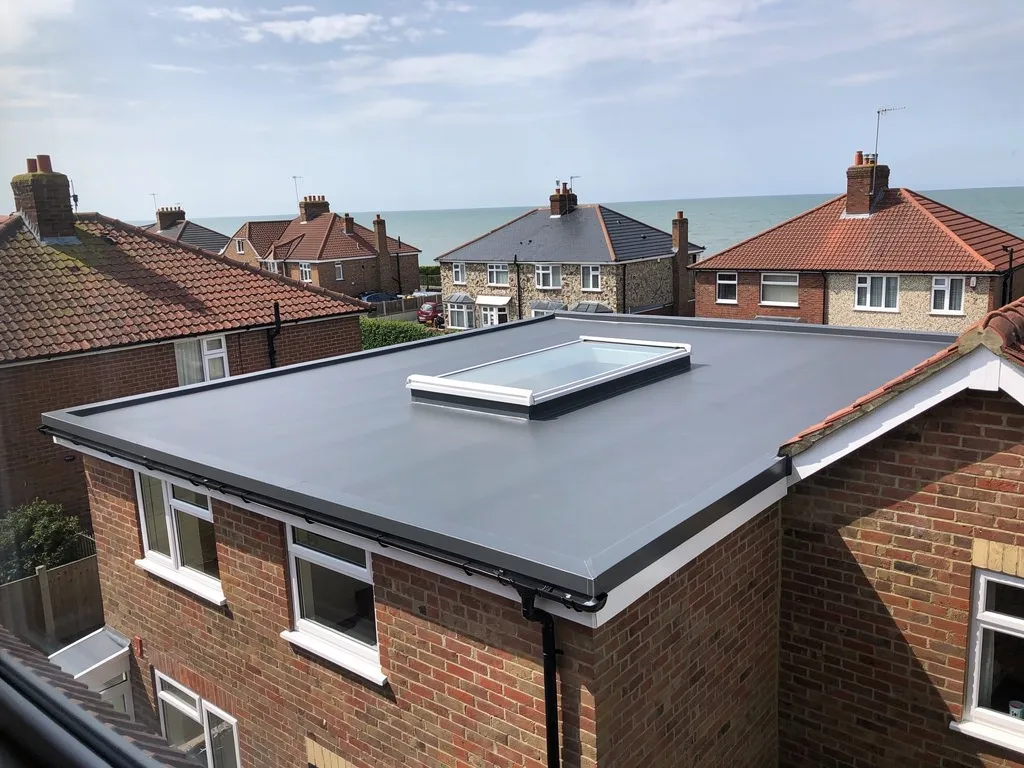
Upstands, flashings and edges
At a wall the membrane climbs the brickwork as an upstand, and a flashing, a cover strip of lead or similar, closes the join. This line is a frequent source of leaks, because brickwork moves, pointing weathers and sealant dries out. The inspector checks that the upstand is high enough and firmly fixed, that the flashing is let into a groove in the brickwork rather than lying loose against it, and that any sealant is sound rather than the only protection.
Edges matter as well. The drip edge or trim at the perimeter needs to lead water into the gutter and not behind the fascia. Roof lights, vents, pipes and rooftop plant each form their own upstand and each can leak at its collar.
On a coastal roof, wind lifts loose edge details, so the inspection includes how those are fixed. Our page on roof photographs explains the pictures worth asking for at these joints.
The deck, the insulation and what lies below
The deck is the structural layer, usually timber boards or sheets, that carries everything. Water that gets past the membrane soaks it, and rot is the cost of leaving it. An inspector presses the surface to feel for softness, looks for dips that suggest weakened boards and checks the ceiling underneath for stains, bubbling paint or a musty smell.
If the deck is damaged, a patch will not last. The question becomes whether the roof needs partial or full replacement. That decision has regulatory weight: Approved Document L (paragraph 11.2) names fresh waterproofing on a flat roof as one form of thermal element renovation, so insulation levels can come into the job. Worse, a deck that has sagged may call for a structural opinion, covered in when to use a structural engineer.
Where the roof is warm and the insulation is above the deck, moisture trapped in the layers can also show up as damp without any visible hole. That is why the loft or ceiling void is part of the inspection. See the loft inspection page for what is looked at from inside.
What comes out of it
A useful inspection ends with findings, not a sales pitch. You should hear which fault caused the leak, whether mending will last or the membrane is spent, and what each choice involves. Photographs of the membrane, the outlets and the upstands, taken on your roof, come with the written quote and its total price.
Typical UK cost guides give a sense of scale. MyBuilder puts a flat roof at roughly £45 to £100 per square metre, with felt, EPDM and GRP at different points in that spread; the price for your roof is fixed in the written quote that follows the survey, and what drives it is the size, the access and the build-up. Always check whether VAT and scaffolding are included.
Asbestos can turn up on older flat-roofed garages and outbuildings, and is covered in the asbestos survey page. Inspect after storms and at least once a year, because a small defect found early is far cheaper than a wet deck found late. The roof inspections and surveys overview shows how we run a visit.
Flat roofs: two more questions
Is ponding always a sign that the roof needs replacing?
No. A shallow puddle that dries within a day or two may only reflect a minor dip. Water that sits for days, or a puddle that is growing, points to a deck or fall problem. The inspection decides which, and whether a repair can cure it.
Can a flat roof be inspected from the ground?
Only partly. You can see staining on walls and gutters, but not the membrane, seams or deck. A flat roof is often reached by a ladder and sometimes by a drone or pole camera, so the inspector sees the surface and the junctions up close.
Tell us about your roof
Describe what is happening and we will call you back to arrange a visit.
- Photographs of what we find
- A written quote with one total price
- Or call 01903 299063
10-year workmanship guarantee, in writing.