
Question answered
Do you need an asbestos survey before roof work?
The short answer
Check for asbestos before roof work on any building built or refurbished before 2000, because the HSE tells owners to assume it is there. Cement roof sheeting, old soffits and boards, and some outbuilding roofs are the usual places. A survey or sample confirms what the material is, and the answer decides who may remove it and how the waste is handled.
If the building is older than the year 2000, the sensible assumption is that asbestos may be present until it has been checked. That matters most for cement sheeting, soffits and garage or outbuilding roofs.
Why the year 2000 matters
The HSE's advice on spotting asbestos is blunt: if the property dates from before 2000, whether built then or refurbished, assume some is in it. That is the starting point for any plan. The rule is cautious on purpose. Asbestos went into building products for decades, so a house of that age may have been altered, extended or patched with materials that contain it, and nobody now living may remember which.
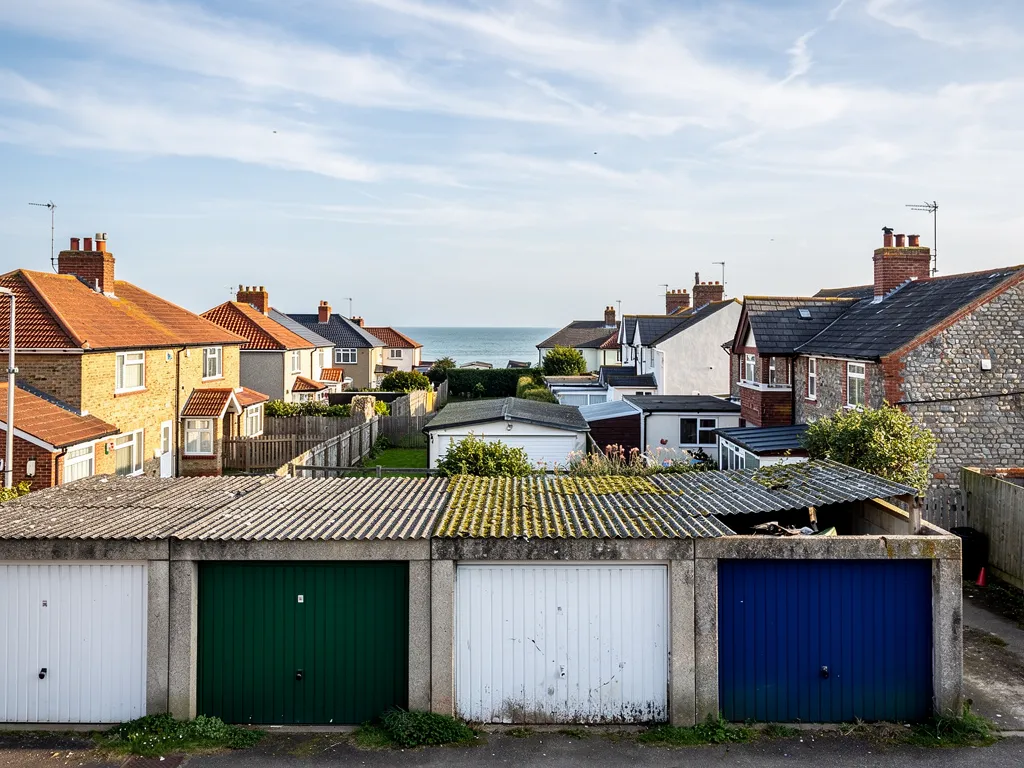
On a roof the relevant products fall into a few groups. Asbestos cement sheeting covers many garages, sheds, porches, lean-tos and farm or industrial buildings, and sometimes rainwater goods. Asbestos insulating board, AIB, was used for soffits, panels and linings. Some roofing felts and textured coatings can also contain it.
A modern covering over an older structure proves nothing. A new tile roof can sit above old soffits, and a recent extension can adjoin a 1960s garage. What decides whether to check is the age of the building behind the covering.
Cement sheets: careful work, and when it turns notifiable
Asbestos cement is the commonest roof material in this family, and the HSE draws a clear line. Taking off asbestos cement sheeting and gutters counts as non-licensed work, provided each piece is lifted with care and stays whole. Weathered cement in otherwise sound condition is included.
Once sheeting is substantially damaged or broken, as when a cement roof is dropped, the job becomes notifiable non-licensed work. The HSE must be told before it starts, with no minimum notice period, the workers need health checks at intervals of no more than three years, and their records are kept for 40 years.
The HSE also says cement roofs are always fragile, and that big pieces should be brought down carefully, never thrown or sent through a rubble chute. Its guidance asks whether new non-asbestos sheets can be laid over the old instead. For a garage that is a question worth putting to any roofer, since overlaying leaves the old sheets undisturbed.
Soffits and boards: where the rules tighten
Soffits, the boards under the roof overhang, are the part of a roofline most likely to hide AIB. Outside soffits feature on the HSE's list of places where asbestos turns up, and its guidance concedes that lookalike boards cannot easily be told from AIB by eye. Paint and thickness give no clue.
That matters because the HSE puts most AIB removal in a higher-risk category, reserved for specialist firms authorised by the HSE, a different league from careful removal of cement sheeting. A roofer who finds suspect boards while renewing fascias should stop and have them identified, not break them out.
The same caution applies to panels in old porch roofs and to linings under flat roofs. If you plan new soffits and fascias on a house of that age, raise it at the survey, so the material is identified before the job is priced and not once the scaffold is up. Our page on roof ventilation signs looks at the eaves from the airflow side, and soffits matter there too.
What a survey does, and what the eye cannot do
Naming the material is a laboratory matter. A roofer can note that a garage roof looks like asbestos cement, or that a soffit is of a kind that sometimes contains it. Only testing confirms. A competent person takes a sample, it is analysed, and the result tells you what you have.
Until then, treat the material as asbestos. Do not drill, scrub, pressure-wash, break or sweep it, and keep family and pets clear of damaged pieces. Never walk on a cement roof, because the sheets are fragile and one can give way under a person's weight.
A roofer's survey can record what is there, photograph it and recommend a next step, such as sampling or overlaying. If the building is let, or is a workplace or shared property, further duties fall on whoever manages it. Where bats may also use the roof space, see the bat survey guide, and for structural concerns, the structural engineer page. The roof inspections and surveys overview sets out how our own visits run.
Waste, consignment notes and who takes it away
Asbestos waste cannot go into an ordinary skip. The HSE's waste guidance calls for double wrapping, labelling, a skip that locks for cement sheet, and no mixing with other rubbish. Throwing sheeting over the side of a standard skip is not acceptable.
The paperwork matters as well. The household exemption from hazardous waste notes does not stretch to asbestos, so whoever takes it out of a home fills in the consignment note in the producer's role. Carrying construction waste puts a firm in the upper tier of waste carrier registration, and you can ask to see it.
Before you agree a price, ask who is removing the material, how it will be handled, its destination and whether the consignment paperwork will reach you. Check that the quote covers removal and disposal, along with VAT and scaffolding.
If a survey finds asbestos, the plan may be to leave it alone, overlay it, or remove it, depending on its condition, its position and what the roof work needs. A written quote with a single overall price can follow once the material is known. For help with the day itself, see the roof survey before solar page.
Asbestos and roofs: two more questions
Can I remove an asbestos cement garage roof myself?
The HSE treats careful removal of undamaged cement sheeting as non-licensed work, but it is hazardous, the sheets are fragile and the waste needs special handling. Ask a competent contractor, and ask whether overlaying the old sheets is possible instead.
Does a house built after 2000 need a check?
The HSE's assumption applies to buildings built or refurbished before 2000. A house built after that date is unlikely to need one, but an older extension, garage or outbuilding on the plot may. Check the age of each part, not only of the main house.
Tell us about your roof
Describe what is happening and we will call you back to arrange a visit.
- Photographs of what we find
- A written quote with one total price
- Or call 01903 299063
10-year workmanship guarantee, in writing.