
Question answered
Should you pay for a roof inspection?
The short answer
Pay for a roof inspection when you need a written report that can be relied on and handed to someone else: buying or selling, a lease or insurance question, a dispute, or a check before other work. For a simple leak or tired tiles, a roofer's survey with photographs and a written quote is usually enough.
Many roofers will look at a roof without charge, so paying for an inspection can seem odd. In certain situations a paid report is the better route, and it helps to know which situations those are.
When a paid inspection makes sense
The case for paying is independence and paperwork. A report you commission belongs to you. Anyone with an interest, from a lender to a neighbour in a shared building, can be shown it, and it fixes the roof's condition on a particular date. That dated record is often the most valuable thing about it, because disputes tend to turn on what the roof looked like before a storm or before work began.
That suits particular situations. You are buying and the homebuyer survey says only that the roof could not be fully seen. You are selling and want a clear picture before listing. A flat roof in a leasehold block is disputed between owners. You are planning solar panels or a loft conversion and want the covering and timbers checked first. Or a storm has done damage and you need evidence for a claim. In each case the person reading the report is someone other than you, and that is the test: if a third party must be convinced, an independent record carries weight that a sales quote does not.
It also makes sense when access is awkward. A steep slate roof, a tall chimney or a flat roof behind parapets may need a drone, a pole camera or someone with a roof ladder and the time to use them properly.
When a roofer's own survey is enough
If the aim is to get something repaired, a roofer has to look at the roof before pricing anyway. A good one photographs the problem, explains the cause and writes up a quote after the visit. That single call does both jobs, so paying a second person to say the same thing is often unnecessary.
The catch is whose interests are at stake. A roofer who earns from a replacement has a reason to find one. So what counts is how well the visitor explains what they found, whatever the visit is called. Ask to see pictures of your own roof, and ask what the smallest repair would be. A trustworthy answer includes the option of doing less, and a reason why the larger job is not needed.
It is worth remembering that a roofer's survey has a purpose beyond the quote: it should explain the fault clearly enough that you could take the findings to someone else and have them agree.
If you are unsure, you can do both: let a roofer survey for the repair, and commission an independent report if the job is large or the advice sits oddly with what you can see yourself.
What a paid report should contain
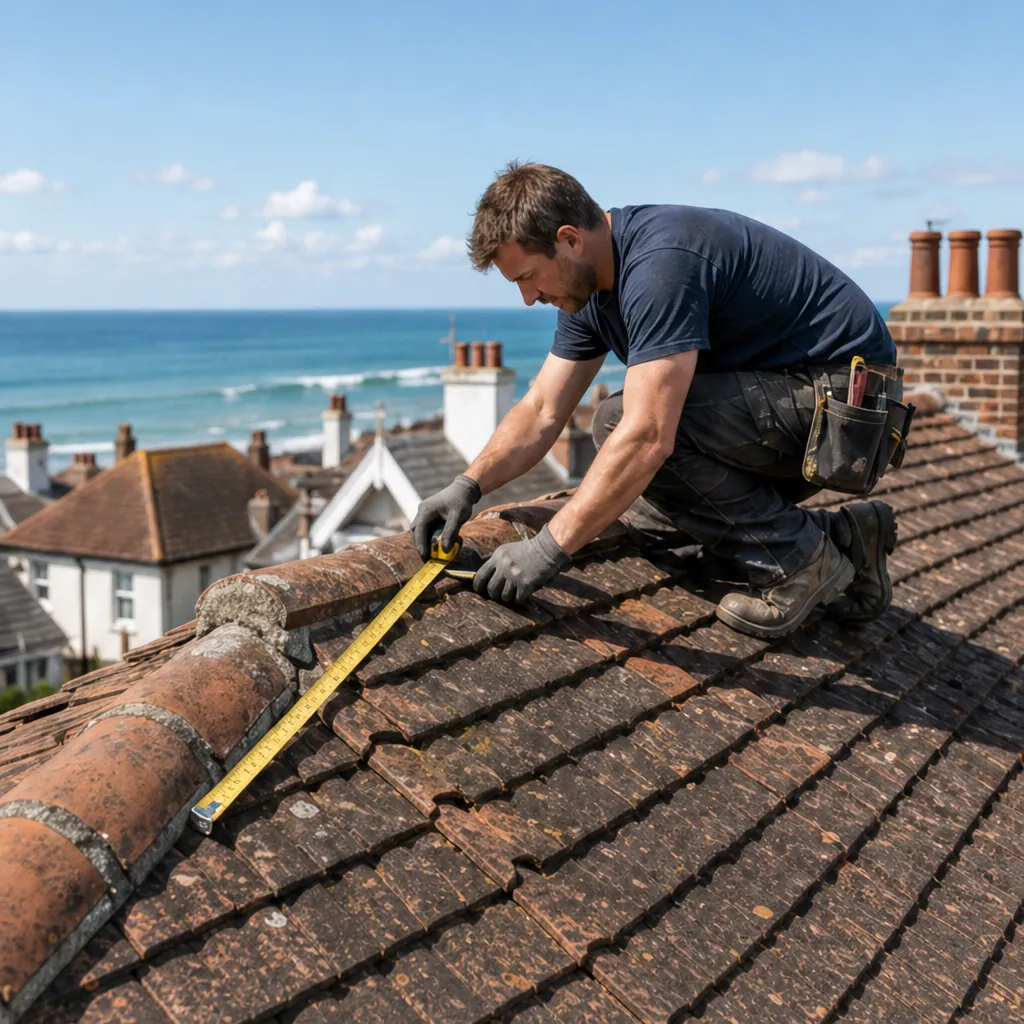
At minimum, expect dated photographs and a description of each part of the roof: covering, ridge, hips, verges, flashings, valleys, gutters and, where reachable, the loft. It should record the condition of each, and give a priority list of repairs. The better reports also say what could not be seen.
The method should be stated. A visual check from the ground, a ladder inspection, a drone flight, a pole camera and a thermal scan each show different things, which is why pole camera inspections are worth reading about if access is limited.
The report should not double as a sales document. If the author also sells roofing work, ask whether the findings are kept apart from any quote.
Finally, check what follows: whether there is a call to talk it through, whether you can put questions to the author, and whether the report is addressed to you by name. A report that cannot be explained afterwards is of little use to the person who has to act on it.
It also helps to know who will use it. If a lender, a managing agent or an insurer needs to read it, ask them first what form they expect, because some will accept only a particular kind of author.
What a paid inspection typically costs
MyBuilder's guide (updated 21/08/2026) gives a typical UK range of £150 to £500 for a roof inspection. Within that, it puts a standard inspection at £150 to £250, a drone survey at £200 to £400 and a thermal survey at £300 to £500.
The spread reflects the size and height of the property, the method, the distance travelled and the depth of the report. Our page on roof inspection costs goes further into this.
Before you pay, ask whether the fee comes off the price of any work you later award to the same firm, and check what it covers: photographs, a written report, a follow-up visit, any laboratory or specialist testing.
If a roofer offers to come and look at no charge, read our note on free roof inspections, and see how long a roof survey takes so you know what the day will involve. The wider picture is in roof inspections and surveys.
Paid inspections: two more questions
Is a drone survey better than a ladder inspection?
Not always. A drone gets a clear view of high or steep roofs without anyone climbing, but it cannot feel a loose tile or look into a valley from below. Many inspectors combine methods, choosing according to the roof in front of them, its height and what the owner needs to know.
Can an inspection report help with an insurance claim?
It can support one, because it records the condition and the likely cause. Insurers decide on the policy terms, and a report guarantees nothing about the outcome. The Financial Ombudsman Service and Which? both publish guidance on storm damage claims.
Tell us about your roof
Describe what is happening and we will call you back to arrange a visit.
- Photographs of what we find
- A written quote with one total price
- Or call 01903 299063
10-year workmanship guarantee, in writing.