
Question answered
Pole camera roof inspections
The short answer
A pole camera inspection uses a camera on an extendable pole to photograph the lower parts of a roof, the gutters and the eaves from the ground. It reaches only as far as the pole allows, so it suits single-storey and low roofs and gives a partial view of higher ones. It finds visible faults but cannot touch, lift or test anything.
A camera on a telescopic pole lets a surveyor look at a roof edge, gutter or low slope without a ladder. It is a quick, low-risk first look, with limits worth knowing before you rely on it.
What the camera is and how it is used
A pole camera is a camera head fixed to a telescopic pole, with a live image on a handset or phone. The operator stands on the ground, raises the pole alongside the wall and points the camera at the part of the roof to be checked. Photographs and short video clips are saved as the record.
It is best treated as a viewing tool, not a survey in itself. It extends the surveyor's eye to places that would otherwise need a ladder or scaffold, and it is useful where a ladder is hard to place, such as above a conservatory, a porch or a flat-roofed extension.
The camera also reaches over a gutter edge to show what is lying in it. Moss, leaf litter, a displaced tile that has dropped into the channel and a gutter that sags between brackets are all visible. For many homes that alone answers a first question: is anything obviously wrong?
What it can see well
It does well with large, visible faults on the near side of the roof. Slipped, cracked or missing tiles, a broken ridge tile, lifted edges, moss build-up, blocked gutters and open joints in guttering can all show up clearly on a good image. On a low roof it can show the lower courses and the area around a dormer or roof window.
Flat roofs at modest height are another good fit. The camera can look across a surface and show ponding, a split in the covering or a blocked outlet. More on what we check is under roof inspections and surveys.
The photographs are valuable in their own right. They are dated records that you can compare later, send to an insurer or show to a second roofer. A roof that has been photographed before and after a storm gives a much better account than one described from memory, and the images cost very little to take.
Where its reach and view run out
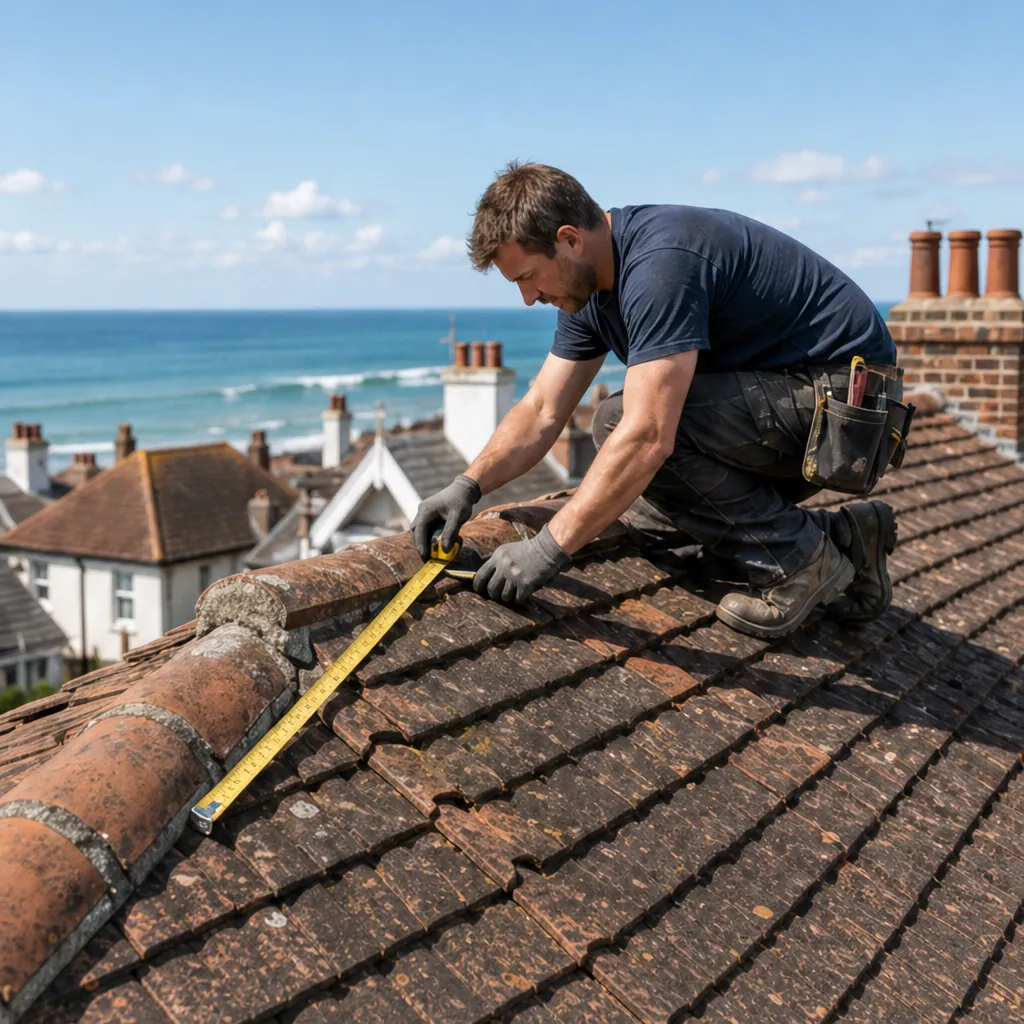
The first limit is height. A pole only extends so far, and the higher the roof, the less of the slope the camera can get above and look down. On a two-storey house the view may stop at the first few courses, and the ridge, the chimney and the far slope remain out of sight.
The second is angle. A camera looking up at a tiled slope from below sees the tile edges, not the surface behind them. Glare, shadow and weather can hide detail. The lead flashings that seal a chimney or wall are often tucked behind a stack or under a tile and will not be clear from the ground.
The third is touch. A camera cannot lift a tile, press a flashing, check that a fixing is present or look under the covering. It cannot see the loft side of the roof at all. Treat the pictures as evidence of what can be seen, and be wary of any report that says the roof is sound on the strength of a camera alone.
Choosing between a pole camera and other methods
The pole camera sits between a look from the pavement and a full survey. It is a fair first step for a low-risk question, such as checking the gutters after a storm, or finding out whether a leak might come from the lower slope. If it shows a fault, the next step is a closer look.
For higher or more complex roofs, a drone gives a wider view and a ladder or scaffold allows a hands-on check. Our guide to the question of paying for a roof inspection explains when each approach earns its cost, and the free roof inspections page explains what to ask of any visit that costs nothing.
MyBuilder's inspection guide gives typical UK ranges of £150 to £250 for a standard inspection and £200 to £400 for a drone survey, as updated on 21 August 2026. Which method suits your roof depends on its height, shape and access, and the written quote follows the survey.
Getting the best from the photographs
Ask what is being photographed and why. A good set covers each slope that can be reached, the ridge line where visible, the gutters along their length and the junctions with walls and chimneys. Ask for the images in full resolution with the date on each, and for notes saying where the camera was held.
Choose a dry day with even light. Low sun throws long shadows over tiles and hides detail, and wet surfaces glare. If the result is unclear, ask for another pass rather than accepting a guess. A repeat shot costs little compared with a missed fault.
If you are preparing to sell, the pictures are a practical record; see our page on the roof check before selling. And remember that a survey is cheaper when the roofer arrives with a clear question, so write down where you have seen stains or heard dripping before the visit.
Camera surveys: two more questions
Can a pole camera find the source of a leak?
Sometimes, when the cause is visible on the lower roof or in the gutter. Many leaks start at flashings, valleys or ridges out of the camera's reach, and the loft side is where the water trail shows, so a leak usually needs a closer inspection as well.
Is it safe for a pole near a house with overhead cables?
Take care. A long pole must be kept well clear of any overhead cable, and a surveyor should check the surroundings before raising it. If cables run near the house, say so when you book, and the operator can choose another method.
Tell us about your roof
Describe what is happening and we will call you back to arrange a visit.
- Photographs of what we find
- A written quote with one total price
- Or call 01903 299063
10-year workmanship guarantee, in writing.