
Question answered
Cracked mortar fillets: what they are and how they are fixed
The short answer
A mortar fillet is a sloping bead of cement sealing the joint between a roof and a wall, used instead of a lead flashing. Cement is rigid, so it cracks as the roof and wall move, and water gets in behind. A cracked fillet can be raked out and rebuilt, but lead flashing is the more durable answer, because the metal can flex with the joint.
A mortar fillet is the sloping bead of cement that some roofs use to seal the line against a wall or chimney. It looks solid, but it cracks, and when it does water slips in behind.
What a mortar fillet is
Where a pitched roof ends against a wall, the gap has to be sealed. The traditional way is a lead flashing. A cheaper and quicker method is a fillet: a triangle of cement mortar pressed into the angle between tile and brick, shaped to shed water away from the joint. You see them along the side of a chimney, beside a taller neighbouring wall, at the edge of an extension and around bay-window roofs.
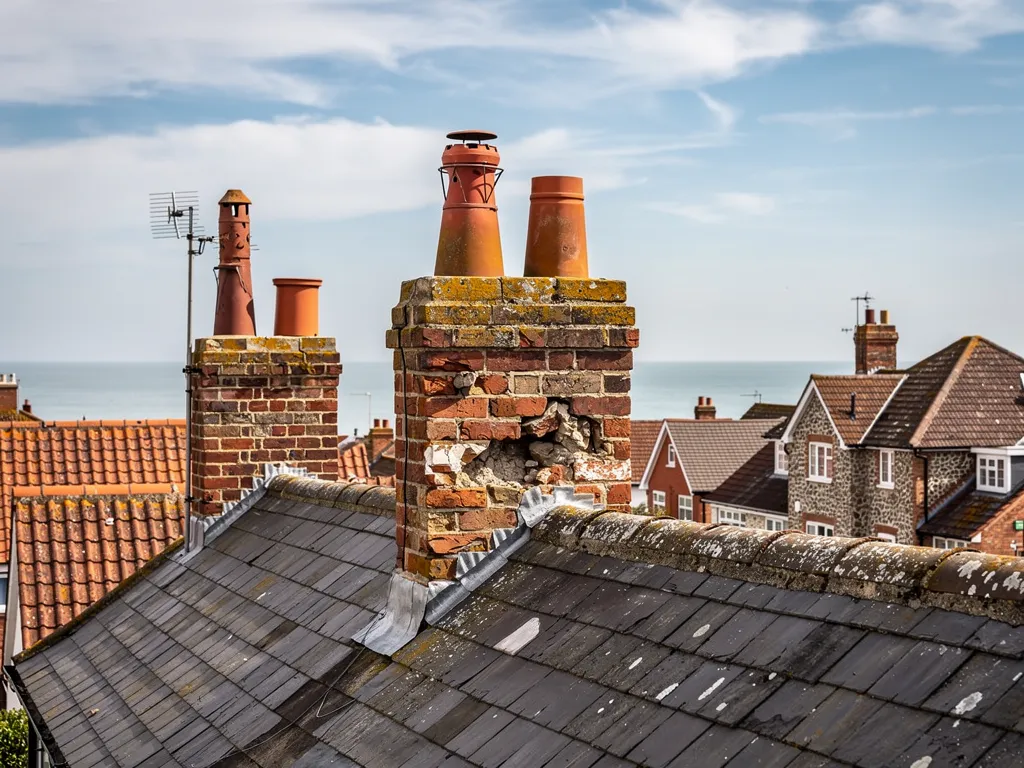
Fillets are common on houses built or repaired in the twentieth century, and they are easy to recognise: a grey, sometimes painted, band of cement running along the junction, often with a visible crack. They may have been put on when a lead flashing was stolen, failed or was thought too costly, and they hold up well for a number of years.
Their weakness is not the water on top but what is going on beneath. The roof expands, shrinks and settles. The mortar cannot.
Why they crack and how water gets in
Cement is strong but brittle. A roof covering and a brick wall warm and cool at different rates and move by small amounts through the year, and wind flexes the timbers. A fillet stuck fast to both surfaces has to take that movement in a rigid bead, so hairline cracks form along the joint. Often the fillet separates from the wall, or the tile edge, and leaves a thin slot.
Rain finds it quickly. Water enters the crack, soaks the mortar and runs behind it. In winter, frost expands the water in the gap and levers pieces off. Eventually lumps fall out, leaving the tile edge and the top of the wall exposed.
The leak that follows is often modest at first: a faint mark on the wall inside, damp at the corner of a ceiling, a stain after a gale. As the junction opens it gets worse. These marks line up with the problems described in can a small roof leak wait, which sets out the risks of leaving it.
Fillet or lead flashing?
Lead and mortar do the same job in different ways. A fillet is a rigid seal stuck to both surfaces. Lead is a flexible sheet tucked into the wall and laid over the tile edges, so it can move with them. That is the reason it is preferred at an abutment.
Leadworx recommends Code 4 as the everyday weight for flashing, and MyJobQuote reports lead flashing lasting beyond 80 years, longer with heavier codes. A fillet rarely approaches that, though it can be rebuilt several times.
In a few cases a fillet is the right call, for instance where a wall surface is rough or irregular, or on a historic building where the original detail was mortar. Some properties have limits on changes, so where the house is listed, ask the Adur & Worthing planning team before changing any detail. In most other cases, a cracked fillet is better replaced with lead than rebuilt in cement.
Every other job of this kind sits under roof repairs, alongside the wall-junction leaks page.
How a fillet is repaired
For minor cracks, the loose and hollow mortar is cut back, the joint is cleaned and brushed, and fresh mortar is pressed in and struck off. This works where the cracking is old, the wall is steady and the remaining fillet is sound, and the survey photographs show which case you have. A repair is also a fair choice on a gable that is hard to reach, and the survey tells you which route suits. If the old mortar sounds hollow when tapped, or lifts off in pieces, it needs complete removal.
Sealant and bitumen strip are the usual quick fixes, and they rarely last. They bridge the crack on the surface while water travels behind, and they cover the evidence a repairer needs. On exposed gables on this coast, wind-driven rain tests such patches in the first rough winter.
When replacing with lead, the fillet is raked off, a chase is cut in the mortar course of the wall, and new flashing is wedged in, worked over the tiles and pointed. Soakers may be needed beneath the tile edge. Where a pipe passes through the roof nearby, check that junction as well; soil pipe leaks are a separate fault that can look similar from inside.
Cost and how we find the real fault
MyJobQuote (22/09/26) gives a typical UK range of £150 to £250 for patching lead on a chimney stack, and £350 to £460 for full replacement without scaffold or £700 to £920 with it. Checkatrade (June 2026) lists stepped lead flashing at £80 to £120 per metre, excluding VAT. Length, height and access move the price.
A damp patch near a fillet is not always caused by the fillet. We trace the water from the inside, then check the stack, the flashing, the gutter and the tiles. If a nesting bird is using a gap in the junction, the work waits; birds nesting in the roof explains why. Tracing a leak back to a fillet that has failed is part of every survey.
You receive photographs of your own junction and a written quote after the survey. Ask any roofer to confirm what the price includes in VAT and scaffolding.
Mortar fillets: two more questions
Can I paint over a cracked fillet to seal it?
Paint or masonry sealer will not close a moving crack. It may hold for one season, then splits again, and it hides the damage from anyone inspecting. If the fillet is sound apart from hairlines, repointing is a better stopgap, and a hollow or lifting fillet should be replaced.
Does a crack in the fillet always mean a leak?
No. A hairline crack may let in only a little water, and a good roof drains it away. But cracks widen with frost and wind, so a fillet that is cracking is a fillet to watch. Check the loft below the junction after heavy rain for damp timber.
Tell us about your roof
Describe what is happening and we will call you back to arrange a visit.
- Photographs of what we find
- A written quote with one total price
- Or call 01903 299063
10-year workmanship guarantee, in writing.