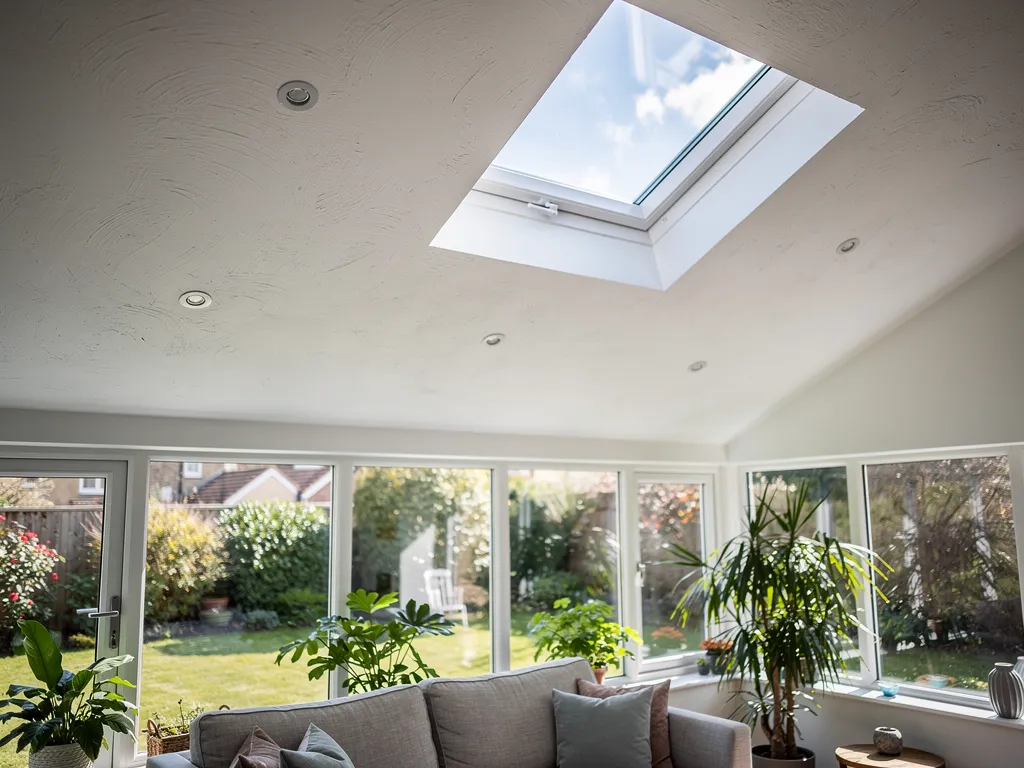
A roof lantern is a glazed unit that stands proud of a flat roof, with sloping glass sides and usually a ridge along the top. It is most often set into the roof of a kitchen or family extension, where a flat roof alone would leave the middle of a deep room dim. The glass lifts the ceiling, lets light fall from above and brings the sky into a room that otherwise borrows daylight from a single wall.
The glazing is the part people choose. The part that decides whether it stays dry is underneath it. A lantern sits on an upstand, a low boxed-in kerb rising off the deck, and the waterproof membrane has to climb that upstand and tuck beneath the lantern frame without a gap. When a lantern goes wrong, the fault is nearly always there, not in the glass.
This guide covers how the upstand is built, what Part L asks of the glazing and the kerb, why condensation and overheating happen, which consents to check, and what to settle before you order. It is written for owners of flat-roofed extensions in Worthing and along the coast, and for anyone weighing a lantern against a flat rooflight or a roof window.
What a lantern asks of the roof beneath it
A lantern is heavier and taller than a flat rooflight, and the roof under it has to be designed for that. The frame, usually aluminium, timber or a mix of the two, carries sloping panes up to a ridge. All of that weight lands on the upstand, and the upstand lands on the roof deck, so the joists around the opening must be strong enough to carry it. In a new extension the designer sets the opening and the lantern is chosen to suit. On an existing flat roof, the opening has to be cut and trimmed with new timbers, which is a structural alteration and one more reason to involve building control early.
Lantern, rooflight and roof window are different things
The words get mixed up, so it helps to fix them. Part L treats a rooflight as glazing that stands proud of the roof, carried on a kerb or upstand. A roof window lies flat within the pitch of the slope around it. A lantern is a rooflight of the large, multi-pane kind, and the rules handle it as one. The rest of the skylights and roof windows range is covered in its own section of this site.
The roof itself matters just as much as the glass. A lantern is a poor idea on a flat roof that is already near the end of its life, because the covering would have to be lifted around the upstand later, and every lifted edge is a new place for water to find. If the membrane is tired, renewing it at the same time as the lantern goes in is the sensible order of work, so the new upstand and the new covering are one continuous job.
The upstand: where lantern leaks begin
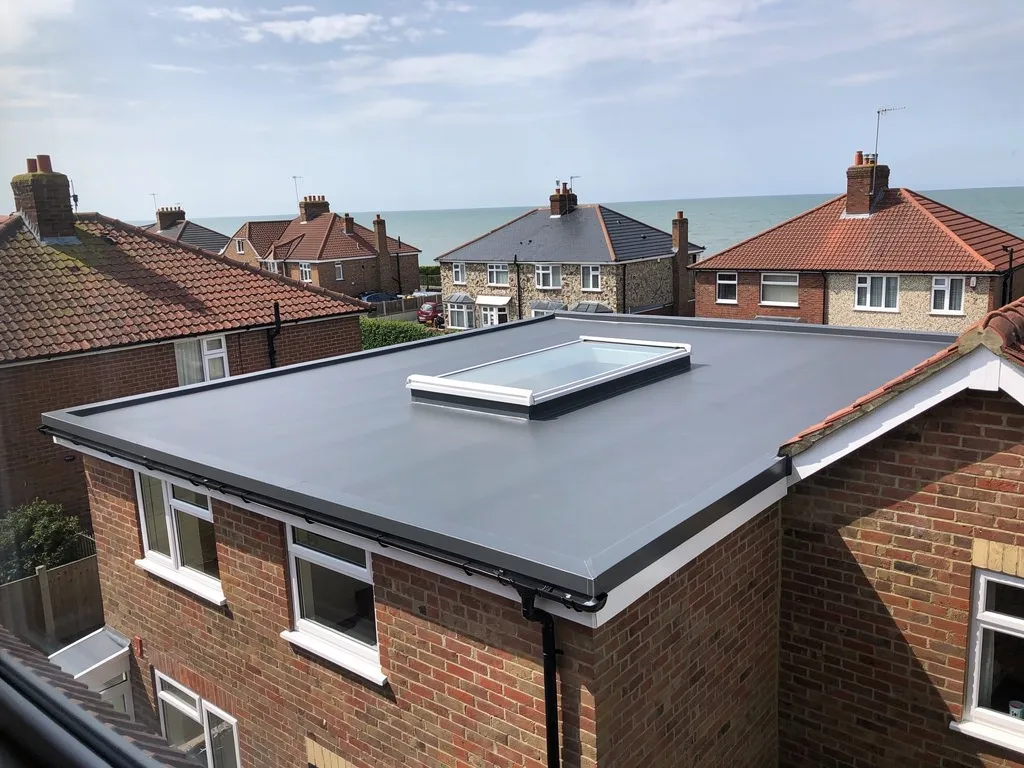
The upstand is a timber box, often formed from treated plywood or timber battens fixed around the opening, then insulated and wrapped in the roof membrane. It raises the lantern above the surface of the roof so that standing water never reaches the joint between roof and frame. The membrane is the waterproof skin that covers the roof, such as EPDM rubber sheet or GRP, which is glass-reinforced plastic laid as a resin coat. It runs up the outside face of the upstand and finishes under a capping or the lantern's own flashing.
Three details decide how well it lasts. The first is height: the upstand must stand clear of any pooling, which means the roof around it needs a proper fall. The recommended finished minimum for a flat roof is 1:80, and the roof should be designed for 1:40 to allow for tolerances and deflection. Water that sits against an upstand tests it far harder than water that drains past.
The second is the corners. A membrane has to turn the corners of the box without a fold that can crack or lift, so corner pieces are formed, glued down and then checked by eye before the lantern goes on. The third is the junction at the back. On the uphill side of a lantern, water runs towards the upstand and can bank up, so a small sloping saddle, often called a cricket, steers it round both sides.
If a lantern already drips at its base, our guide to a leaking roof window goes through how the cause is traced.
Part L, U-values and what the glazing must achieve
Heat loss through a roof or a pane of glass is expressed as a U-value, and a lower figure means the warmth stays in. Approved Document L Vol 1, in its 2021 edition incorporating 2023 amendments, sets the ceilings in Table 4.2 for elements that are new or replaced in an older home. For a new or replaced flat roof the limit is a U-value of 0.15 W/(m²·K). A rooflight, the category a lantern falls into, is limited to 2.2. A roof window is held to a tighter 1.4, or Window Energy Rating Band B at best, which is why you will see two different figures quoted for glass in a roof and should not mix them up.
The note to that table matters for lanterns in particular. For an upstand built on site the ceiling is 0.35, so the kerb beneath the glass must be insulated in its own right. A well-insulated roof with a poorly insulated kerb leaves a cold ring around the opening, and that ring is exactly where condensation collects.
Replacing an existing lantern
When a lantern is swapped for a new one, Part L expects the replacement to do no worse than what came out. In practice a new lantern is nearly always a clear improvement on one that is decades old, because modern units use sealed double glazing and frames with a thermal break, an insulating strip between the inner and outer metal.
Ask any supplier to quote the figure for the lantern as assembled, not for the centre of the glass alone. The frame and the edge spacer pull the overall figure up, and the whole-unit number is the one that has to meet the limit.
Condensation and overheating in a glazed roof
Glass in a roof meets two weather problems that a wall window rarely does: water vapour from the room condenses on cold surfaces, and the sun beats straight down through the panes. Both are manageable when they are planned for and tedious when they are not.
Why a lantern runs damp
Condensation forms when warm, moist air touches a surface colder than itself. The coldest parts of a lantern are the frame and the edge of the glass, so a faint film of moisture along the base of each pane on a cold morning is common and usually harmless. It becomes a problem when it runs constantly, drips onto the floor or leaves black mould on the timber lining. That points to one of three things: a frame with no thermal break, an upstand with too little insulation behind it, or a room that holds a lot of moisture with nowhere for it to go.
A kitchen produces steam all day, so an extractor fan that vents outside, plus a trickle vent or opening panel, does more for a lantern than any coating on the glass. Dry air at the room level means less moisture reaches the panes. The same causes are behind most damp patches round a roof window too.
Heat in summer
A south-facing lantern over a kitchen can make the room hot, because the glass faces the sun for most of the day. Solar control glass, an internal blind or an opening vent at the ridge all help. It is easier to specify these before the lantern is made than to retrofit them.
Planning, building control and protected buildings
A lantern is a larger alteration than a roof window, so the consents deserve a proper check before the order is placed.
On planning, Class C of the General Permitted Development Order is the catch-all for further changes to a house roof. Among its limits is a projection allowance of 0.15 metres, measured outward from the original roof surface, and another keeps the alteration from topping the ridge or highest point of the original roof. A lantern stands on an upstand and rises well beyond a few centimetres, so ask the Adur & Worthing planning team whether your design needs permission before you commit. Flats do not have these Part 1 rights at all. Do not assume that an answer given for a roof window carries over to a raised lantern.
In a conservation area or the South Downs National Park, planning rights can be narrower, and Article 4 directions in some local areas remove rights for roof alterations on elevations facing a street. A listed home needs listed building consent for any change that alters its special character. For a period property the better choice may be a slimmer rooflight, which our conservation rooflights guide describes.
Building Regulations
Cutting a new opening in a roof is a structural alteration, so building control is involved. A solid extension roof also brings insulation and ventilation requirements. Where the work is notifiable, we set out the steps and send the Building Regulations notification, whether it goes to a registered building control approver or to the council's own team.
Choosing and ordering a lantern: the questions to settle first
Most disappointments with lanterns come from decisions made in the wrong order. A short list of choices, made before the supplier's drawing is signed, avoids most of them.
Size, proportions and opening
Measure the finished upstand, not the hole in the old roof, because the lantern sits on the kerb and the kerb sets the size. Check the sightlines from inside the room, since a ridge that looks elegant on the drawing can sit awkwardly against a beam or a wall. Decide early whether you want a vent at the ridge or a roof-level opening panel, as the frame is built differently for each.
Frame, glass and finish
Aluminium frames suit a slim modern look and need little upkeep. Timber suits a period extension but needs sealing and repainting. Ask for the glass specification in writing: double glazing, whether it is toughened or laminated on the inside, and the whole-unit U-value. Think about cleaning too, because a pitched glass roof collects pollen, salt and bird droppings, and you will want to know how it is reached.
If a full lantern is more than the room needs, a smaller flat rooflight, a roof window or a sun tunnel may bring in enough daylight for less. And if a branded unit is above your budget, our guide to Velux alternatives covers other makers for the smaller glazing types.
A lantern job starts with a roof survey and photographs, then a written quote giving one overall figure. Cost turns on the lantern's size and specification, the state of the roof beneath, access and any structural work. The glazing maker's warranty paperwork should be passed to you at the end, and the waste leaves with us.