
Question answered
The duty to manage asbestos on a commercial roof
The short answer
Anyone responsible for an older commercial building should treat asbestos as present until it is ruled out. HSE's rule of thumb is to assume it where the building was built or refurbished before 2000. On a roof the usual suspects are cement sheets and old soffit boards. Sound material left undisturbed is one route, planned careful removal another, and breaking it up is the dangerous one.
HSE's starting advice for any commercial building from before 2000 is to assume asbestos is in it. On a roof, that shapes how sheeting, soffits and every job overhead are handled.
Why pre-2000 means assume, not guess
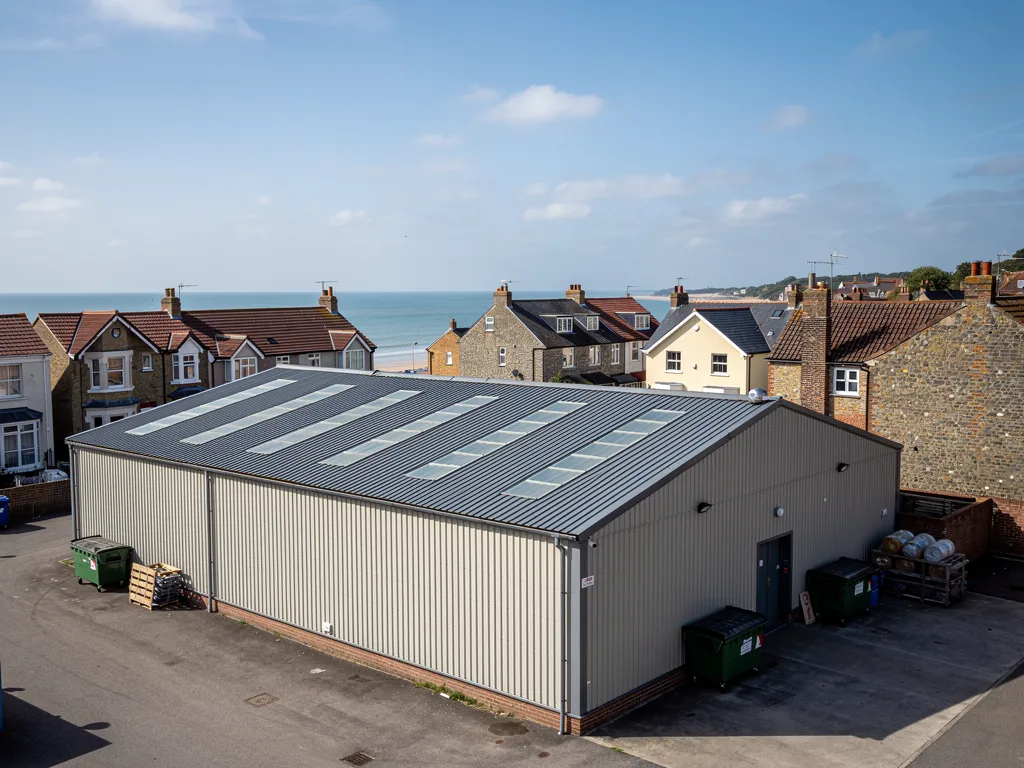
HSE's advice on whether asbestos is present is blunt: if a property dates from, or was last refurbished in, the years before 2000, assume some is there. That is a working assumption until proven otherwise, and it protects everyone who might otherwise drill, cut or kneel on a roof expecting something harmless. On commercial roofs the places to think about are cement sheeting, cement rainwater goods and soffits under the eaves.
Both words in that rule matter. A shed put up in the 1990s may have been extended or re-covered later, and each part carries its own date. An older block may also have lost its first sheeting years ago. The date of the roof you are under can differ from the date on the deeds.
The first job, therefore, is a records check before any trade goes up. Ask the landlord, managing agent or last surveyor what was recorded about materials. If the answer is nothing, identification comes before disturbance. Our rundown of the types of commercial roof helps you recognise what is overhead.
Cement sheeting is brittle, though its removal can be routine
Sheeting made of asbestos cement falls, on HSE's classification, among products whose removal can be done without a specialist regime, so long as they are lifted carefully and kept in one piece. Weathered sheets that are not badly damaged still qualify. A sound roof of this type is therefore not always a specialist job, but it remains a planned one with controls and trained people.
HSE is equally clear that these roofs are always fragile. A sheet that looks fine can give way under a footstep, which adds a fall to the fibre hazard. Crawling boards and edge protection are the minimum. Our guide to fragile roof safety explains how access is arranged.
One option HSE raises is worth asking about: could a sound roof be covered over with a different, non-asbestos sheet instead of being stripped? That leaves the material in place and avoids breaking it, though the new layer needs its own checks on fixings and weight. The survey is where that choice gets made.
Soffit boards that are not what they seem
Cement is not the only form. HSE lists external soffits among the locations where it has been found, and the board behind a soffit may be asbestos insulating board, shortened to AIB. By eye, AIB looks like ordinary modern board, and HSE says the two are hard to separate without testing. A guess is not good enough.
The legal weight shifts too. HSE places most AIB removal in its higher-risk category, handled by specialist contractors under a stricter regime than cement sheeting. A roofline replacement on an older commercial building can therefore change character as soon as the board is identified.
Plan with that in mind. If soffits must come off for new gutters, a netting scheme or a cladding repair, have the board identified first and leave the programme loose until the result arrives. Costs and timescales for controlled work are not those of an ordinary fascia swap, and discovering the difference mid-job from a scaffold platform helps nobody.
Where broken sheets turn into notifiable work
Damage is the dividing line. Once cement sheets have been badly damaged or smashed, say by dropping a whole roof down, HSE treats the work as notifiable non-licensed work. That means telling the enforcing authority before starting, with no minimum notice period, plus medical examinations for the workers at least every 3 years and health records held for 40 years.
The handling advice is concrete. Dust is the signal: once the cement starts breaking apart and a cloud forms, the job has crossed over. Heavy pieces are carried down to ground level. Nobody should toss them, and rubble chutes stay out of it.
For a client, the message is practical. A quick, rough method that cracks or drops sheets can convert a manageable task into a notifiable one, with extra duties attached. Ask how sheets will be lifted and lowered, who has been trained, and whether the work is notifiable. Vague answers mean the job is not ready to begin.
Skips, paperwork and the other trades on your roof
Waste follows its own rules. HSE's waste guidance calls for double wrapping and labelling, a lockable skip for cement sheet rather than sheeting tossed over an ordinary skip, and a ban on blending it into other waste to dilute it below 0.1 per cent. Sheets left unwrapped at the foot of a scaffold are a sign the job is not under control. GOV.UK adds that when a contractor takes asbestos out of a home, the contractor fills in the consignment note as the producer, and carrying construction waste puts a business in the upper tier of registration. Ask any firm for its waste route and paperwork.
Other trades matter just as much as roofers. New rooftop plant, bird netting or a warranty inspection puts people on the roof and fixings through the sheets, so raise the asbestos question with them first. See rooftop plant, bird proofing a commercial roof and manufacturer warranties, all part of our commercial roofing work.
Old sheeting on an older unit: two more questions
Will a roof survey on an older unit check for asbestos?
We look hard at the sheeting, soffits and rainwater goods and flag anything that could be asbestos, with photographs of your own roof. Proving what a material is takes sampling and laboratory analysis, and we advise that before anyone cuts, drills or strips. The written quote follows the survey.
Is it acceptable to leave an asbestos cement roof alone?
Often, yes, if the sheets are sound and undisturbed. HSE itself asks whether a roof could be covered with a non-asbestos sheet instead of removed. The fragility remains, so access needs control and anything that fixes through the sheets needs a plan first. Condition decides, and the survey records it.
Tell us about your roof
Describe what is happening and we will call you back to arrange a visit.
- Photographs of what we find
- A written quote with one total price
- Or call 01903 299063
10-year workmanship guarantee, in writing.